What Are Holograms Used For? 12 Real-World Uses of Hologram Technology
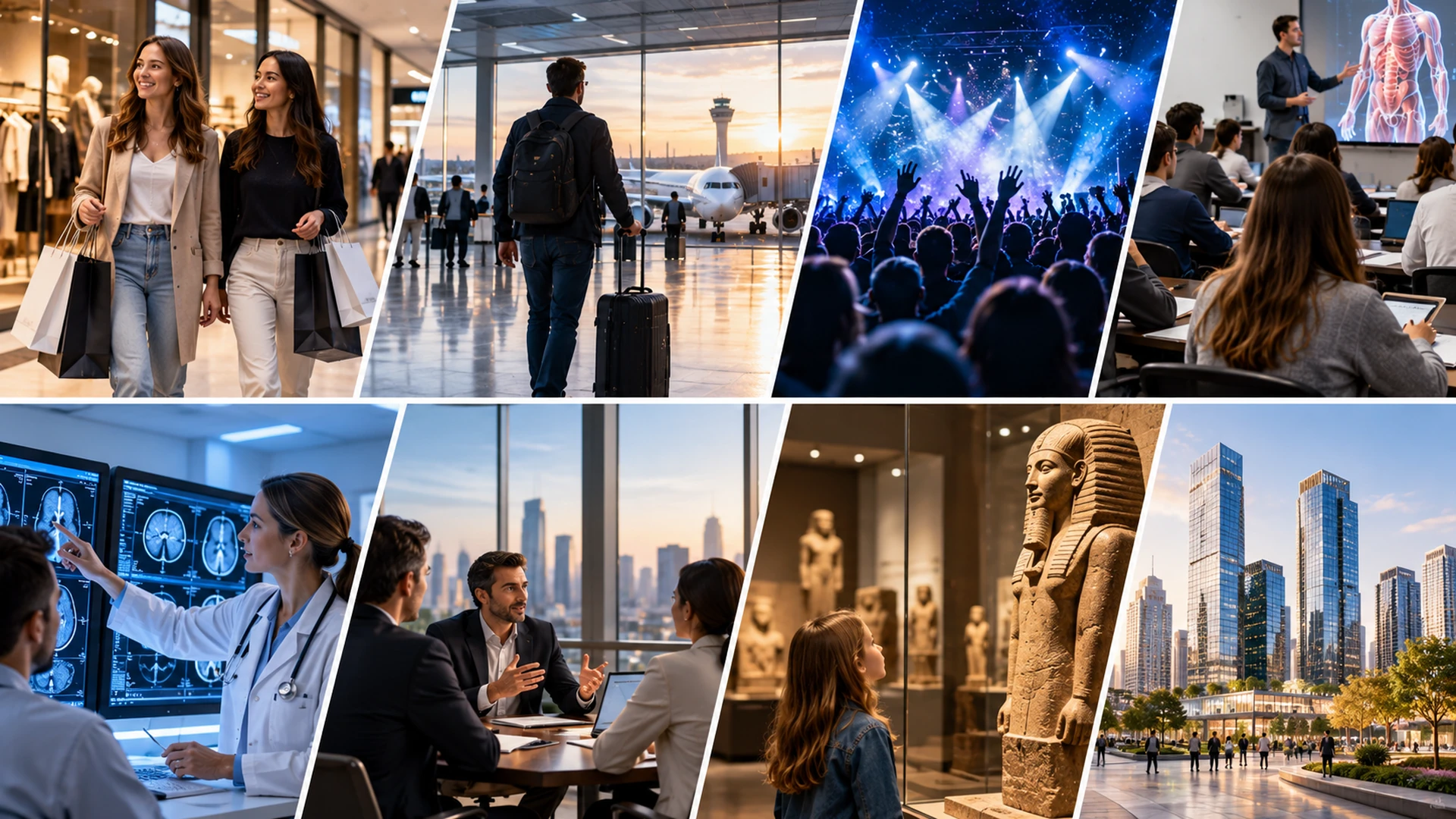
From AI assistants and advertising to healthcare, museums and telepresence, holographic technology is already being used across the real world
Holograms were once something most people associated with Star Wars, science fiction films and futuristic concerts. Today, holographic technology is being used in advertising, retail, artificial intelligence, entertainment, healthcare, education, museums, transport, telepresence and many other industries.
So what are holograms actually used for?
Holograms are used to make digital people, products and information appear three-dimensional and physically present in the real world. Modern holographic displays are increasingly used for advertising, AI assistants, customer service, entertainment, education, product visualisation, communication and wayfinding.
However, not every technology commonly called a hologram works in the same way. As we explain in What People Mean When They Say Hologram, the scientific definition is narrower than the way the word is commonly used in commercial displays and popular culture.
What Do We Mean by a Hologram?
Scientifically, holography involves recording and reconstructing information about the light waves coming from an object. Dennis Gabor's invention and development of holography eventually earned him the Nobel Prize in Physics in 1971.
Commercially, the word "hologram" has developed a much broader meaning. Today it can describe transparent holographic displays, Pepper's Ghost illusions, hologram fans, light-field displays, volumetric displays and other technologies that make digital content appear to occupy physical three-dimensional space.
If you want the technical differences between these systems, see our guide to how holograms work.
1. Holographic Advertising
Advertising is becoming one of the most important commercial applications for holographic displays.
Traditional digital advertising still largely exists on flat rectangular screens. Holographic advertising introduces apparent physical depth, making products, characters and people appear to exist within or in front of the display.
A trainer can rotate in three dimensions. A bottle can appear suspended in space. A fashion model can stand inside a shop window. A virtual brand ambassador can speak directly to customers.
For advertisers fighting for attention in environments already saturated with screens, that visual difference can be valuable. Holographic displays can be deployed in shopping centres, airports, retail stores, exhibition spaces, entertainment venues and other high-footfall locations.
Once those displays become interactive, advertising stops being something people simply watch. It becomes something they can engage with.
2. AI Avatar Assistants
One of the biggest changes in holographic technology is the integration of artificial intelligence.
Instead of showing a prerecorded person repeating the same message, a holographic digital human can listen to someone, interpret a question and respond in real time.
That creates a new category of physical AI assistant. A holographic AI avatar can act as a receptionist in an office, a concierge in a hotel, a sales assistant in a store, a museum guide, an airport assistant or a virtual representative for a brand.
The significance is not simply technological. Most generative AI currently lives behind text boxes, smartphone screens and voice interfaces. Giving AI a recognisable face and physical presence changes the way people can interact with it.
In simple terms, the hologram becomes the physical interface for the AI.
3. Retail and Shopping
Retailers can use holographic displays to bring products, people and digital content into physical stores without requiring the object or person to actually be there.
A fashion retailer could show a collection using life-size digital models. A car manufacturer could demonstrate different vehicle configurations. A cosmetics company could introduce shoppers to a virtual beauty adviser. A consumer electronics company could present a new device across multiple locations at the same time.
Holographic retail displays can also switch between advertising and interactive experiences, allowing the same physical installation to serve several purposes throughout the day.
As retail media continues to grow, the ability to combine attention, interaction and measurable engagement could become particularly important.
4. Airports, Railway Stations and Wayfinding
Large transport environments are difficult places to navigate. Airports and railway stations serve huge numbers of people speaking different languages, often under time pressure and looking for information quickly.
Holographic AI assistants can provide a more human alternative to conventional information screens. A passenger could ask where their gate is, where baggage reclaim is located, which terminal their airline uses or where to find the nearest restaurant.
The same avatar could communicate in multiple languages and provide directions, transport information and answers to frequently asked questions.
Instead of searching through layers of menus on a touchscreen, the passenger can simply ask a question.
5. Concerts and Live Entertainment
Some of the most famous examples of so-called holograms have appeared on stage.
The 2012 appearance of Tupac Shakur at Coachella became one of the defining moments in modern holographic entertainment. Since then, artists, performers and entertainment companies have continued experimenting with digital performers.
ABBA Voyage pushed the concept further by building an entire entertainment experience around highly realistic digital versions of the band.
Technically, many of these experiences are not true optical holograms. They use sophisticated projection, reflection, CGI and display technology. For the audience, however, the objective is similar: make someone who is not physically standing on the stage appear to be there.
6. Holographic Telepresence
Video conferencing made it normal to communicate with someone thousands of miles away. Holographic telepresence tries to reduce the feeling that a conventional screen is separating you.
Instead of appearing inside a small rectangle on a monitor, a person can be captured remotely and displayed at approximately human scale in another location.
This can be used for conferences, product launches, corporate meetings, university lectures, medical consultations and public appearances. Executives can address offices on another continent, speakers can appear at events without travelling and specialists can communicate remotely while maintaining a stronger feeling of physical presence.
Video calls connect places. Holographic telepresence tries to create presence between people.
7. Museums and Cultural Heritage
Museums are responsible for preserving the past while competing for the attention of audiences accustomed to increasingly interactive digital experiences.
Holographic displays can help bridge those worlds. Historical figures can tell their own stories. Lost objects can be digitally reconstructed. Fragile artefacts can be visualised without being physically handled. Characters from different periods can explain events from their own perspective.
Instead of simply reading a plaque describing history, visitors can encounter a life-size digital interpretation of it.
Artificial intelligence extends this further. A holographic historical character could answer different questions from every visitor rather than delivering one fixed presentation.
8. Education and Training
Three-dimensional visualisation can be particularly useful when a subject is difficult to understand on a flat screen.
Students can examine human anatomy, engineering components, planets, molecules or historical artefacts from different perspectives. A medical student could study a three-dimensional heart. An engineering student could examine the internal structure of a machine. A classroom could host a life-size digital speaker from another country.
AI can make those experiences interactive. Instead of simply watching educational content, students can ask a holographic teacher or subject expert questions and receive immediate responses.
9. Healthcare and Medical Visualisation
Holographic and spatial display technologies are also used and researched for medical visualisation.
Medical imaging already creates detailed three-dimensional information from CT, MRI and other scanning technologies. Displaying that information spatially can make complex anatomy easier to understand.
Doctors and medical students can examine structures from different angles and better understand relationships between organs, bones, blood vessels and other anatomy. Specialist holographic and light-field technologies are also being explored for surgical planning, training and medical education.
This is a very different application from an advertising hologram, but it demonstrates why the term "holographic technology" now covers a wide range of systems.
10. Product Visualisation and Design
Some products are difficult, expensive or impossible to transport. That makes them natural candidates for holographic visualisation.
Architecture firms can display buildings before they exist. Manufacturers can present machinery without transporting tonnes of equipment. Property developers can show future developments. Automotive companies can present vehicles, engines and components. Design teams can examine three-dimensional prototypes before manufacturing them.
Holographic, light-field and volumetric technologies allow physical objects and digital models to increasingly occupy the same visual environment.
11. Smart Cities and Public Information
As cities become more connected, the way information is presented in public spaces is also changing.
Holographic displays can provide public information, directions, transport updates, tourism information and emergency messaging while also functioning as advertising infrastructure.
An installation in a shopping district might promote brands during normal operation, provide tourists with directions when approached and switch to public information when required.
Adding AI makes the interface much more flexible. Instead of installing a separate kiosk for every function, one intelligent digital person could potentially perform many of them.
12. Security and Authentication
One of the oldest everyday uses of holography is also one of the least futuristic.
Security holograms appear on bank cards, identification documents, product packaging, certificates and other items where authentication matters.
These holograms are deliberately difficult to reproduce accurately and can contain visual effects that change depending on viewing angle or lighting.
This application uses holography very differently from modern digital holographic displays. It is also an important reminder that millions of people already interact with holographic technology every day, often without thinking about it.
Which Types of Hologram Are Used Today?
The word hologram now describes several different display technologies. Different technologies are better suited to different applications.
| Technology | Common Use |
|---|---|
| Traditional optical holography | Security, imaging and scientific applications |
| Transparent holographic displays | People, products, AI avatars, advertising and telepresence |
| Pepper's Ghost | Concerts, attractions and large-scale stage effects |
| Hologram fans | Advertising, logos and animated products |
| Light-field displays | Design, engineering and glasses-free 3D visualisation |
| Volumetric displays | Scientific, medical and 360-degree visualisation |
| Computer-generated holography | Research, spatial computing and advanced display systems |
Are Holograms Actually Used in Real Life?
Yes. Holographic and hologram-style technologies are already being used commercially around the world.
What does not yet exist as a mainstream commercial technology is the perfect science-fiction hologram: a bright, life-size, full-colour moving person floating completely unsupported in open air and visible naturally from every direction.
Research continues to improve holographic, light-field and volumetric displays. The practical challenge is not only creating convincing three-dimensional imagery, but making it bright, large, responsive, affordable and robust enough for widespread use.
AI Could Be the Most Important Hologram Application
For decades, the goal of holographic technology was primarily visual: make something digital look as though it is physically present.
Artificial intelligence changes that objective. The digital person inside a holographic display can now understand language, access information, translate between languages and generate responses in real time.
Suddenly the hologram is no longer simply something to look at. It can do something.
That combination could ultimately prove more important than perfecting the visual illusion itself. A slightly imperfect holographic person that can understand you, help you and respond naturally may be far more useful than a technically perfect hologram that can only play a prerecorded video.
What Will Holograms Be Used For in the Future?
The biggest opportunity may be where several of today's applications begin to merge.
- Advertising can become conversational.
- Wayfinding can become personal.
- Retail displays can become sales assistants.
- Museum exhibits can answer questions.
- Digital signage can become intelligent.
- Telepresence can combine with AI so that real and artificial people can occupy the same type of display.
For a broader look at where the technology may be heading, read our 10 Predictions for Holographic Technology in 2030.
Frequently Asked Questions
What are holograms mainly used for?
Holograms are used for advertising, entertainment, AI avatars, telepresence, education, healthcare, museums, product visualisation, security, retail and public information. Different holographic technologies are designed for different applications.
Do holograms exist today?
Yes. True optical holograms have existed for decades, while modern commercial systems use several additional technologies to create holographic or three-dimensional visual effects.
Are Star Wars holograms possible?
Not yet in the exact form shown in Star Wars. Creating a bright, full-colour, moving image floating freely in open air and naturally visible from every direction remains extremely challenging. However, holographic, light-field and volumetric technologies continue to move closer to science-fiction expectations.
Can a hologram talk to you?
Yes. Modern holographic displays can be combined with artificial intelligence, microphones, cameras and speakers to create AI avatars capable of holding real-time conversations.
Do you need glasses to see a hologram?
Most commercial holographic displays are designed to be viewed without glasses or headsets. This is one of the major differences between holographic displays and virtual reality.
What is the difference between a hologram and a holographic display?
A true hologram reconstructs a light wavefront using holographic principles. The term "holographic display" is used more broadly in the commercial market for technologies that create convincing three-dimensional or spatial imagery without requiring the viewer to wear a headset.
The Hologram Is Becoming an Interface
The story of holograms is no longer simply about creating impressive floating images.
Advertising, artificial intelligence, retail, transport, entertainment, education and communications are beginning to converge around the same idea: digital information does not always need to remain trapped inside conventional screens.
At Miirage, this is where holographic displays and AI increasingly meet. A display can attract attention like media, present a digital person at human scale and then allow that person to answer questions, explain products, guide visitors or deliver information in real time.
Holographic technology gives digital information presence. Artificial intelligence gives it intelligence.
Combine the two and the hologram stops being a special effect. It becomes an interface between the digital and physical world.