
2027 Industry Report
The Global Holobox &
Holographic Display Market
Market structure, technology, vendors, deployment economics, AI avatars and the 2027-2030 outlook.
Report scope
Life-size “holobox” cabinets, holographic and spatial display systems, rotor-LED displays, light-field displays, modular walls and related AI-avatar platforms used in retail, OOH, enterprise, hospitality, healthcare, education, events and entertainment.
This report focuses on the commercial systems and operating models that compete for real-world deployments, not on holography as a single laboratory-defined technology category.
Executive Summary
The holographic display sector enters 2027 at an inflection point. What began as an events-led novelty category is becoming a broader physical-interface market spanning digital signage, retail media, live telepresence, product visualisation and embodied AI. The strongest commercial momentum is no longer confined to spectacle. It is moving toward persistent deployments where the hardware is remotely managed, measurable, interactive and linked to business workflows.
Market sizing: Published estimates are highly definition-sensitive. Fortune Business Insights estimates a broad holographic-display market at USD 5.42 billion in 2026 and USD 33.36 billion by 2034, while The Business Research Company estimates USD 2.99 billion in 2026 and USD 5.74 billion by 2030. This report therefore treats top-down market values as directional and does not claim a clean holobox-only market size. [1][31]
Fragmented technology: The label “holographic display” covers several distinct architectures. For procurement, this report separates seven relevant types: transparent-display cabinets, proprietary enclosed cabinets, rotor-LED systems, light-field displays, thin spatial/HLD panels, Pepper’s Ghost projection systems and showcase reflectors.
Vendor reset: The competitive landscape changed materially before 2027. ARHT Media entered bankruptcy and ceased operations in October 2024. Holoconnects Netherlands B.V. was declared bankrupt in April 2026, while the Holoconnects brand and deployments continued under new ownership by Filigree Labs B.V. [18][19][20][33]
Embodied AI: AI avatars are shifting the value proposition from “content playback” to “physical interface.” Proto, Miirage, Holoconnects, HEREweHOLO and HYPERVSN all market AI-driven human or character experiences, with varying degrees of platform integration. [5][7][10][12][14]
Retail media tailwind: Retail media is forecast by WARC to reach USD 223.4 billion globally in 2027, equivalent to 15.2% of worldwide ad spend. That creates a large adjacent budget pool for measurable in-store and mall-based holographic inventory. [16]
Economics are deployment-driven: Hardware price alone does not determine ROI. The key variables are media sell-through, venue economics, content cost, remote management, measurement, service support, campaign frequency and whether the display can support multiple revenue-generating modes such as advertising, AI assistance and sponsored experiences.
2027 thesis: The winning systems are likely to be those that become easier to install, thinner, brighter, less reflective, simpler to network and more open to AI and media-platform integration. The category is moving from “hologram hardware” toward managed spatial-media infrastructure.
1. What Constitutes a Holobox?
Several vendors use Holobox or HoloBox in product naming. In this report, “holobox category” is used purely as analytical shorthand for self-contained, life-size holographic display cabinets that create the apparent presence of a person, product or character. This usage does not imply that any vendor product name or trademark has become generic.
1.1 Core characteristics of the holobox category
Freestanding or self-contained enclosure intended for public or enterprise spaces.
Portrait, often life-size presentation area, typically around 75-86 inches for full-body people.
Glasses-free viewing for groups rather than headset-based AR/VR.
Content optimised against black or transparent-looking backgrounds to create apparent depth.
Integrated playback and increasingly cloud-based content management.
Often includes touch, camera, microphone and speakers for interactivity or telepresence.
Increasing support for AI avatars, digital humans, product experts, reception and wayfinding.
Designed for temporary activations, rental or permanent network deployment.
1.2 What a holobox is not
A holobox is generally not a true hologram in the scientific sense of reconstructing an optical wavefront from interference data. Commercial systems usually rely on transparent displays, controlled illumination, reflection, layered imagery, lenticular/light-field optics or related display techniques. This distinction matters because technical performance, viewing angle, brightness and depth differ substantially between technologies. [8][11][21]
2. Market History: From Stage Illusion to Spatial Media
| Period | Industry development |
|---|---|
| 1862 | Pepper’s Ghost is publicly demonstrated at London’s Royal Polytechnic Institution, adapting Henry Dircks’ earlier concept into a practical stage illusion based on reflection through angled glass. [21][22] |
| 1947-1971 | Dennis Gabor conceives wavefront reconstruction in 1947; his foundational holography work follows in 1948. He receives the 1971 Nobel Prize in Physics for the invention and development of the holographic method. [23] |
| 2000s | Digital projection and high-brightness display systems revive Pepper’s Ghost-style installations for live events and branded experiences. |
| 2006 | Madonna and Gorillaz combine live performance with 3D animated virtual characters at the 2006 Grammy Awards, helping reintroduce “hologram performance” to mass audiences. [32] |
| 2012 | The Tupac performance at Coachella becomes a global proof point for digital resurrection and large-scale projected presence. The effect used a modern Pepper’s Ghost variant rather than true holography. [24][25] |
| 2014-2020 | Enterprise telepresence and display companies including ARHT Media, Proto/PORTL and Holoconnects productise life-size presence into transportable systems. |
| 2020-2024 | Cloud CMS, cheaper 4K panels, better cameras, remote monitoring and improved content workflows shift the category from event-only use toward permanent installations. |
| 2024-2026 | Generative AI and real-time digital humans become a major use case. ARHT exits; Holoconnects restructures; new display approaches from Looking Glass and other vendors reduce depth and weight. [18][19][15] |
| 2027 outlook | The category increasingly overlaps with retail media, digital signage, physical AI and agentic customer service rather than existing as a standalone “hologram” niche. |
3. Global Market Size and 2027 Outlook
Reliable market sizing is difficult because research firms define “holographic display” differently. Some include components, medical and industrial holography, automotive HUDs or projection technologies that do not compete directly with life-size holobox systems. Consequently, market values should be read as directional indicators of the broader display category, not as a clean estimate of annual holobox hardware revenue.
Published estimates illustrate the boundary problem. Fortune Business Insights reports USD 4.31 billion in 2025, USD 5.42 billion in 2026 and USD 33.36 billion by 2034, a 25.52% CAGR. The Business Research Company instead estimates USD 2.47 billion in 2025, USD 2.99 billion in 2026 and USD 5.74 billion by 2030, a 17.7% forecast CAGR. The figures are not like-for-like because the firms define and segment the market differently. Applying the Fortune Business Insights CAGR implies about USD 6.8 billion in 2027, but that is a mathematical scenario, not a standalone audited forecast or a holobox-only estimate. [1][31]
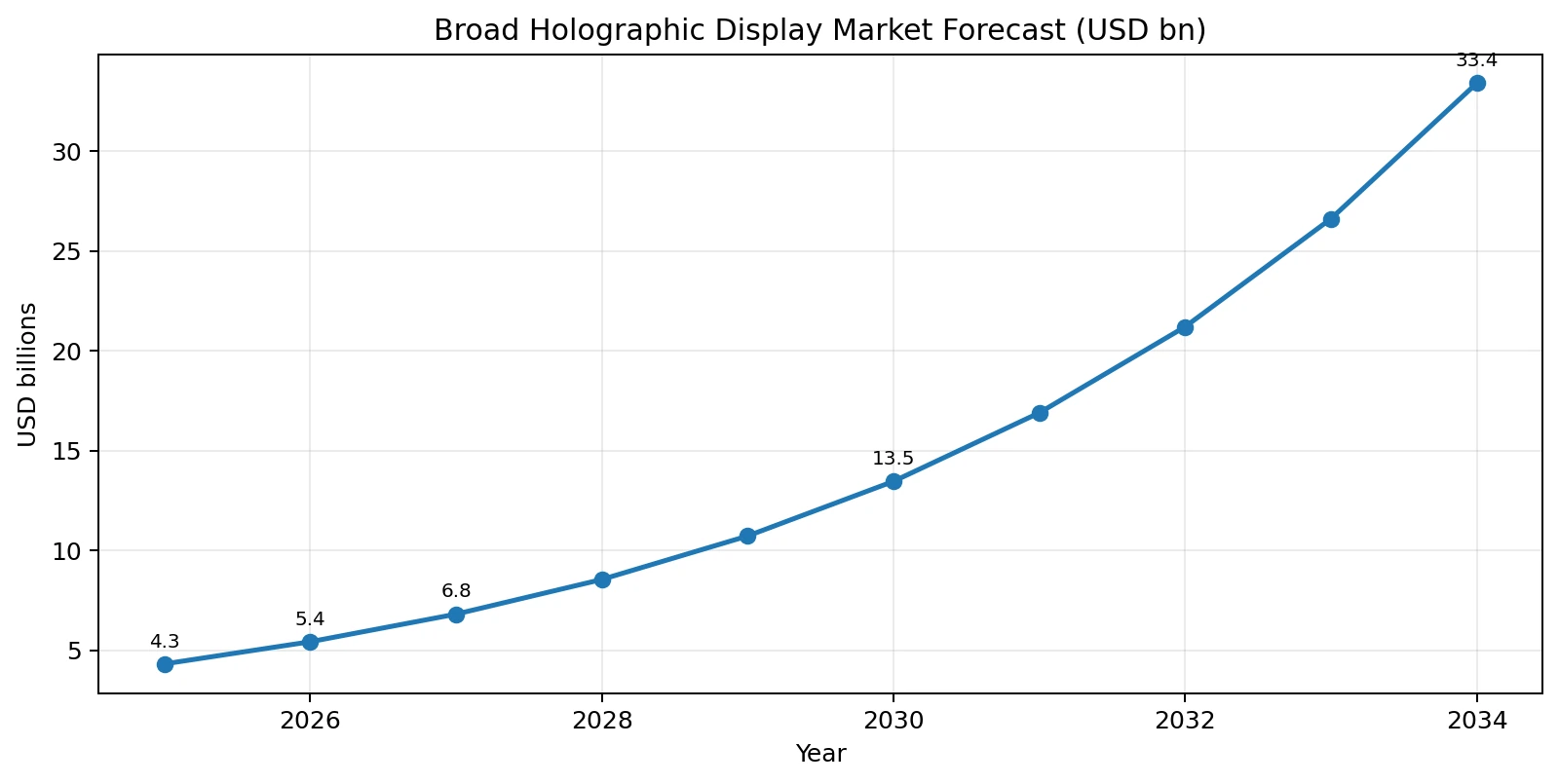
Figure 1. Fortune Business Insights-based broad-market scenario. 2027-2033 values are mathematical extrapolations using the source’s stated 25.52% CAGR and should not be interpreted as a separate third-party forecast or a holobox-only market estimate.
3.1 Demand drivers
Retail media expansion. WARC forecasts global retail media spend of USD 223.4 billion in 2027. [16]
DOOH digitisation. Global OOH spend reached USD 54.2 billion in 2025 and WOO forecast USD 56.4 billion for 2026, with DOOH the main growth engine. [17]
AI agents moving into physical environments through reception, product advice, customer support and guided selling.
Hybrid work and telepresence where life-size visual presence has higher perceived immediacy than standard video conferencing.
Experience-led retail and brand activation seeking formats with higher stopping power and social sharing potential.
Falling content-production costs from generative video, AI-assisted 3D, automated localisation and synthetic presenters.
Growing measurement standards for OOH and in-store retail media, making spatial formats easier to compare with other media inventory. [26][27]
4. Technology Types
| Technology | How it works | Best suited to | Strengths | Constraints | Examples |
|---|---|---|---|---|---|
| Transparent-display cabinet | Transparent LCD or related panel in a controlled enclosure with rear illumination and carefully prepared content. | Life-size people, product display, AI avatars, telepresence. | Strong human presence; touch/camera integration; networkable. | Cabinet depth/weight; reflections; sunlight; perceived depth depends on content and lighting. | Miirage Miracle; Holoconnects Holobox; HEREweHOLO Holobox |
| Enclosed proprietary optical cabinet | High-resolution display within an enclosed proprietary optical, illumination and software architecture. | Premium enterprise presence, events, live beaming, AI. | Integrated platform; strong audiovisual stack; enterprise software. | Cost; weight; vendor-specific optics and software; physical footprint. | Proto Luma / M2 |
| Rotor-LED persistence of vision | High-speed rotating LED blades create floating imagery against open space. | Retail spectacle, event signage, logos, products, large walls. | Very bright; scalable; visually striking from distance. | Moving parts; safety/enclosures; lower fidelity for realistic humans; camera flicker. | HYPERVSN SmartV Solo / Wall |
| Light-field display | Optical layer presents multiple views simultaneously, creating binocular/motion parallax. | Engineering, medical, product visualisation, interactive 3D. | Genuine multi-view spatial depth; no cabinet illusion required. | GPU/content pipeline; viewing cone; large formats historically costly. | Looking Glass Light Field |
| Hololuminescent / spatial panel | High-resolution 2D display combined with a fixed holographic volume embedded in the optical stack. | Digital signage, retail, life-size people and products. | Very thin; installs more like signage; standard video workflows. | Newer product class; real-world fleet maturity still developing. | Looking Glass HLD |
| Pepper’s Ghost / projection foil | Projected or displayed image reflected from angled glass/foil. | Stages, concerts, large events, museums. | Very large scale; proven dramatic effect. | Requires controlled geometry, rigging and lighting; not plug-and-play. | Musion-style systems / custom AV |
| Pyramid / showcase reflector | Small angled transparent surfaces reflect screen content into a display volume. | Jewellery, cosmetics, small products, museums. | Compact; can combine physical object and digital layer. | Limited scale and viewing geometry. | Realfiction Dreamoc |
5. Leading Vendors and Competitive Landscape
5.1 Miirage
Miirage is positioned around hologram advertising, retail media and AI-avatar assistants rather than only one-off event hire. Its current public product architecture includes the Miirage Miracle portrait display and modular displays, with cloud control, 4K presentation, touch interaction and AI-ready functionality. Miirage also markets a no-CapEx venue model for high-footfall locations, with displays deployed to create advertising inventory for landlords and OOH partners. [2][3]
Strategic emphasis: scalable advertising networks, retail media, AI assistants and live holographic communication.
Publicly stated Miracle footprint: approximately 1,150 mm wide x 700 mm deep x 2,170 mm high. [2]
AI positioning: branded, multilingual digital humans for product guidance, wayfinding and customer service. [3]
Differentiator: combining display deployment with a media-network commercial model, rather than treating hardware sales as the only revenue source.
5.2 Proto
Proto is a US-based enterprise vendor that has evolved from premium holographic presence hardware toward a full-stack spatial-computing platform. The Proto Luma is an 86-inch, seven-foot life-size system with multi-touch, an AI-enhanced 4K camera, microphone array and ProtoOS. Proto Cloud supports AI avatars/personas and allows organisations to select an LLM or connect a custom LLM API endpoint. [4][5][6]
Proto Luma dimensions: 223 cm x 127 cm x 60 cm; weight about 186 kg without transport case. [4]
Strong vertical coverage: enterprise, retail, live events, healthcare and education. [4]
Platform advantage: integrated OS, cloud, conversational AI, avatar/persona tools and live beaming. [5][6]
Commercial positioning: premium enterprise system with pricing generally on request.
5.3 Holoconnects
Holoconnects is a Dutch-origin life-size hologram brand built around the Holobox family. Its flagship product uses a transparent display and dedicated light-box architecture for life-size people and products, with smaller units, modular Hologrid systems and an AI Hologram layer. The original Holoconnects Netherlands B.V. was declared bankrupt on 16 April 2026. The brand states that it is now owned and operated by Filigree Labs B.V., with existing deployments and support continuing. [7][18][20]
Published pricing is inconsistent across Holoconnects’ current official pages as of 8 October 2026: the flagship product page states “from EUR 25,000”, while a separate 2026 cost guide lists EUR 29,500. Buyers should treat these as indicative and confirm the current quoted price and inclusions. [7][35]
AI Hologram layer is advertised from EUR 2,500 and includes human hand-off for cases requiring staff. [10]
Public deployments include hospitality, telehealth, corporate and training environments. [20]
Current flagship dimensions: 206 cm high x 140 cm wide x 100 cm deep; weight 250 kg. [34]
Buyer consideration for 2027: verify contracting entity, warranties, software continuity and service coverage due to the 2026 restructuring.
5.4 HEREweHOLO
HEREweHOLO is a Netherlands-based manufacturer that develops the Holobox, compact Holomini and modular Holowall. The company states that its 86-inch Holobox uses a transparent 4K display, anti-reflective tempered glass and an in-house rear illumination system. It combines hardware manufacturing, content, live production and bespoke software. [8][9]
Published purchase pricing starts at EUR 27,500, with no mandatory recurring software subscription for basic operation. [9]
Capabilities include 5G live presentation, touch, camera, depth sensing and AI/digital-twin experiences. [9][12]
Named project examples include Brussels Airport, AFAS Software, Heijmans, Accenture and Dutch public-sector campaigns. [13]
Differentiator: in-house content and fabrication plus an explicit focus on Europe-based production and support.
5.5 Other significant players
| Company | Position | Strength | 2027 relevance |
|---|---|---|---|
| HYPERVSN | Rotor-LED SmartV Solo and modular SmartV Wall; strong in retail/event visual spectacle. SmartV Solo is marketed at up to 3,000 nits with sizes around 22 and 30 inches. [14] | Brightness, scalability, open-air “floating” effect. | Best compared as holographic signage rather than life-size transparent-cabinet telepresence. |
| Looking Glass Factory | Light-field displays plus the newer Hololuminescent Display (HLD) family. 86-inch HLD is 4K, about two inches thick, and priced at USD 20,000. [15] | Thin installation, spatial-depth innovation, 2D video compatibility. | Potentially disruptive to cabinet weight/depth if large-format fleet reliability proves strong. |
| Realfiction | Dreamoc showcase displays and R&D in directional pixel / glasses-free 3D technologies. Dreamoc HD3 is a compact 23-inch Full HD system. [28] | Premium small-product presentation, physical/digital combination. | Not a direct life-size holobox substitute. |
| ARHT Media (legacy) | Former HoloPresence/CAPSULE telepresence vendor. Assignment in bankruptcy effective 3 Oct 2024; the company announced on 4 Oct that operations had ended. [19][33] | Historically validated enterprise telepresence demand. | No longer an active new-system vendor; relevant as installed-base legacy and industry history. |
6. Technical Comparison of Leading Life-Size Systems
| System | Display architecture | Image | I/O & interaction | Software / AI | Physical format | Public pricing |
|---|---|---|---|---|---|---|
| Miirage Miracle | Portrait transparent-display system | 4K / Ultra HD | Touch; camera; mic; network | AI avatars; live streaming; CMS | ~115 x 70 x 217 cm | Public price on request |
| Proto Luma | 86-inch multi-touch holographic display | 4K-class content / 86-inch display | 4K camera; 6-mic array; touch | ProtoOS, conversational AI, live beaming | 223 x 127 x 60 cm | On request |
| Holoconnects Holobox | 86-inch transparent display + light box | 4K-capable life-size system | Touch/live modes vary by config | HoloControl / IRIS OS; AI Hologram | 206 x 140 x 100 cm (H x W x D); 250 kg | Official pages list EUR 25k-29.5k; confirm quote |
| HEREweHOLO Holobox | 86-inch transparent 4K display + rear light system | 4K | Touch; webcam; depth camera; 5G | Live telepresence; AI/digital twin | 220 x 137 x 80 cm (H x W x D); 220 kg | From EUR 27.5k |
| Looking Glass HLD 86 | Hololuminescent spatial panel | 4K UHD | IR touch; external player/CMS | Standard video + spatial depth | ~86-inch, ~2 in / 5 cm depth | USD 20k |
| HYPERVSN Holographic Human | 3 synchronised rotor displays | Up to 1080-class per rotor architecture | CMS; interaction options | Digital avatar / 3D content | Open-frame vertical configuration | On request |
Comparison note: vendors use different definitions for resolution, “3D,” brightness and depth. Specifications are therefore not perfectly like-for-like. The most meaningful procurement test is to view the intended content in the intended ambient-light environment.
6.1 Practical technical criteria that matter more than headline resolution
Ambient-light performance: Transparent and reflective systems can lose contrast in bright sunlight or uncontrolled storefront light. Anti-reflective glass, enclosure design and rear illumination are often more important than nominal pixel count.
Viewing geometry: A system may look excellent front-on but weaker from oblique angles. Buyers should define the real pedestrian approach path, not just showroom viewing.
Human realism: Life-size people expose weaknesses in compression, eye contact, skin tone, frame rate and black-level handling more than product animation does.
Latency: For telepresence and AI conversation, audio round-trip time and lip-sync strongly affect perceived quality.
Serviceability: Networks need remote rebooting, health monitoring, content scheduling, component replacement and local support.
Content pipeline: A “holographic” display with a difficult or expensive content process can underperform a simpler display with better creative throughput.
Safety and compliance: Rotor systems need guarding and safe mounting. Camera/microphone deployments need privacy and security controls. Permanent venue deployments may require fire, electrical and accessibility review.
7. Deployment Examples
Retail and airports: Miirage publicly lists installations at Smartech/Selfridges in London and tm:rw in Times Square, New York. HEREweHOLO lists a permanent Holobox at Brussels Airport. [2][13]
Hospitality: Holoconnects states that Holobox deployments are live across CIC Hospitality properties in Scandinavia and has demonstrated AI check-in/guest-service use cases. [20][10]
Healthcare: Holoconnects cites Crescent Regional Hospital in Texas for telehealth. Proto markets healthcare remote consultation and training as a core vertical. [20][4]
Enterprise and technology: Proto has showcased deployments and partnerships at enterprise technology events, including edge-AI demonstrations with Cisco and Intel at MWC 2026. [29]
Public safety: HEREweHOLO reports Dutch police hologram deployments, including a campaign that generated more than 300 tips and contributed to solving an older case. [30]
Entertainment: The sector’s cultural lineage includes the 2012 Tupac Coachella performance, an influential large-scale Pepper’s Ghost-style installation that demonstrated the viral power of apparent holographic presence. [24][25]
8. Use Cases by Sector
| Sector | Typical applications | Primary KPI |
|---|---|---|
| Retail / retail media | Campaign playback, product launch, virtual brand ambassador, guided selling, endless aisle, sponsored AI product expert. | Attention, engagement, conversion, media revenue, basket uplift. |
| Malls / OOH | Premium digital inventory, interactive campaigns, entertainment between campaigns, live appearances. | Campaign yield, occupancy, dwell, footfall interaction, earned media. |
| Airports / transport | Wayfinding, multilingual assistance, premium brand campaigns, passenger information. | Service deflection, dwell monetisation, language coverage. |
| Hospitality | Virtual concierge, check-in support, upsell, multilingual guest information. | Labour leverage, service availability, upsell, guest experience. |
| Healthcare | Remote specialist presence, patient guidance, education, training. | Access to expertise, travel reduction, comprehension, staff training. |
| Education | Remote lecturers, historical characters, spatial learning objects, interactive tutors. | Engagement, access, retention, novelty. |
| Enterprise | Executive telepresence, reception, product demo, innovation centres. | Travel avoidance, stakeholder impact, brand perception. |
| Events / entertainment | Live beaming, digital performers, celebrity/character appearances, large-scale 3D effects. | Ticket/visitor impact, PR, sponsorship, shareability. |
| Museums / culture | Digital guides, reconstructions, characters, artefact visualisation. | Interpretation, accessibility, engagement. |
| Telecom / experience centres | 5G demonstration, remote expert, product visualisation, AI advisor. | Technology demonstration, lead generation, assisted selling. |
9. Advertising Economics
The advertising opportunity is the area where holobox networks can move beyond equipment economics. A permanently installed display in a high-footfall environment can be treated as media inventory, while the same unit can also serve interactive, AI or venue-content functions between campaigns. This hybrid model changes the return profile: the display is not merely depreciating hardware; it can become a monetisable endpoint.
9.1 Why the timing is favourable
Retail media is expected to reach USD 223.4 billion globally in 2027, while OOH continues to digitise and standardise audience measurement. IAB and IAB Europe have established in-store retail-media definitions and measurement standards, and WOO released Global OOH Audience Measurement Guidelines 2.0 in 2026. These developments make it easier to frame holographic inventory in language familiar to media buyers: impressions, viewability, attention, dwell, interaction, conversion and incrementality. [16][26][27]
9.2 Illustrative unit economics
The following is an illustrative model, not a claim about market-average pricing. It shows how a venue or media owner can evaluate one display endpoint over 36 months.
| Input | Illustrative value | Comment |
|---|---|---|
| Installed hardware + setup | USD 35,000 | Illustrative all-in capitalised cost including display, freight and installation. |
| Economic life | 36 months | Conservative commercial planning horizon. |
| Monthly hardware amortisation | USD 972 | 35,000 / 36. |
| Connectivity, support, maintenance | USD 350 / month | Illustrative managed-service allowance. |
| Total fixed monthly cost | USD 1,322 | Before content production, venue revenue share and selling costs. |
| Campaign revenue scenario A | USD 3,000 / month | Two USD 1,500 campaign slots. |
| Campaign revenue scenario B | USD 6,000 / month | Four USD 1,500 campaign slots. |
| Campaign revenue scenario C | USD 10,000 / month | Five USD 2,000 campaign slots or equivalent sponsorship mix. |
In this framework, the commercial question is not whether the screen costs USD 20,000, USD 30,000 or USD 40,000. The decisive variables are sell-through, campaign yield, venue share, content cost and network operating efficiency. At scale, remote management and reusable creative templates can matter more than a modest difference in hardware acquisition price.
9.3 Measurement hierarchy for holographic advertising
Opportunity to see: verified footfall in the relevant viewing zone.
Attention: proportion of passers-by who orient toward or actively view the display.
Dwell: duration of active attention.
Interaction: touch, voice, gesture, QR or other deliberate actions.
Conversion proxy: product-page visits, coupon redemption, store entry or lead capture.
Closed-loop outcome: sales lift, incremental revenue or new-to-brand impact where retailer data permits.
10. AI Avatars: The Most Important New Layer
AI avatars are transforming the category from a playback medium into an interface. The display gives conversational AI a physical presence, while speech recognition, retrieval, LLM reasoning, voice synthesis and avatar animation provide the intelligence. This is strategically significant because a venue can justify a unit from both media and operations budgets.
10.1 Typical AI-avatar architecture
1. Microphone/camera/touch input captures the user’s question or intent.
2. Speech recognition converts voice to text, with language detection where required.
3. A controlled knowledge layer retrieves approved brand, product, venue or policy information.
4. An LLM or rules engine formulates the answer within guardrails.
5. Text-to-speech generates the branded voice.
6. The digital human or avatar lip-syncs and animates in real time.
7. Analytics log non-sensitive interaction data, resolution outcome and escalation.
8. Human hand-off or live video is triggered when the request exceeds the AI’s permitted scope.
10.2 Vendor positioning in AI
| Vendor | AI approach |
|---|---|
| Miirage | Branded multilingual holographic assistants for selling, guidance, support and wayfinding; controlled brand knowledge and analytics. [3] |
| Proto | Proto Cloud personas with selectable LLMs and custom LLM API endpoints; integrated avatar deployment on ProtoOS. [5][6] |
| Holoconnects | Task-specific “AI Hologram” agents with published starting price and human hand-off. [10][11] |
| HEREweHOLO | Digital twins / AI receptionist use cases with multilingual speech, touch, webcam and depth-camera interaction. [12] |
| HYPERVSN | Digital Avatar positioning layered onto rotor-LED holographic human systems and its software suite. [14] |
10.3 What buyers should require from an AI avatar
Brand-safe knowledge controls and traceable source content.
Explicit fallback behaviour when the system is uncertain.
Human escalation for regulated, sensitive or high-value interactions.
Low-latency speech-to-speech performance.
Multilingual support with consistent approved terminology.
Privacy-by-design analytics and transparent handling of camera/microphone data.
Remote model, content and prompt updates without visiting the display.
Integration with product catalogues, CRM, booking, ticketing, maps or service systems where appropriate.
11. Future Developments: 2027-2030
Thinner life-size systems: Looking Glass’s 86-inch HLD demonstrates the direction of travel: life-size spatial imagery in a panel roughly two inches deep. Even where cabinet systems remain visually superior for certain content, buyer expectations for depth, weight and mounting simplicity will fall. [15]
Better daylight performance: Anti-reflective coatings, brighter transparent-display stacks and improved light management will expand shop-window and semi-outdoor use. Full direct-sunlight performance remains a difficult benchmark for transparent and reflective technologies.
AI-native deployment: The default specification will increasingly include microphones, cameras, touch, compute, retrieval, APIs and human escalation rather than treating AI as an optional demo layer.
Open software stacks: Enterprise buyers will push vendors to support multiple LLMs, standard APIs, external CMS platforms and existing identity/security infrastructure. Proto’s custom LLM endpoint support is an early example of this direction. [5]
Programmatic media integration: As holographic endpoints become networked and measured, campaign scheduling can converge with DOOH and retail-media workflows. The commercial prize is not a one-off activation but bookable premium inventory.
Generative content compression: Synthetic presenters, AI video and automated localisation should reduce the marginal cost of new campaigns, variants and languages. This improves network economics and makes high-frequency creative refresh practical.
Sensor fusion: Presence, touch, voice and privacy-preserving computer vision will allow content to adapt to audience flow without requiring biometric identification.
Spatial commerce: Displays will move from “watch” to “ask, compare, configure and buy,” combining visual theatre with conversational product discovery and transaction hand-off.
Consolidation and service differentiation: The bankruptcies/restructurings of ARHT and Holoconnects’ original operating entity show that impressive demos do not guarantee durable economics. Buyers will place greater weight on recurring revenue, serviceability, installed-base support and balance-sheet resilience. [18][19][33]
12. 2027 Market Scenarios
| Scenario | Description | Assessment |
|---|---|---|
| Base case | Life-size cabinet systems continue growing in enterprise, retail and hospitality; AI becomes standard; thin spatial panels gain early adoption but do not displace cabinets immediately. | Most likely |
| Upside | Retail-media owners adopt holographic endpoints as a premium network format; standardised measurement and lower content costs improve sell-through; AI assistants add operating-budget justification. | High strategic upside |
| Downside | Novelty fades faster than content quality improves; installation and support costs remain high; buyers default to cheaper large-format LED/OLED plus conventional kiosks. | Material risk |
| Technology disruption | Thin spatial/light-field panels reach cabinet-level human realism and ambient-light performance, causing a rapid shift away from deep/heavy enclosures. | Plausible 2028-2030 |
13. Procurement and Competitive Evaluation Framework
A buyer comparing systems should run the same content and use case across vendors. Showroom demos using vendor-selected assets are not sufficient. A meaningful proof of concept should score the following dimensions:
| Criterion | Weight | What to test |
|---|---|---|
| Visual realism | 20 | Skin tone, black levels, apparent depth, edge artefacts, motion, compression. |
| Ambient-light resilience | 15 | Performance under the actual venue lux level and reflections. |
| Viewing zone | 10 | Quality from realistic approach angles and distances. |
| Interaction / AI latency | 10 | Speech response, lip-sync, touch responsiveness, fallback. |
| Content workflow | 10 | Creation cost, supported formats, localisation, scheduling. |
| Remote operations | 10 | CMS, monitoring, reboot, diagnostics, multi-unit sync. |
| Deployment footprint | 10 | Depth, weight, power, shipping, setup time, accessibility. |
| Commercial model | 10 | Purchase/rental, recurring fees, revenue share, warranty. |
| Vendor resilience | 5 | Support coverage, ownership, financial continuity, installed base. |
14. Conclusion
The 2027 holobox and holographic display market is best understood as a convergence market. It sits at the intersection of digital signage, OOH, retail media, telepresence, spatial computing and AI. The old category was defined by the illusion itself: making a person or product appear to float in space. The next category will be defined by what that presence can do: attract attention, communicate, answer, sell, guide, measure and connect.
Miirage, Proto, Holoconnects and HEREweHOLO all compete in life-size presence, but their strategic emphasis differs. Miirage is increasingly media-network and AI-assistant oriented; Proto is building a full-stack enterprise spatial-computing platform; Holoconnects continues around the Holobox family under new ownership; HEREweHOLO combines European manufacturing with content and live production. HYPERVSN, Looking Glass and Realfiction broaden the competitive set by solving adjacent spatial-visualisation problems with fundamentally different display architectures.
For buyers, the most important 2027 question is therefore not “Which hologram looks best?” It is “Which platform creates the highest sustained value in this location, with this content, for this audience, under a support model that can scale?”
Sources and References
- Fortune Business Insights, “Holographic Display Market Size, Share, and Industry Analysis,” updated 14 Sep 2026. View source ↗
- Miirage, company and Miirage Miracle product overview, accessed Oct 2026. View source ↗
- Miirage, “Hologram AI Avatars & Holographic Assistants,” accessed Oct 2026. View source ↗
- Proto, “Proto Luma,” product specifications, accessed Oct 2026. View source ↗
- Proto, “The Spatial Computing Platform,” accessed Oct 2026. View source ↗
- Proto Support Center, “How To Create a Persona Using an Avatar Template in Proto Cloud,” 17 Jul 2026. View source ↗
- Holoconnects, “The 86: the life-size Holobox hologram display,” accessed Oct 2026. View source ↗
- HEREweHOLO, “What is a Holobox?”, accessed Sep-Oct 2026. View source ↗
- HEREweHOLO, “Holobox hologram display,” accessed Oct 2026. View source ↗
- Holoconnects, “AI Hologram: Agents with a body,” accessed Oct 2026. View source ↗
- Holoconnects, “AI avatars & conversational AI holograms,” accessed 2026. View source ↗
- HEREweHOLO, “AI avatar & digital twin,” accessed Oct 2026. View source ↗
- HEREweHOLO, project index, accessed Oct 2026. View source ↗
- HYPERVSN, product and official technical information, accessed Oct 2026. View source ↗
- Looking Glass Factory, Hololuminescent Display overview / 86-inch HLD, accessed Oct 2026. View source ↗
- WARC, “The Future of Commerce Media 2026,” 18 Aug 2026. View source ↗
- World Out of Home Organization, “Global OOH Expenditure Report 2026,” 2026. View source ↗
- FaillissementsDossier, Holoconnects Netherlands B.V. insolvency record, 16 Apr 2026. View source ↗
- MNP Ltd., ARHT Media Inc. bankruptcy proceedings, 3 Oct 2024. View source ↗
- Holoconnects, “under new ownership and fully operating,” 2026. View source ↗
- Jeremy Brooker, “The Polytechnic Ghost,” Early Popular Visual Culture 5(2), 2007/2009 online. View source ↗
- University of Westminster Archive, “Ghosts and pantos at the RPI,” 2019. View source ↗
- Sean F. Johnston, “From white elephant to Nobel Prize: Dennis Gabor’s wavefront reconstruction,” Historical Studies in the Natural Sciences 36(1), 2005. View source ↗
- Los Angeles Times, “Tupac hologram at Coachella 2012,” 17 Apr 2012. View source ↗
- Installation International, “Musion Eyeliner projects Tupac’s ghost at Coachella,” 18 Apr 2012. View source ↗
- World Out of Home Organization, Global OOH Audience Measurement Guidelines 2.0, Jun 2026. View source ↗
- IAB Europe and IAB, In-Store Retail Media Definitions and Measurement Standards, Dec 2024. View source ↗
- Realfiction, Dreamoc HD3 technical specifications, accessed Oct 2026. View source ↗
- Proto, February 2026 Newsletter, published 1 Mar 2026. View source ↗
- HEREweHOLO, government and public-space applications, accessed 2026. View source ↗
- The Business Research Company, “Holographic Display Market Report 2026,” Sep 2026. View source ↗
- Recording Academy / GRAMMY.com, “Madonna & Gorillaz Deliver a Groundbreaking Virtual Performance at the 2006 Grammys,” accessed Oct 2026. View source ↗
- ARHT Media Inc. / GlobeNewswire, “ARHT Media Inc. Announces Filing for Bankruptcy,” 4 Oct 2024. View source ↗
- Holoconnects, “How tall is a Holobox? Dimensions & weight,” accessed Oct 2026. View source ↗
- Holoconnects, “Hologram display cost: 2026 price list per model,” accessed Oct 2026. View source ↗
Methodology and Limitations
This report is based on public vendor specifications, public case studies, industry bodies, market-research summaries and insolvency records available as of 8 October 2026. Vendor performance claims and deployment descriptions are identified as vendor-reported where appropriate. Market-size estimates are not directly comparable across research firms because definitions and segment boundaries differ. The 2027 value shown in Figure 1 is an extrapolation from source [1], not a separate audited forecast or a holobox-only estimate. Pricing can change by geography, configuration, software, freight, tax, support and volume.
Miirage product discussion incorporates publicly available Miirage materials. The report is analytical and should not be read as an independent product certification, investment recommendation or guarantee of future market performance.
Explore Miirage hologram technology
See how Miirage combines hologram displays, retail media and branded AI avatar assistants for permanent and campaign-based deployments.
Published by Miirage Limited. This report is analytical industry research based on publicly available information and should not be read as an independent product certification, investment recommendation or guarantee of future market performance.