How Do Holograms Work?
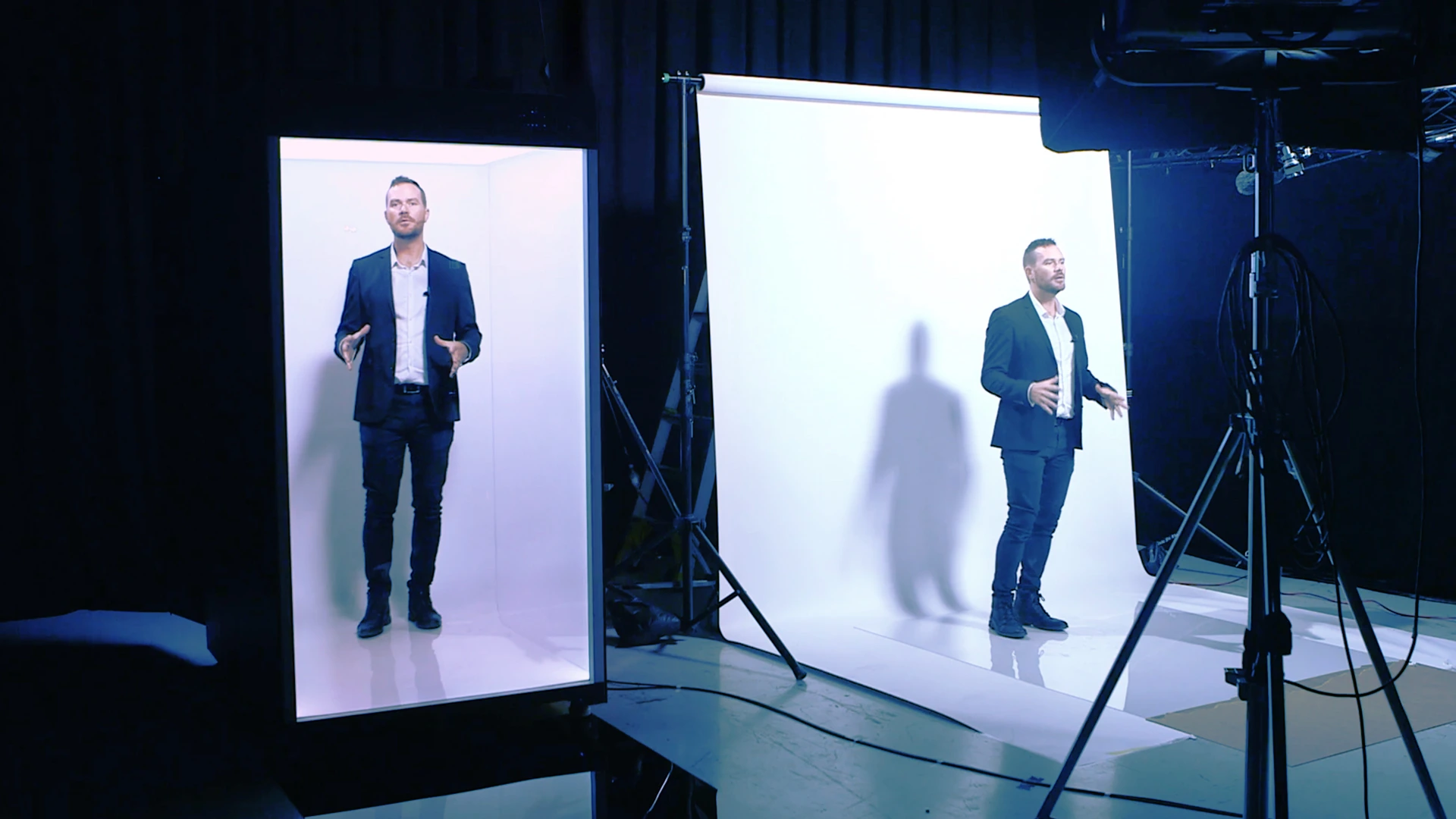
Fans, projection foil, ghost mesh, HoloBoxes and light-field displays all create holographic effects in very different ways
A person appears to be standing inside a glass box. A sneaker rotates in mid-air. A speaker addresses an audience thousands of miles away at full human scale. A digital character materialises on a concert stage.
We have become used to calling all of these things holograms, but there is a fascinating problem with that word: they do not all work in the same way.
Some holographic displays use rapidly moving LEDs. Some use transparent foils, gauzes or meshes and carefully controlled projection. Some generate many different views of a 3D scene at once. Systems from companies including Miirage, Proto and HoloConnects use another approach again, combining a transparent display with controlled illumination, physical depth and specially prepared content.
The destination is similar. The engineering is completely different.
First, what is a real hologram?
Traditional optical holography has a much narrower scientific definition than the word usually has in advertising, events or popular culture.
A conventional photograph records the intensity of light arriving at a surface. Traditional holography records information about the light wavefront through interference. When that recorded pattern is illuminated correctly, diffraction can reconstruct the original wavefront and reproduce spatial information from the original scene.
That is why interference and diffraction are fundamental to optical holography. An Optica introduction to holography describes those phenomena as the foundations for understanding the recording and reconstruction process.
Most commercial displays described as holograms do not reconstruct a complete optical wavefront in that way. Instead, they create enough visual evidence of depth that the human visual system accepts the illusion.
Perspective, contrast, scale, shadows, occlusion, transparency, binocular disparity and motion parallax can all make an image feel as though it occupies physical space.
Four different routes to the holographic illusion
Most modern commercial holographic displays can be understood as four broad technological families:
- Hologram fans and persistence-of-vision displays
- Projection systems using transparent foil, gauze or ghost mesh
- Transparent-display HoloBoxes
- Light-field and multi-view displays
They can look superficially similar from a distance, but what is happening behind the image is completely different.
1. How do hologram fans work?
Hologram fans are among the strangest display technologies to watch when they are switched off. They look like rotating arms or fan blades with rows of LEDs attached. Switch them on and, at sufficient speed, much of the physical mechanism becomes difficult to perceive. In its place, a bright digital object appears to float in the air.
The underlying idea is generally described as persistence of vision, or POV. LEDs mounted along a rotating arm are switched on and off at precisely calculated positions. Instead of permanently filling a rectangular screen with pixels, the same LEDs repeatedly occupy many different positions as the arm rotates.
A useful engineering demonstration of the principle used 40 independently addressable LEDs to create the illusion of approximately 4,800 pixels at more than 30 frames per second. The project shows how a relatively small number of physical LEDs can effectively paint a much larger image by moving through space. Read the persistence-of-vision display project.
Commercial systems such as HYPERVSN apply the same broad principle in a much more polished form. Carefully designed objects, logos and animations work particularly well because the LEDs illuminate only the parts of the scene that need to be visible. There is no conventional bright rectangular background around the image.
This does not usually mean the image is filling an arbitrary three-dimensional volume. In a typical hologram fan, the image is drawn across the plane swept out by the rotating LEDs. The illusion of something floating in open space comes partly from the fact that the display mechanism itself becomes visually unobtrusive.
It is a remarkably clever solution, but it also involves fast-moving mechanical components. That has implications for installation, acoustics, safety and how closely members of the public can approach the display.
2. How do holographic projection foil, Holo-Gauze and ghost mesh work?
Musion-style foil, Holo-Gauze and ghost mesh are best understood as members of the same broad family. They all use a transparent or semi-transparent physical surface together with projected light.
That surface might be an optically clear polymer foil. It might be a fine gauze or textile. It might be a theatrical mesh or scrim. The exact optical arrangement changes, but the goal is similar: let the audience see a bright digital image while still being able to see the physical scene beyond or through the material.
The result is a digital object that appears to occupy the same space as the real environment.
Musion and Pepper's Ghost
Musion is closely associated with the modern large-format version of Pepper's Ghost, an illusion popularised in nineteenth-century theatre.
The basic physics are reflection. A transparent surface is positioned so that light from a hidden image source reflects towards the audience. The viewer can see through the material at the same time, so the reflected image appears to exist in the physical scene.
The Institute of Physics demonstrates the principle using a transparent screen positioned at approximately 45 degrees. Light changes direction by reflection while the audience continues to see through the transparent material, creating a virtual image that seems to sit behind the surface.
Modern stage systems can replace the hidden physical object with video or projection. A large transparent foil becomes part of the optical path, allowing a performer, presenter or digital object to appear on stage alongside real scenery.
A peer-reviewed paper in Frontiers in Physics describes modern Pepper's Ghost systems as using transparent half-mirrors or foils to create the effect commonly called a "floating hologram".
Holo-Gauze and ghost mesh
Holo-Gauze, holographic gauze and ghost mesh use a slightly different optical arrangement but belong to the same practical family of technologies.
Instead of relying primarily on a reflective foil in classic Pepper's Ghost geometry, a projector sends the image directly onto a fine semi-transparent fabric or mesh. Enough light is caught by the fibres to make the projected subject visible, while the audience can still see much of the real scene behind it.
The engineering challenge is a balancing act. Make the material too visible and the audience notices the screen. Make it too transparent and too little projected light is retained to create a strong image.
That is why controlled lighting and dark video backgrounds are so important. A brightly lit person against black can appear while most of the surrounding frame effectively disappears.
The result can be spectacular at stage scale, but projector placement, ambient light, audience sightlines, fabric tension and the surrounding environment all need to cooperate with the illusion.
3. How does a HoloBox work?
This is the category occupied by self-contained systems from companies including Miirage, Proto and HoloConnects.
They do not need rotating LED blades. They do not need a large sheet of projection foil suspended across a stage. They do not project onto ghost mesh.
Instead, the holographic illusion is created inside a physical enclosure.
The core ingredients can be reduced to a simple formula:
Content + transparent display + controlled light + physical depth = holographic presence.
The transparent LCD
To understand the system, it helps to understand what an LCD actually does.
LCD stands for liquid crystal display. At a simplified level, it behaves like an extremely sophisticated light valve. Liquid crystal elements, polarising layers and colour filters regulate how much light is transmitted through each pixel.
A normal LCD television contains an opaque backlighting system behind the panel. That backlight provides the light that the LCD modulates to create an image.
A transparent LCD changes the arrangement. The conventional opaque background is removed from the viewing path, allowing light from the physical environment behind the display to pass through the panel.
The screen can therefore display digital imagery while the viewer can still perceive an illuminated space behind it.
Why the box matters
Put a transparent LCD directly against a wall and you have a transparent display. That alone does not produce the complete HoloBox effect.
A HoloBox places real physical distance behind the display plane. In the Miirage Miracle, for example, the enclosure is approximately 700 mm deep. The transparent display sits at the front of a genuine illuminated volume rather than immediately in front of an opaque television-style backlight.
That physical depth gives the eye a second spatial reference plane.
The digital subject appears on the transparent LCD at the front. The illuminated interior and rear wall exist physically behind it. As the viewer changes position, the relationship between foreground and background helps reinforce the sensation that the digital subject occupies a real volume rather than simply sitting on an ordinary television.
Proto's published patent describes this architecture very clearly. It specifies a transparent monitor positioned at the front of a three-dimensional, internally illuminated display box, with light panels and translucent surfaces distributing illumination through the interior. View the published patent documentation on Google Patents.
This does not mean the transparent LCD itself has suddenly become a true volumetric display. The pixels are still on a display plane. The illusion is strengthened by combining that digital plane with real depth, illumination, shadows, reflections, perspective and purpose-built content.
Why the light box is essential
The interior illumination is not simply decorative.
A transparent LCD needs light passing through it in order to produce a strong visible image. The enclosure therefore becomes part of the display's optical system.
That lighting has several jobs at once. It must provide enough light for the transparent display, illuminate the physical depth behind the subject, avoid distracting hotspots, maintain visual contrast and help the digital content feel integrated into the box.
This is why describing a modern HoloBox as "just a transparent screen" misses much of the engineering.
The screen, the enclosure, the lighting and the content operate as one visual system.
Content is part of the technology
This may be the most underestimated ingredient of all.
Play a normal full-screen television advert on a transparent LCD and it can still look like a flat video. The more completely the content fills the display, the more it can hide the physical depth behind it.
Holographic content works best when it is designed for the optical system. People and products can be isolated cleanly. Perspective must feel natural. Scale needs to be believable. Contact shadows and reflections can help establish where a person or product appears to meet the physical floor.
Miirage therefore treats content creation as part of the holographic system rather than an afterthought. The Miirage FAQs explain how filmed people, products, animation, live streaming and other content formats can be prepared for holographic display.
The Miirage Miracle uses a 4K transparent display. A 3,840 by 2,160 UHD frame contains approximately 8.3 million pixels. At human scale, that resolution matters because faces, hair, clothing, product textures and subtle motion all contribute to the illusion of presence.
Miirage, Proto and HoloConnects: similar optical family, different products
Miirage, Proto and HoloConnects compete in broadly the same technological territory, but that does not make the finished systems identical.
The fundamental visual philosophy is recognisable: a transparent front display, an illuminated enclosure with genuine physical depth, and content designed to exploit the relationship between the two.
The differences then come from product engineering. Panel quality, optical treatment, brightness, enclosure depth, diffusion, thermal management, software, remote control, cameras, microphones, touch systems, audio, live streaming, AI integration and content production can all change the finished experience.
That is why two HoloBoxes can look similar in a product photograph yet perform very differently when viewed in person.
The transparent panel is only one component.
Why HoloBoxes become particularly interesting when AI is added
A HoloBox does not have to be a passive video player.
It can contain a computer, cameras, microphones, speakers, touch input, connectivity and sensors. Add conversational artificial intelligence and the hologram can respond to the person standing in front of it.
The Miirage AI avatar platform turns that physical holographic presence into an interactive assistant that can answer questions, guide visitors, explain products, provide training and communicate in multiple languages.
That changes the role of the display. It is no longer simply something people watch. It can become something they speak to.
4. How do light-field holographic displays work?
Light-field displays use a fundamentally different technique again.
Looking Glass is one of the best-known companies in this category. Rather than showing essentially one normal image plane against physical depth, a light-field display presents multiple views of a three-dimensional scene and directs those views towards different viewing positions.
Move your head and you receive a different perspective. Your left and right eyes can also receive slightly different views.
Those are powerful depth cues because they reproduce some of the directional behaviour of light coming from a real three-dimensional object.
North Carolina State University lists its Looking Glass Portrait as capable of showing up to 100 distinct views across a 58-degree viewing cone, without glasses or a headset. Read the NC State overview.
That makes light-field technology fundamentally different from a HoloBox, hologram fan or projection surface.
So which hologram technology is best?
There is no universal answer because they solve different problems.
- Hologram fans are particularly effective for floating logos, products and animations where the absence of a visible rectangular screen is part of the spectacle.
- Projection foil, Holo-Gauze and ghost mesh can create enormous stage-scale effects for concerts, theatre, presentations and large installations.
- Light-field displays are compelling when multi-view perspective and glasses-free spatial visualisation are central to the experience.
- Transparent-display HoloBoxes package human-scale holographic presence into a self-contained unit, making them especially useful for retail, airports, shopping centres, museums, exhibitions, events, advertising, telepresence and AI assistants.
Different engineering. Different strengths. Different kinds of illusion.
The brain is the final component of every hologram
The most interesting part of holographic technology may not be the projector, fan, LCD or light-field optics.
It may be the person looking at it.
A holographic display gives the visual system clues. Perspective suggests distance. Occlusion suggests that one object sits in front of another. Shadows suggest contact with a surface. Reflections suggest material and position. Motion parallax suggests separation in depth. Binocular disparity can suggest three-dimensional structure.
Our brains combine those signals almost instantly.
That is why someone can stand in front of a holographic display, fully understand that they are looking at pixels, projection or rapidly moving LEDs, and still experience the sensation that the object has physical presence.
The display does not always need to reproduce every property of reality. It needs to reproduce enough of the right clues.
Holograms are becoming much more than a visual trick
For decades, the cultural reference point for holograms has been science fiction. But the commercial evolution of holographic technology may ultimately be more interesting than recreating a floating movie effect.
Displays are becoming interactive. They are becoming networked. They can be remotely managed. People can be streamed live across borders. Digital products can appear at human scale. AI characters can see, hear and respond to the people around them.
For Miirage, that is where holographic technology becomes especially powerful. The objective is not simply to make a digital object appear to float. It is to give digital content a convincing physical presence in real-world environments.
The question is no longer only "How do holograms work?"
It is increasingly "What happens when digital content no longer feels trapped behind an ordinary screen?"
There is no single hologram technology. The magic comes from using light, depth, movement and human perception in different ways to make digital content feel physically present.Further Reading
- Miirage: Frequently Asked Questions
- Miirage: Holographic Displays and the Miirage Miracle
- Optica: Introduction to Holography
- Institute of Physics: Pepper's Ghost
- Frontiers in Physics: Modern Pepper's Ghost and Floating Hologram Systems
- Cornell ECE 4760 Project: Persistence of Vision Display
- Google Patents: Transparent-Monitor Holographic Display Architecture
- NC State University: Multi-View Light-Field Display Overview