Why the Future of Technology Still Needs to Feel Familiar
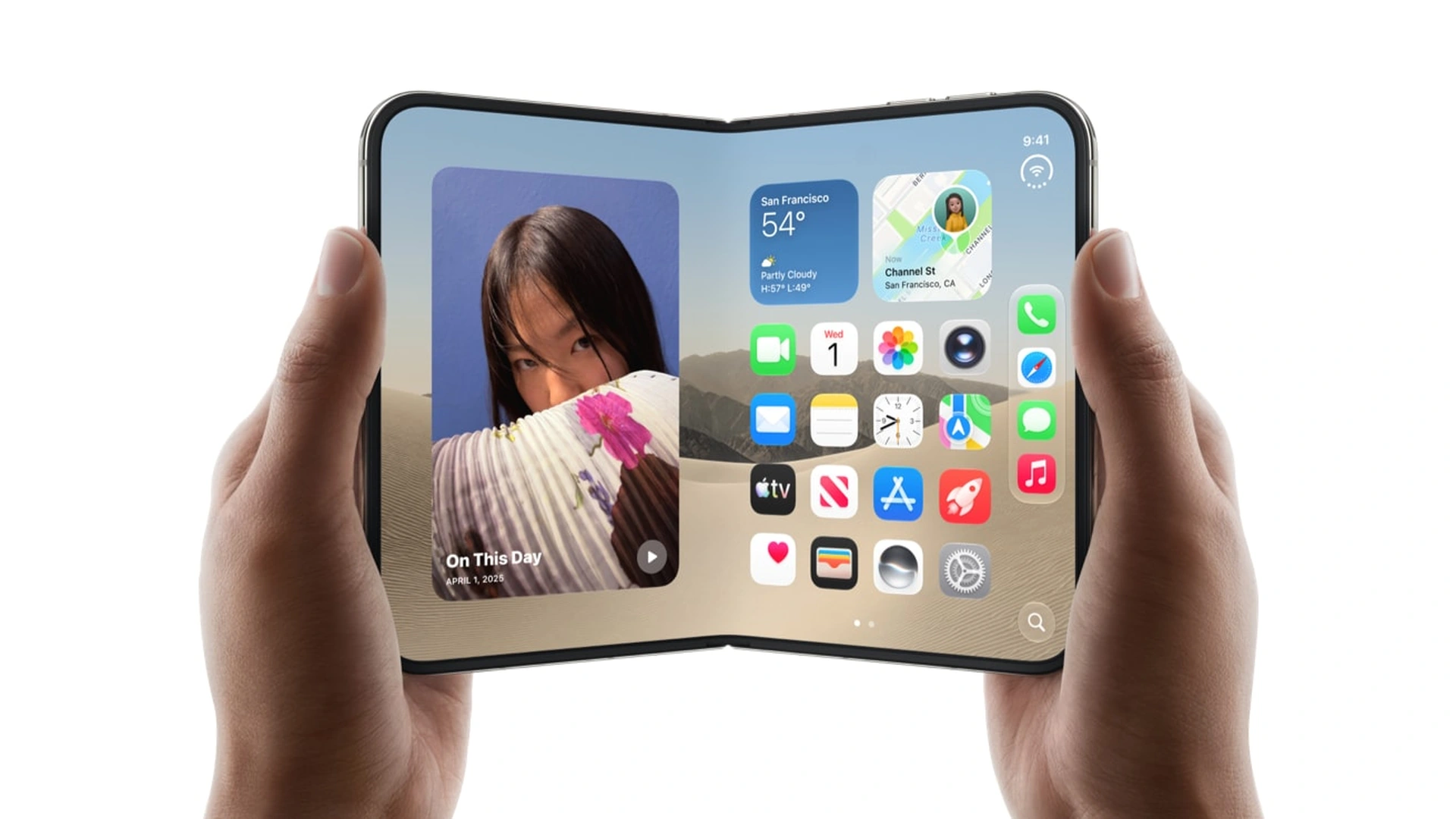
Apple's first foldable iPhone is more than a hardware story. It is a reminder that the technologies people adopt fastest often change what is possible without asking us to abandon what already feels natural.
For decades, the technology industry has been obsessed with what comes next.
The next screen. The next interface. The next device. The next way of communicating. More recently, artificial intelligence has accelerated that conversation, with increasingly bold predictions that smartphones, apps, keyboards and even screens themselves could eventually disappear.
Yet something interesting is happening.
On 9 September 2026, Apple unveiled the iPhone Duo, its first foldable iPhone and arguably the biggest physical change to the iPhone since its launch nearly two decades ago.
It folds. It opens into a 7.6-inch display. It introduces new ways to multitask, watch content and interact with apps. In the UK, it starts at £1,999.
But fundamentally, it is still an iPhone.
And that may tell us something important about how humans actually adopt technology.
Apple itself describes the experience as feeling "entirely new yet remarkably familiar." That might be more significant than the folding screen itself.
We have been carrying the same idea for almost 20 years
Think about how radically technology has changed since the first iPhone appeared in 2007.
Mobile internet has gone from 3G to 4G and 5G. Smartphone cameras have evolved from basic snapshots into sophisticated computational imaging systems. Processing power has increased enormously. Cloud computing has become ubiquitous. Apps have transformed banking, shopping, transport, entertainment and communication.
Now generative AI can write, translate, analyse, create images, understand speech and increasingly perform tasks on our behalf.
Yet the basic object in our pocket remains remarkably recognisable.
A rectangular screen. A collection of apps. A keyboard. A camera. A touchscreen.
We unlock it, tap something and look at a screen.
The smartphone has been reinvented repeatedly from the inside, while remaining surprisingly stable on the outside. And there is little evidence that people are desperate to give it up.
Ofcom reported in December 2025 that UK adults were spending an average of four and a half hours online every day, with most of that time spent on smartphones. Adults used an average of 41 apps per month.
Globally, the scale is even more striking. The GSMA's State of Mobile Internet Connectivity 2025 found that 4.4 billion people, or 54% of the world's population, used their own smartphone to access the internet by the end of 2024. That figure increased by around 250 million people in a single year.
For something that is supposedly approaching obsolescence, the smartphone seems remarkably healthy.
AI was supposed to change all of this
There is good reason to believe AI will eventually change how we interact with technology.
AI assistants can already understand natural language. Cameras can interpret the world around us. Wearable devices can provide information without requiring us to remove a phone from our pocket. Smart glasses, spatial computing, autonomous AI agents and conversational interfaces all point towards a future in which tapping through dozens of apps may feel increasingly outdated.
But there is a difference between changing what a smartphone does and eliminating the smartphone altogether.
Ofcom recorded 1.8 billion UK visits to ChatGPT during the first eight months of 2025, compared with 368 million during the same period a year earlier. AI adoption is accelerating quickly, but the smartphone has not disappeared. Instead, AI is increasingly being absorbed into it.
Apple's iPhone Duo makes that particularly visible. The device combines a new physical form with Apple Intelligence and Siri AI. The AI revolution is not being presented as an alternative to the phone. It is being embedded inside one.
Technology rarely develops as neatly as predictions suggest. One technology does not always arrive and immediately destroy everything that came before it. Very often, the new technology gets absorbed into something people already understand.
The folding phone is a fascinating experiment
Foldable phones themselves are not new. Manufacturers including Samsung, Huawei, Motorola, Google and others have spent years developing the category.
Yet foldables remain relatively niche.
Counterpoint Research estimates that foldable smartphones still account for only around 2% of the global smartphone market, despite the category now being in its eighth generation. Cumulative foldable shipments are expected to pass 100 million units by the end of 2026.
Counterpoint also forecasts that Apple could take around 25% of the global foldable market in 2026, with up to six million foldable iPhone shipments despite entering late in the year.
If that happens, it will not necessarily be because Apple invented folding screens.
It may be because Apple has taken an unfamiliar form factor and placed it inside one of the most familiar consumer technology ecosystems in the world.
An iPhone user does not need to learn what an iPhone Duo is from scratch. Their photos are still there. Their messages are still there. Their apps are still there. Their Apple account is still there. The gestures, icons, notifications and basic behaviours remain recognisable.
The object has changed significantly, but the mental model has not.
That is powerful.
Humans have a complicated relationship with change
Technology companies naturally focus on what is technologically possible. Consumers make decisions differently.
We evaluate usefulness, price and performance, but we also evaluate effort, uncertainty, habits and familiarity.
Behavioural researchers have studied what is known as status quo bias, our tendency to favour existing behaviours and systems even when alternatives become available.
A meta-analysis of 34 published studies examining information-system adoption found significant relationships between status quo factors, expectations and willingness to adopt new systems.
This does not mean consumers dislike innovation. Quite the opposite. People frequently embrace extraordinary technological change.
But successful innovation often gives users a bridge between the world they know and the world being introduced to them.
The transition feels manageable.
The original iPhone itself was an example. People already understood phones. They understood cameras. They understood music players. They understood email and websites. Apple combined those behaviours into an interface that was radically different, but still anchored in concepts people recognised.
Perhaps the next generation of technology will follow the same pattern.
The future may arrive through familiar interfaces
Consider some of the technologies currently competing to define the next decade:
- AI assistants and autonomous agents
- Smart glasses and spatial computing
- Robotics and digital humans
- Holographic displays and conversational avatars
Each can be presented as a completely new way of interacting with technology. But that may not be how they achieve mass adoption.
Smart glasses make sense partly because humans already understand glasses. Conversational AI feels intuitive because humans already understand conversation. A digital assistant becomes easier to use when you can simply ask it a question.
A holographic AI representative can feel surprisingly intuitive for the same reason. The interface is not really the hologram. The interface is a person.
Imagine arriving inside an airport, shopping centre, hospital, hotel or corporate headquarters. You could download an app. You could find a touchscreen. You could scan a QR code. You could search a website.
Or you could simply walk up to a life-sized digital person and ask, "Where do I need to go?"
That interaction requires almost no explanation.
The technology behind it may involve transparent displays, real-time rendering, speech recognition, artificial intelligence, multilingual language models and complex software. But the behaviour required from the human being is incredibly familiar.
Talk. Listen. Respond.
Holographic AI is interesting for exactly this reason
Much of the conversation around holograms focuses on spectacle, and understandably so. Seeing a life-sized digital person apparently standing inside a physical location is visually striking.
But as holographic technology combines with conversational AI, its more important advantage may eventually be behavioural rather than visual.
Miirage is exploring the combination of life-sized hologram displays and AI avatars that can communicate with people in natural language. The underlying technology is new. The human behaviour is ancient.
You approach someone. You ask a question. They answer.
The same principle can apply to retail, airports, corporate environments, museums, healthcare, events and public spaces. A hologram display does not need to replace every screen or every smartphone. It simply adds another interface where a face-to-face conversation is more natural than opening an app.
That may be a far more realistic picture of the technological future.
New technologies do not always replace old ones
Television did not kill radio. Streaming did not eliminate cinemas. Tablets did not eliminate laptops. Video calls did not eliminate meetings. Online shopping did not eliminate physical stores.
And AI may not eliminate smartphones.
Technological history is full of predictions based on replacement when the eventual reality is coexistence, adaptation and convergence.
Devices absorb capabilities from one another. Interfaces evolve. Behaviour changes gradually. Occasionally something disappears completely, but often the technologies that survive are those flexible enough to incorporate whatever comes next.
The smartphone may be one of them.
Foldable phones demonstrate this perfectly. The iPhone Duo does not ask consumers to abandon the smartphone. It asks them to reconsider what shape a smartphone can take.
That sounds like a subtle difference. Psychologically, it is enormous.
Apple's biggest innovation may be making change feel normal
There is an interesting contradiction at the heart of the iPhone Duo.
It represents one of Apple's biggest physical changes to the iPhone, yet Apple has gone to considerable effort to make the experience continuous.
The outer display behaves like an iPhone. Open it and the screen expands. Apps adapt. Content moves with you.
Apple says the inner display is 50% larger than the display on iPhone 18 Pro Max, while the outer 5.4-inch display provides 90% of the screen area of iPhone 18 Pro.
It changes the hardware without demanding that users abandon everything they already know.
That may prove to be the most important lesson.
The future of technology will undoubtedly look different. We will talk to machines more frequently. AI systems will act on our behalf. Digital people may appear in physical spaces. Displays may become transparent, wearable, foldable or spatial. Some interfaces could eventually disappear entirely.
But humans will still be humans.
We bring habits, expectations, instincts and learned behaviours with us.
The technologies that ultimately become part of everyday life may therefore not be those that look the most futuristic. They may be those that make the future feel strangely familiar.
Apple's folding iPhone could be an early reminder of that.
The next technological revolution may not begin by asking us to forget everything we know. It may begin by giving us something we already understand, then quietly showing us that it can do much more.
The technologies that win may not be the ones that ask people to abandon familiar behaviour. They may be the ones that make the future feel natural from the first interaction.Further Reading
- Apple: Apple unveils iPhone Duo
- Counterpoint Research: Global foldable shipments to hit 100 million cumulative units
- Ofcom: From apps to AI search, how the UK goes online in 2025
- GSMA: The State of Mobile Internet Connectivity 2025
- Online Information Review: Status quo bias in information system adoption