How Holographic AI Is Merging Wayfinding and Advertising
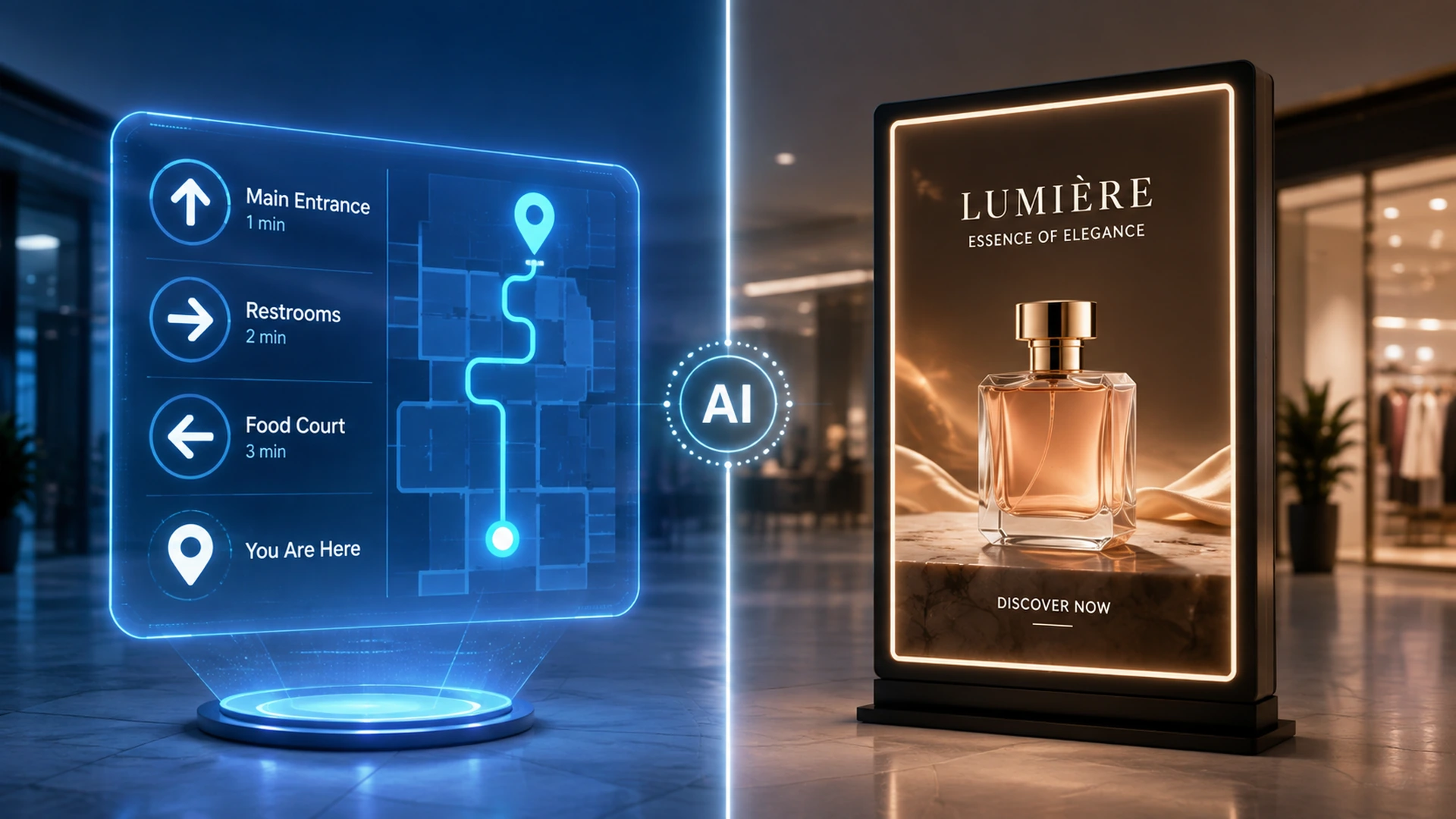
What happens when the screen that helps you find your destination can also help you discover what is worth seeing, buying or doing along the way?
Wayfinding and advertising have traditionally been treated as two completely separate systems.
One helps people get somewhere. The other tries to persuade them to stop somewhere else.
In a shopping centre, airport or large public venue, visitors might use a static directory, information desk or touchscreen to find their destination, while advertising screens around them display entirely separate commercial messages. The systems may occupy the same physical environment, but they rarely understand the same customer journey.
Holographic AI creates an opportunity to change that.
A visitor can approach a visible AI assistant, ask where something is located and receive an immediate spoken answer, visual directions or an interactive route. During that same interaction, the system can also help the visitor discover relevant shops, restaurants, products, services, events or promotions.
The result is more than a digital directory and more than an advertising screen. It is a useful customer service point that can also become a premium media platform.
Businesses are no longer limited to choosing between digital signage and human customer service. Holographic AI combines the visual impact of physical presence with the scalability of artificial intelligence.
Three Markets Are Converging at the Same Time
The idea becomes more interesting when viewed against what is happening across advertising, retail media and artificial intelligence.
Retail media is expanding quickly. According to IAB Europe, European Retail Media advertising grew 16.7% in 2025 to reach €13.3 billion, passing 10% of total digital advertising spend in Europe. Brands increasingly want media closer to the moment of purchase, where attention can be connected to action.
Out-of-home advertising is becoming more digital at the same time. The Out of Home Advertising Association of America reported that U.S. OOH revenue reached a record $3.16 billion in Q2 2026, up 10.7% year on year. Digital OOH grew even faster at 18.5% and represented 38.4% of total quarterly OOH revenue.
Artificial intelligence is also making customer interactions more contextual. McKinsey notes that 71% of consumers expect personalised interactions and 76% become frustrated when those interactions are not relevant. Its analysis also suggests that AI-driven personalisation can improve customer satisfaction by 15% to 20%, increase revenue by 5% to 8% and reduce cost to serve by up to 30%. Those figures relate to AI-driven personalisation broadly, not holographic displays specifically, but they show why context is becoming commercially valuable.
Put those trends together and a new model begins to emerge: physical media that does not simply display information, but understands why somebody approached it and can respond accordingly.
What Is Holographic AI Wayfinding?
Traditional wayfinding normally relies on signs, printed maps, touchscreen directories or mobile applications. Each can work well, but they require the visitor to understand the interface before they can get the answer.
Conversational AI reverses that relationship. The visitor can simply ask the question in the way they would ask another person.
For example:
- Where is the nearest restaurant?
- Where can I buy a phone charger?
- How do I get to Gate 24?
- Which floor is the cinema on?
- Where are the accessible toilets?
- Is there somewhere nearby that sells children's shoes?
A Miirage wayfinding AI assistant can provide the answer conversationally, display directions and connect the visitor to a map, QR journey, venue page or other information. It can also support multiple languages, which becomes particularly important in international environments.
The key change is simple: instead of forcing people to understand the interface, the interface can understand the question.
Every Wayfinding Question Contains Context
This is where the commercial opportunity begins.
Someone asking where the restaurants are has expressed an immediate interest in food. Someone looking for a particular category of retailer may be moments away from making a purchase. Someone asking where a lounge is located may also want to know whether they are eligible to enter it. A family asking where the cinema is may be interested in what else is happening nearby.
Traditionally, most of this context disappears. A directory provides the answer and the interaction ends.
Holographic AI allows the experience to continue when there is a genuinely useful next step.
Instead of simply saying, "The restaurants are on Level 2," an assistant might say, "The restaurant area is on Level 2. Take the escalator behind me and turn right. There are also several offers available in that area today if you would like to see them."
The primary purpose of the interaction is still service. The visitor gets the answer they asked for. The commercial layer appears only when it is relevant.
The advertising is not interrupting the customer journey. It can become part of the customer journey.
Why Shopping Centres Are a Natural Test Case
Shopping centres bring customer service and commercial discovery together more tightly than almost any other environment.
Visitors constantly need information. They want to know where shops are, where to eat, what time stores close, where facilities are located, which events are running and how to reach different parts of the centre.
At the same time, every shopping centre contains businesses competing for footfall. Retailers want customers. Restaurants want covers. Entertainment operators want bookings. Brands want attention. Shopping centre owners and retail media networks want premium inventory that can generate additional revenue.
This is why the growth of retail media advertising matters. IAB Europe's 2025 market data shows that the channel is no longer a niche experiment. It has become one of the fastest-growing parts of European digital advertising.
A holographic AI assistant could potentially serve the visitor and the commercial ecosystem from the same location. Someone asking, "Where can I buy running shoes?" could receive a route to the appropriate part of the centre. Relevant retailers could then be presented as useful options, subject to the venue's rules and any commercial relationships being made clear.
The experience remains wayfinding, but it has also become product discovery and retail media.
This is an evolution of the idea explored in Miirage's article Retail Media 3.0: Bringing Depth to the Aisle. The next step is not simply making retail media more visible. It is making it more useful.
Airports Make the Scale Even Clearer
Airports are another environment where navigation, information and commercial activity exist side by side.
The scale is enormous. Airports Council International World reported that global passenger traffic reached 9.8 billion passengers in 2025. The world's 20 busiest airports alone handled 1.59 billion passengers, around 16% of global air travellers.
Those passengers need constant guidance. Gates, check-in areas, lounges, baggage information, transport connections, toilets, restaurants, duty-free zones and passenger services all create wayfinding demand.
They are also increasingly comfortable with digital travel tools. SITA's Passenger IT Insights 2025, based on 7,500 travellers across 25 countries, found that 79% of passengers were ready for digital identities on their phones. The broader message is that passengers increasingly expect technology to remove friction from the journey.
A holographic airport advertising display that can also answer questions changes the commercial proposition. It is no longer useful only when an advert is playing. It can provide guidance, multilingual information and assistance between campaigns or during direct interactions.
A passenger asking, "Where can I get something to eat before my flight?" has not asked to see an advertisement. They have asked for help. But answering that question naturally involves commercial destinations.
That is where the dividing line between wayfinding, recommendation and advertising begins to disappear.
Service First, Advertising Second
The strongest version of this model is not an AI avatar trying to sell something during every conversation.
That would quickly destroy trust.
If somebody asks for the toilets, tell them where the toilets are. If somebody is trying to find a departure gate, help them reach the gate. If somebody needs accessibility information, provide it clearly and without turning the interaction into a sales opportunity.
Commercial content works when it is relevant to the request, not when it hijacks the request.
That means the system can follow a simple hierarchy:
- Answer the visitor's question first.
- Offer a useful next step when there is one.
- Introduce commercial content only when it fits the context.
- Make sponsored or paid recommendations clear.
- Keep safety, accessibility and essential venue information independent of advertising.
This is the distinction between advertising that feels intrusive and advertising that feels useful.
It also explains why interactive advertising displays have more potential than passive screens. Interactivity creates a reason for the content to adapt. AI gives the interaction enough intelligence to make that adaptation meaningful.
From Digital Signage to Digital Assistance
Conventional digital advertising usually works in one direction. A screen displays a message and hopes somebody notices it.
Holographic AI introduces a two-way interaction.
A visitor can ask a question. The system can understand the intent. The answer can change according to the question, the location of the display, the time of day, the venue's live information and the content currently available.
That changes what an advertising display can become.
Instead of simply displaying "Visit our restaurant," the system can help somebody find somewhere suitable to eat.
Instead of showing "Shop our latest collection," it can help somebody locate the relevant store, understand what it sells and decide whether they want directions.
Instead of promoting "Download our app," it can explain why the app might be useful and provide a QR journey only if the visitor wants to continue on their own device.
The difference is between showing advertising and creating an interaction that can lead naturally towards commercial discovery.
A New Type of Media Inventory
For media owners, this creates the possibility of advertising inventory based on interaction rather than exposure alone.
Most OOH and retail media inventory is still sold around location, audience and time. An advertiser buys the right to appear on a screen in a particular environment for a particular period.
Holographic AI can add a second layer. The media can respond when a visitor expresses intent.
Potential formats could include:
- Clearly labelled sponsored recommendations
- Retail promotions linked to relevant visitor questions
- Product discovery and comparison journeys
- Brand-funded concierge experiences
- Interactive campaign conversations
- QR journeys connected to offers, bookings or product pages
- Location-specific promotions
- Event and entertainment discovery
- Branded AI characters or specialist product assistants
The physical display is therefore no longer simply an advertising surface. It becomes an interactive commercial touchpoint.
This connects directly with the argument in Holographic AI Avatars Are Unlocking the Next Era of Out-of-Home Revenue: useful infrastructure can create value for a venue even when no advertisement is running.
Context Does Not Have to Mean Surveillance
There is an important distinction between contextual relevance and personal profiling.
A wayfinding assistant does not need to know a visitor's identity to understand that someone asking for a coffee shop is interested in coffee. It does not need facial recognition to understand that someone asking for Gate 24 needs directions to Gate 24.
Much of the useful context can come directly from the interaction itself:
- The question the visitor chose to ask
- The physical location of the display
- The time of day
- Venue-approved information and promotions
- Availability or operational information provided by connected systems
This creates a potentially powerful model for physical-world personalisation: relevant enough to be useful, but without assuming that relevance requires identifying the individual.
One Display Can Perform Several Jobs
Perhaps the biggest commercial advantage is that the same display does not have to perform only one function.
At different moments, it could operate as:
- A wayfinding assistant
- A multilingual customer service point
- A retail media display
- A product specialist
- A brand ambassador
- An event host
- A promotional platform
- An interactive advertising experience
When nobody is interacting with it, the system can show scheduled holographic advertising or venue content. When someone approaches and begins a conversation, it can become an AI avatar assistant. When the interaction ends, the display can return to programmed media.
This ability to move between media and utility is what makes the model commercially interesting.
The infrastructure being used to improve the visitor experience can also create commercial value. The infrastructure being used for advertising can simultaneously provide a genuine visitor service.
The Future Is Not More Screens. It Is More Useful Screens.
The world does not have a shortage of digital displays.
Shopping centres, airports, transport hubs and public spaces are already surrounded by them. The challenge is making those displays useful enough to deserve attention.
Artificial intelligence provides an opportunity to transform passive screens into systems that can listen, understand and respond. Holographic display technology gives those systems a visible physical presence that stands apart from conventional digital signage.
Combine the two and something important happens.
Advertising can become helpful. Wayfinding can become interactive. Customer service can become scalable. A piece of digital infrastructure that previously performed one task can suddenly perform several.
For shopping centres, airports and other large destinations, that changes the economics. Wayfinding and information systems have traditionally been operational costs. Advertising is a revenue opportunity. A platform capable of doing both can bring those two models closer together.
This does not mean every visitor interaction should be monetised. It means the same infrastructure can serve more than one purpose.
For venue owners looking to improve customer experience while expanding their digital media proposition, that combination is becoming increasingly difficult to ignore.
Holographic AI Is Blurring the Line Between Service and Media
The most interesting future for holographic AI may not be replacing people or replacing screens.
It may be connecting things that were previously separate: customer service and digital signage, wayfinding and retail media, information and advertising, physical environments and artificial intelligence.
A visitor might approach a holographic AI assistant because they need directions. They leave knowing where they are going, but they may also discover a restaurant, retailer, product, event or experience they did not know was there.
For the visitor, that can mean a better journey. For the advertiser, it can mean reaching someone at a genuinely relevant moment. For the venue, it can mean turning a customer service touchpoint into infrastructure that can also generate commercial value.
That is why the convergence of holographic AI, wayfinding and advertising could become one of the most commercially significant applications of AI in physical spaces.
Miirage is building this model across wayfinding AI, retail media, shopping mall advertising, airport advertising and interactive advertising, bringing visual presence, conversational AI and real-world utility into the same platform.
The most valuable advertising may be the advertising that arrives as a useful answer.