Why Digital Holograms Are Becoming Serious Business Technology
Digital holograms are moving beyond spectacle and becoming practical tools for retail, advertising, product visualisation, telepresence and AI interaction.
For decades, digital information has largely lived inside rectangles. Televisions, phones, computer monitors, advertising screens, digital billboards and kiosks have all followed essentially the same principle: place an image on a flat surface and ask people to look at it. That model is not disappearing, but something very different is beginning to develop alongside it.
Products can now appear to occupy physical space. People can be presented life-size in locations thousands of miles away. Digital characters can stand inside retail environments, corporate headquarters, airports and exhibitions. Artificial intelligence can give those characters the ability to listen, answer questions, change languages and respond to the person standing in front of them.
Digital holograms are beginning to move beyond being treated purely as spectacle and towards becoming useful commercial technology. The interesting question is no longer simply whether holograms can attract attention. It is what businesses can actually do with that attention once they have it.
A Market Moving Quickly
Measuring the holographic display industry is difficult because different research companies define the category in different ways. Some include light-field displays, some include volumetric technology, transparent display systems, projection systems, holographic telepresence and other specialist optical technologies. Market forecasts therefore need to be treated carefully rather than presented as universally agreed measurements.
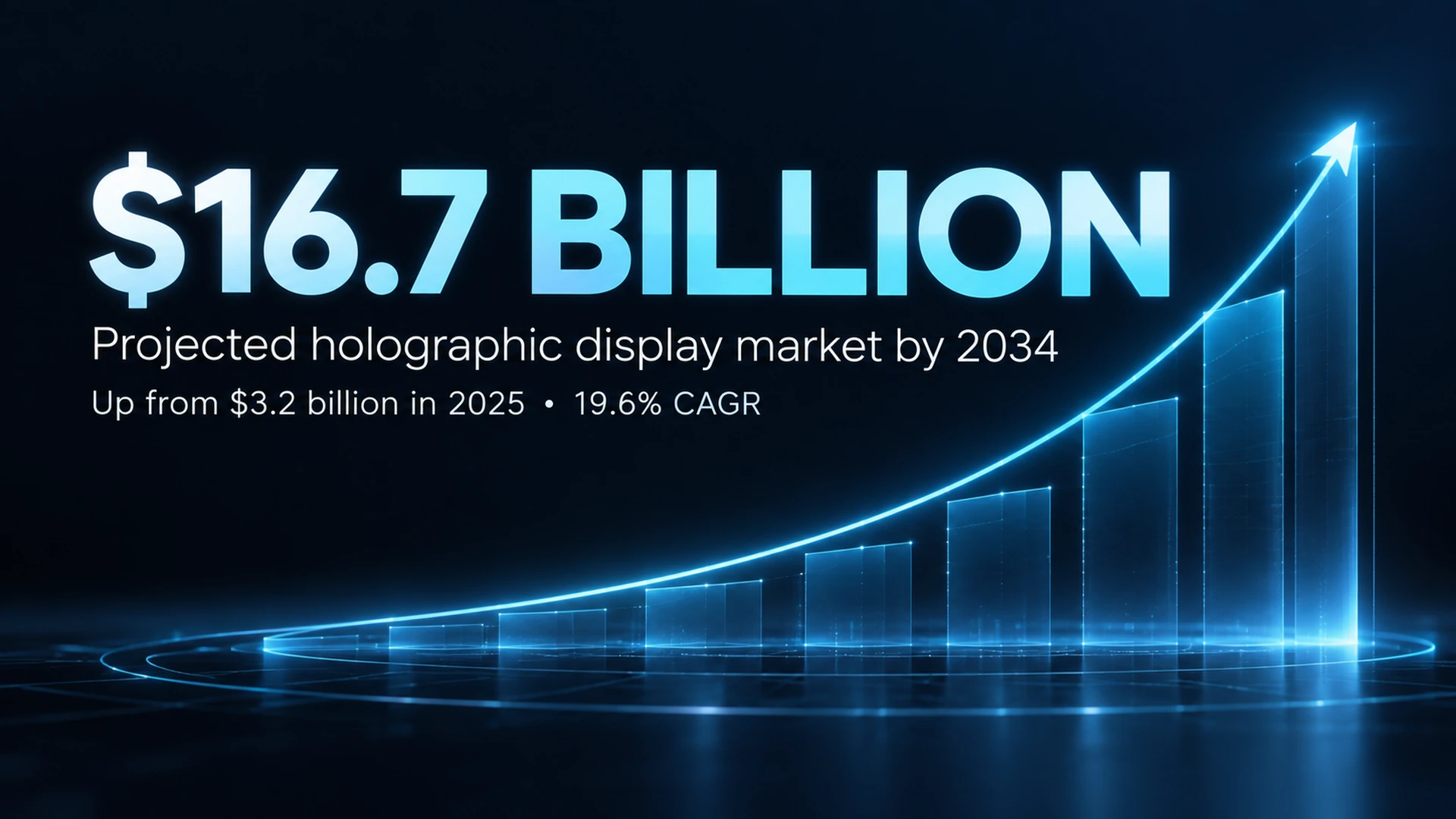
Even so, the direction of the research is remarkably consistent. IMARC Group estimates that the global holographic display market was worth approximately $3.2 billion in 2025 and forecasts that it could reach $16.7 billion by 2034, representing compound annual growth of approximately 19.6%. Research and Markets
Another 2026 industry forecast from Global Market Insights values the market at approximately $4.3 billion in 2025 and projects that it could reach $40.8 billion by 2035, representing annual growth of around 25.5%. Research and Markets
The difference between those estimates is substantial, which demonstrates why market forecasts should not be treated as precise facts. However, both point towards the same broader conclusion: analysts expect holographic display technologies to experience rapid growth over the coming decade.
Grand View Research provides another useful indication of where this technology sits within the wider display industry. It estimates that the global 3D display market was worth approximately $9.7 billion in 2025 and could reach around $38 billion by 2033. Within that market, it identifies holographic displays as the fastest-growing display segment. Grand View Research
Why Is This Happening Now?
Holograms themselves are not a new idea. What is changing is the technology surrounding them. Displays are becoming brighter and more capable, computing power is increasing, 3D content creation is becoming faster and more accessible, real-time rendering has improved, connectivity has become faster, and cloud infrastructure makes it possible to manage content remotely across multiple locations.
At the same time, artificial intelligence has advanced rapidly. AI systems can now understand natural language, respond with increasingly natural voices, translate between languages and process questions almost instantly. Computer vision can identify when somebody approaches a display, while generative AI can dramatically reduce the time required to create digital people, animations and interactive content.
Individually, each of these developments is useful. Combined, they begin to change the role of a holographic display completely. Instead of being a piece of hardware that simply plays visually impressive content, it can become an intelligent interface operating inside a physical environment.
Attention Has Become More Valuable
There is also a much simpler commercial reason for the growing interest in holographic displays: getting people to look at something has become increasingly difficult. Walk through almost any major airport, shopping centre or city centre and digital screens are everywhere. Consumers are surrounded by displays while also carrying their own screens in their pockets. By the time somebody encounters an advertising screen inside a retail environment, they may already have spent several hours that day looking at a smartphone, laptop or television.
Digital signage still works. A major 2025 study published in the Journal of Marketing examined 237 advertising campaigns involving approximately 30 million shoppers and found that digital signage at the point of sale increased the probability of purchasing the advertised product by 8.1%. Journal of Marketing
That research investigated conventional digital signage rather than holographic displays, so it would be incorrect to claim that holograms automatically produce the same uplift. What the research does establish, however, is that what shoppers see close to the point of purchase can materially influence what they buy. That creates an interesting opportunity for holographic displays. If conventional digital signage can influence behaviour, there is a strong commercial reason to explore display formats that look meaningfully different from the flat screens surrounding them.
Making Digital Products Feel Physical
One of the most interesting commercial applications of digital holograms is product visualisation. Traditional retail has always faced a physical limitation: space. A retailer can only display the products that physically fit inside a store. A furniture retailer may only be able to show a fraction of its complete catalogue. An automotive showroom can house only a limited number of vehicles. An electronics retailer may need to select which configurations are displayed, while luxury brands may deliberately hold relatively small amounts of physical inventory.
This becomes even more relevant as retailers experiment with smaller urban stores, experience centres and digitally enabled showroom formats. A holographic display creates another option. Instead of physically stocking every product variation, a retailer can use digital content to present products three-dimensionally. Different colours, configurations, models and products that are not currently available in that specific store can all potentially be visualised through the same piece of hardware. The physical store therefore becomes less dependent on the amount of physical stock it can carry.
There is another important difference between displaying a physical product and presenting a digital version of it. The digital product can move, transform and reveal information that would be impossible to demonstrate with the real object alone. A trainer can rotate in space, a watch can separate into its internal components, a vehicle can change colour instantly, and a complex machine can reveal what is happening inside it. Small products can be enlarged so that tiny details become visible, while products that are enormous in reality can be reduced to a scale suitable for an exhibition or showroom.
At that point, the product is no longer simply being displayed. It has become content. That opens opportunities across retail, exhibitions, trade shows, experience centres, museums, property marketing, automotive showrooms, airports, shopping centres and corporate environments.
Digital People Are Another Part of the Opportunity
Products are only one part of the story. People can also become holographic content. A life-size person can be filmed and presented in another location, creating a form of digital presence without requiring that individual to travel physically to every destination. The entertainment potential is obvious, but the commercial applications are potentially much broader.
A company executive could address employees in another country. A specialist could appear at an exhibition. A lecturer could teach in multiple locations. A celebrity could appear during a product launch. A brand ambassador could be reproduced across several retail environments, while a technical expert could demonstrate a product without needing to be permanently present at every location.
Market researchers are beginning to identify this as a significant application area. A 2026 digital holography study distributed by Research and Markets forecasts holographic telepresence as the fastest-growing application within its definition of the digital holography market, projecting annual growth of approximately 22.6% between 2026 and 2033. Research and Markets
As with all commercial forecasts, that does not guarantee the outcome. What it does show is that significant attention is now moving towards the idea of using holographic technology to create presence rather than simply display imagery.
Then AI Changes the Equation
This is where the technology becomes significantly more interesting. A recorded holographic person can communicate a message. A live holographic person can communicate with an audience in real time. An AI holographic person introduces something different because it can respond directly to the individual standing in front of it.
Someone could approach a holographic assistant in an airport and ask where their gate is. The avatar could provide directions and then answer a follow-up question about transport or airport facilities. A second traveller could ask the same question in another language and receive an answer in that language.
In a retail environment, an AI avatar could explain a product, answer questions about specifications and compare different options. In a corporate headquarters, it could welcome visitors and direct them to meeting rooms. At an exhibition, it could provide information while human staff are occupied with other visitors. In a museum, a digital character could answer questions about an exhibit. In a training environment, the same system could deliver information repeatedly while allowing users to ask their own questions.
This is where the distinction between a display and an interface begins to disappear.
From Attention to Utility
Historically, much of the commercial appeal of holographic experiences has been based around attention. Did people stop? Did they watch? Did they photograph the experience? Did they share it online? Those things still matter, particularly in advertising, events and brand activations. However, artificial intelligence adds another potential measure of value: utility.
Consider a holographic display inside a shopping centre. Its visual appearance may initially cause somebody to stop because it looks different from the conventional digital screens around it. Once that person approaches, however, the system could become a wayfinding assistant, explain which stores are available, answer questions about opening hours or promote particular products and services.
Inside an airport, the same principle could be applied to passenger information. At an exhibition, a holographic AI assistant could explain a company's products. In a corporate environment, it could welcome visitors. In retail, it could act as a digital product specialist. The holographic element attracts attention, while the AI gives people a reason to remain engaged.
One Display Can Perform Multiple Jobs
This flexibility also creates an interesting commercial model because the same display does not necessarily need to perform a single task throughout the day. A holographic display in a shopping centre could run visually striking advertising or branded content while nobody is interacting with it. When somebody approaches, the content could change and an AI avatar could appear. Once the interaction finishes, the system could return to its scheduled advertising.
The same physical footprint can therefore move between advertising, product visualisation, information, customer service, entertainment, wayfinding, training and AI interaction. That is a fundamentally different proposition from installing technology purely because it looks futuristic. The stronger commercial argument is that one piece of hardware can potentially perform several roles depending on the content and software being used.
Where Miirage Fits
At Miirage, this is the area of holographic technology that we believe is becoming particularly interesting. The objective is not simply to create something that people describe as a hologram. The opportunity is to use the visual impact of holographic presentation to create something commercially useful.
A holographic display can present a person, a product, an animation or an advertising campaign. It can be used to visualise things that are difficult to display physically and to create digital experiences that stand apart from the conventional screens surrounding them.
When an AI avatar is added, the same display can become interactive. It can answer questions, provide information, change languages, guide visitors or deliver training. When that interaction finishes, the display can return to branded or advertising content. The hologram therefore starts to become more than a visual effect. It becomes a digital platform occupying physical space.
From Spectacle to Useful Technology
Nobody knows exactly how large the holographic display industry will ultimately become. The wide range of market forecasts demonstrates how difficult emerging technology categories can be to measure.
What is much easier to see is that several major trends are converging at the same time. 3D display technology is improving, content creation is becoming easier, artificial intelligence is becoming dramatically more capable, and businesses are actively looking for alternatives to conventional screens. Retailers also increasingly need to connect digital experiences with physical environments, while consumers are becoming accustomed to interacting with artificial intelligence using normal language.
Holographic displays sit directly at the intersection of those trends. The most important development may therefore not be that digital holograms are becoming more realistic. It may be that they are becoming more useful.
For years, the purpose of many holographic experiences was simply to make somebody stop and look. The next generation of holographic displays has the potential to do something much more valuable: give that person a reason to interact.