50 Years After Star Wars, Holograms Are Finally Becoming Real
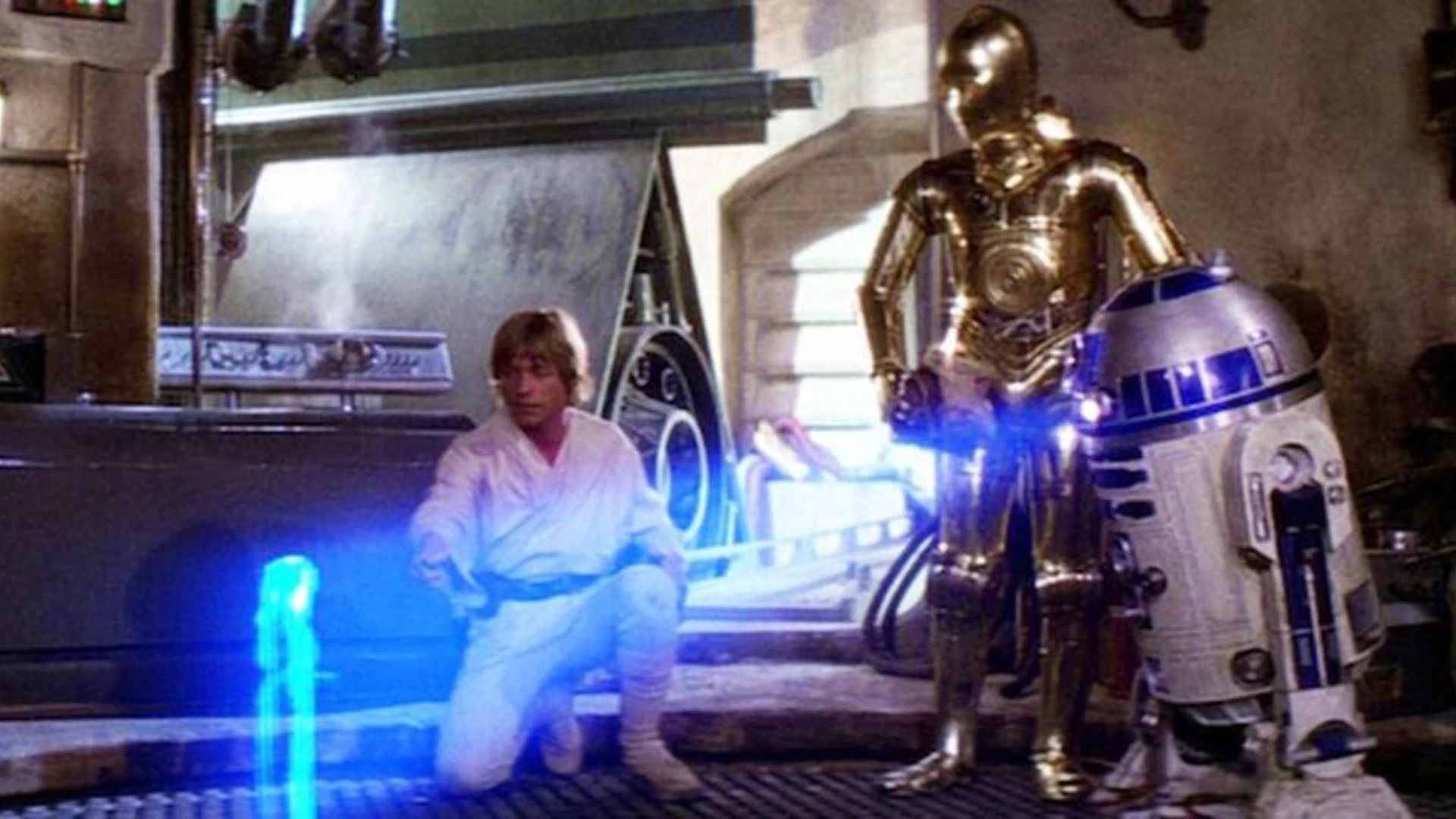
In 1977, Princess Leia appeared as a flickering blue hologram. Fifty years later, the idea of digital people occupying physical space no longer feels like distant science fiction.
In a small room on Tatooine, a young Luke Skywalker watched something audiences had barely seen before. R2-D2 projected a tiny blue image of Princess Leia into the room, delivering a message that would change the direction of Luke's life and help define how generations imagined the future.
In 2027, Star Wars celebrates its 50th anniversary. Lucasfilm has announced a year-long celebration, including a newly restored theatrical re-release of the original 1977 film beginning on 19 February 2027. Lucasfilm says the re-release will bring the original film back to cinemas for a limited time. Star Wars Celebration then takes place in Los Angeles from 1 to 4 April 2027, followed by Star Wars: Starfighter, starring Ryan Gosling, on 28 May 2027. StarWars.com has confirmed the Celebration dates, while the official film page confirms the Starfighter release date.
It is an appropriate moment to revisit one of the franchise's most enduring technological ideas. Because after half a century, the hologram is beginning to move from science fiction into the physical world.
A tiny blue image changed our idea of the future
Holograms have appeared throughout Star Wars, but Princess Leia's message remains the defining example. Lucasfilm itself calls it arguably the most memorable hologram in the saga. The company notes that holograms have repeatedly been used to deliver secret messages, communicate in real time, introduce characters and display maps and battle plans. Its retrospective on holograms in Star Wars explains how Leia's message becomes the call to action that pulls Luke into the story.
George Lucas could simply have had Luke listen to a recording.
Instead, Leia appeared in the room.
The information had a physical presence. That distinction matters because the scene was not memorable simply because Leia transmitted data. It was memorable because it created the impression that another human being was somehow occupying the same space.
The technology shown in the film was a visual effect rather than a true free-floating holographic projection. But that hardly matters to its cultural impact. Star Wars helped establish what audiences expected futuristic communication to look like.
It was not another telephone.
It was not another television.
It was presence.
Star Wars turned imagination into expectation
The scale of the original film's success makes that influence even more remarkable. According to The Numbers, the 1977 film was produced for an estimated $11 million and has generated approximately $775.4 million at the worldwide box office across its theatrical life.
At the 1978 Academy Awards, Star Wars received 11 nominations and seven wins, including awards for visual effects, film editing, sound, art direction and John Williams' score. The Academy's official record lists all 11 nominations and seven wins.
Its influence then spread far beyond a single film. Adding the worldwide theatrical grosses currently listed by The Numbers for the Star Wars franchise produces a total of more than $10.7 billion. The franchise box office table includes the original trilogy, prequels, sequels, spin-offs and 2026's The Mandalorian and Grogu.
But the franchise's deeper technological influence is harder to put a number on. Star Wars helped generations imagine robots, artificial intelligence, virtual interfaces, digital maps and remote visual communication. Some of those ideas have developed differently from the fictional versions, but the expectation survived.
We began to expect technology to become less like a machine we operate and more like something that shares our environment.
Then Iron Man took the hologram one step further
Three decades after Princess Leia appeared in front of Luke Skywalker, another fictional technologist changed the way audiences imagined holograms.
Tony Stark did not simply look at holographic information.
He interacted with it.
Throughout the Iron Man films, Stark works inside environments filled with digital objects and three-dimensional information. Models can be expanded, rotated, analysed and manipulated through gestures. Artificial intelligence, in the form of J.A.R.V.I.S., is integrated into the experience rather than treated as a separate application.
This was not accidental visual decoration. Perception, the design studio that worked on Iron Man 2, says its role expanded to more than 125 shots, covering futuristic interfaces and technology concepts throughout the film. For Tony Stark's workshop, the studio describes the creative challenge as building a visual manifestation of J.A.R.V.I.S. inside a fully immersive holographic environment. Perception's Iron Man 2 technology case study shows the holographic periodic table, glass interfaces, smart surfaces and three-dimensional concepts developed for Stark's world.
That represented an important evolution in popular culture's idea of the hologram.
Princess Leia demonstrated holographic presence.
Tony Stark demonstrated holographic interaction.
The hologram was no longer simply something you watched. It became something you could use.
Science fiction keeps moving the goalposts
Comparing Star Wars and Iron Man reveals how quickly our expectations of futuristic interfaces have changed.
In 1977, seeing another person apparently projected into a room felt extraordinary.
By 2010, Tony Stark expected digital objects to understand his gestures. He expected artificial intelligence to assist him. He expected information to occupy the physical space around him. He expected the interface to respond immediately.
Audiences accepted it because science fiction had spent decades teaching us what the future was supposed to feel like.
Real technology often develops in a similar sequence.
First, we make something visible.
Then we make it interactive.
Then we make it intelligent.
The real world is beginning to catch up
Walk through a modern airport, shopping centre, exhibition hall or technology event and you can increasingly encounter digital people appearing at human scale.
They might welcome visitors, present a product, explain a service, speak several languages or be controlled by a real person appearing from another location.
These systems are often described commercially as holographic displays, even though the technologies used to create the illusion vary considerably. Some use transparent displays. Some use reflection and projection. Others use LED systems, optical structures or carefully designed enclosures that create the perception of depth.
The important change is not simply how the image is produced.
It is what happens when digital content stops feeling trapped inside a conventional flat screen.
There is growing commercial interest in that idea. Fortune Business Insights estimates that the global holographic display market was worth $4.31 billion in 2025, growing to $5.42 billion in 2026, and projects it could reach $33.36 billion by 2034. That represents a forecast compound annual growth rate of 25.52% from 2026 to 2034. Forecasts are estimates rather than guarantees, but the scale of the projection illustrates the level of investment and interest entering the category. The market report also identifies retail, hospitality, healthcare, education and events among the industries adopting holographic display technology.
Presence can be more powerful than resolution
The fascinating thing about Princess Leia's message is how imperfect it is.
She is tiny.
She is blue.
The image flickers.
Yet none of that matters because Leia appears to be there.
For the past two decades, much of the display industry has concentrated on improving screens. Higher resolution. More brightness. Better contrast. Thinner panels. Larger displays.
Those improvements matter, but another increase in resolution does not necessarily change the nature of an experience.
A person who appears to occupy physical space feels fundamentally different from another video playing on another rectangle.
That becomes particularly important in public environments. Retailers, advertisers, museums, entertainment venues and event organisers are not simply competing with each other for attention. They are competing with the screen already sitting in almost everybody's hand.
Making another screen slightly bigger may not be enough.
Making digital content feel present might be.
From holographic characters to AI characters
This is where the ideas imagined by Star Wars and Iron Man begin to converge.
Princess Leia gave us presence.
Tony Stark gave us interaction.
Artificial intelligence adds something else.
Conversation.
A holographic person no longer necessarily needs to deliver a prerecorded message. It can respond. Ask a question and it can answer. Change language and it can change language with you. Ask for directions and it can guide you. Place it inside a retail environment and it can explain products. Place it inside an office and it can welcome visitors. Place it inside a museum and a historical character can help explain an exhibition.
Holographic technology then moves from displaying content to creating an interface.
The screen stops simply telling a story. It begins participating in one.
Research into related immersive technologies suggests that interactivity and spatial presentation can materially change the experience. A 2026 meta-analysis in the International Journal of Research in Marketing analysed 298 effect sizes from 111 experimental studies comparing extended reality product experiences with conventional images and videos. The study examined 3D, augmented reality and virtual reality presentations across online retail research.
Separate research published in the Journal of Digital Economy found that highly interactive and vivid augmented reality experiences can increase perceived usefulness and enjoyment, which can then strengthen consumer engagement and purchase intention. The research focuses on augmented reality rather than holographic displays, so the technologies should not be treated as interchangeable. The broader behavioural point is still useful: people respond differently when digital information becomes more interactive, spatial and immediate.
The next challenge is not making holograms possible
It is making them useful.
For decades, holographic technology has often been treated as spectacle. A celebrity appears on stage. A character materialises at an event. People take photographs. Then the installation disappears.
Spectacle still has value. Attention matters.
But the more interesting future may be what happens after the novelty wears off.
A useful holographic system could spend part of its time entertaining an audience, another part answering questions, another presenting products and another displaying advertising. The same physical footprint can perform several different functions.
At Miirage, this is one of the areas we find particularly interesting. A hologram AI avatar can combine visual presence with conversational artificial intelligence, allowing brands and organisations to welcome visitors, answer approved questions, explain products, provide training, give directions and communicate in multiple languages from a visible point inside a physical environment.
When nobody is interacting with it, the same holographic display can return to branded content or advertising. The footprint remains the same, but its purpose changes.
The objective is not necessarily to recreate the fictional technology of Star Wars or Iron Man perfectly.
It is to recreate the qualities that made those fictional interfaces memorable.
Presence.
Interaction.
Intelligence.
From science fiction to expectation
There is something wonderfully circular about watching Star Wars approach its 50th birthday.
In 1977, filmmakers used visual effects to persuade audiences that a person could appear somewhere they were not.
Three decades later, Iron Man imagined us reaching into holographic information and manipulating it with our hands while an AI assistant worked alongside us.
Today, engineers, designers and artificial intelligence companies are beginning to bring elements of both ideas into the physical world.
That reveals something important about technological progress.
Science fiction does not always predict exactly how technology will work.
Sometimes it does something more powerful.
It establishes what people eventually expect technology to do.
We may not have lightsabers. We may not have hyperspace. And most of us are still some distance from Tony Stark's workshop.
But the idea that a person, character or intelligent assistant could appear in front of us, respond to us and interact with us no longer feels like fantasy.
Fifty years after Princess Leia appeared as a flickering blue image in front of Luke Skywalker, the holographic future imagined by science fiction is starting to look surprisingly familiar.
And perhaps the most interesting part is that we are only at the beginning.
Princess Leia gave us presence. Tony Stark gave us interaction. AI is turning the hologram into a conversation.Further Reading
- StarWars.com: Star Wars Returns to Theaters for 50th Anniversary
- StarWars.com: 6 Ways Holograms Play an Important Role in Star Wars Storytelling
- StarWars.com: Star Wars Celebration Los Angeles 2027
- Perception: Iron Man 2 Technology Design
- The Numbers: Star Wars Franchise Box Office History
- Academy of Motion Picture Arts and Sciences: 1978 Academy Awards
- Fortune Business Insights: Holographic Display Market
- International Journal of Research in Marketing: Meta-analysis of Extended Reality in Online Retail