What’s the Difference Between Hologram Fans and Holoboxes?
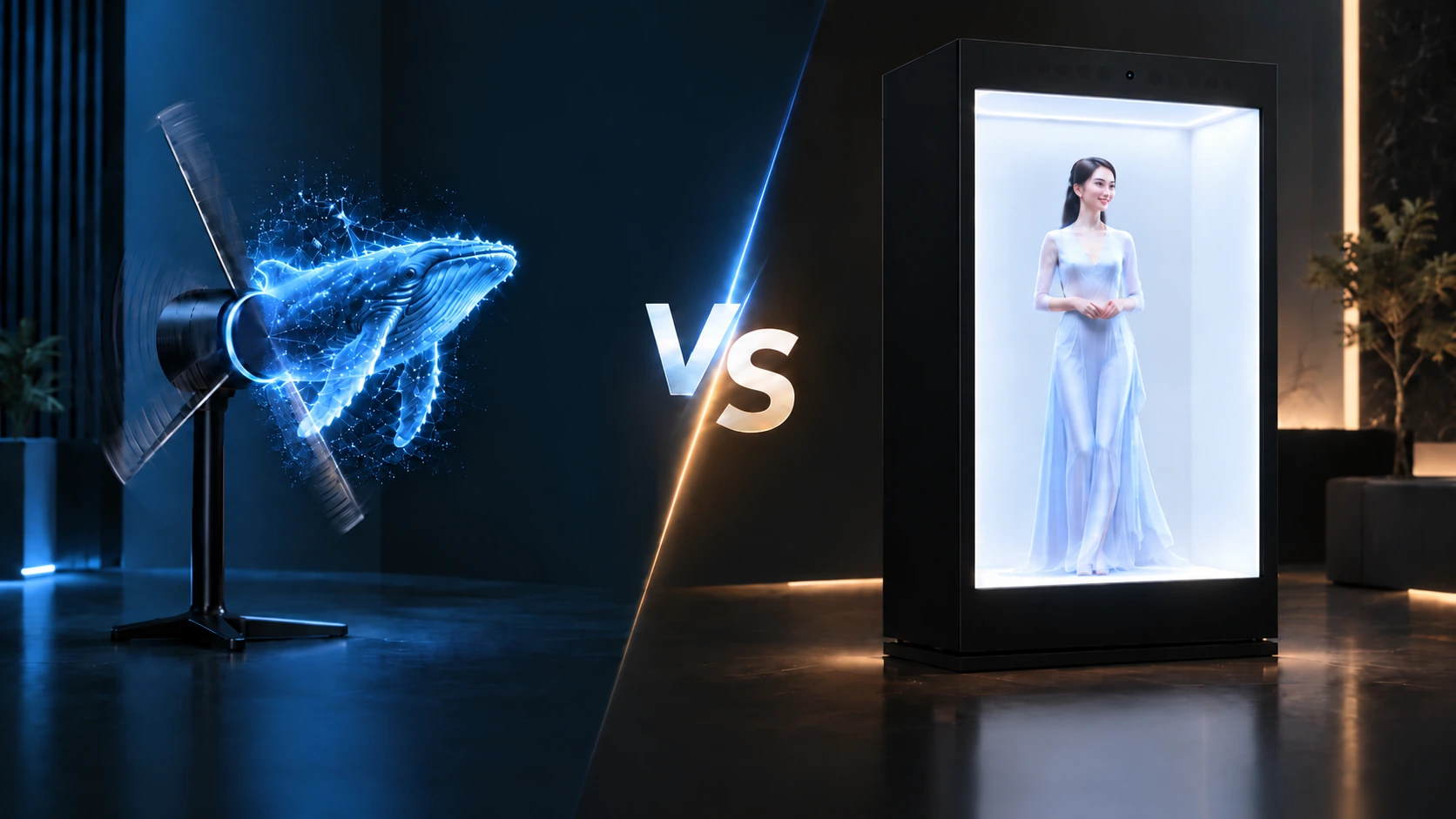
They may both be called holograms, but the technology, cost and real-world experience can be very different.
The word “hologram” is now used to describe several very different display technologies. Two of the most recognisable are hologram fans and enclosed holographic displays, often described more generally as hologram boxes or holoboxes.
At first glance, both are trying to achieve something similar. They make digital content appear to occupy physical space rather than simply sitting on a conventional television or LED screen.
But underneath the visual effect, the technologies are fundamentally different. They differ in how they create the image, how well they can be filmed, their operating noise, safety requirements, installation complexity and, perhaps surprisingly, their cost.
What Is a Hologram Fan?
A hologram fan uses rapidly rotating blades or rays fitted with LEDs. As the blades spin, the LEDs illuminate at precisely controlled positions. The movement happens quickly enough that the human visual system perceives the individual points of light as a continuous image, a technique commonly known as persistence of vision.
Against the right background, a logo, product, animation or person can appear to float in mid-air with little or no visible screen surrounding it. Professional installations can also combine numerous fan units together, synchronising the rotating displays to create one much larger visual surface.
It is an ingenious approach, but creating the illusion with rapidly rotating hardware introduces several practical considerations that are easy to overlook when judging the display only by what it looks like to the naked eye.
What Is a Hologram Box?
An enclosed holographic display takes a different approach. Rather than constructing the image using spinning LEDs, modern systems can use transparent display technology combined with carefully controlled lighting, contrast and specially prepared content to create the impression of depth.
This allows people, products and digital characters to appear inside the display while maintaining a holographic appearance. The term “hologram box” or “holobox” is often used informally to describe this wider category of enclosed holographic display.
So although hologram fans and hologram boxes can produce superficially similar effects, they achieve them in completely different ways. And that difference matters.
1. One of the Biggest Differences Is What Happens When You Take Out Your Phone
A hologram fan can look impressive to somebody standing directly in front of it. But take out a smartphone and start recording it and the result can look very different.
Instead of capturing the clean floating image visible to the human eye, a phone camera can record flickering, broken or fragmented images, visible rotating sections, bands across the image or incomplete portions of the hologram.
This is a camera sampling problem. The holographic image is being created by rapidly moving LEDs, while the camera is capturing a sequence of discrete exposures. The timing of the LEDs, the rotation of the blades, the camera frame rate, shutter speed and rolling-shutter readout can interact. When those timings do not align well, the camera may record flicker or banding that a person looking directly at the display does not see. The IEEE P2020 imaging work describes the same underlying LED sampling problem, where a pulsed LED source can appear constant to a human observer but flicker or produce banding when captured by a camera.
Professional filming can often compensate by changing shutter settings, exposure timing or display configuration. But that is very different from somebody walking through a shopping centre, seeing an installation, pulling out their phone and immediately pressing record.
Enclosed transparent-display systems do not rely on rapidly spinning LED blades, so the specific blade-rotation synchronisation problem does not apply. Like any digital display, they can still show camera artefacts under some settings, but they are generally much more straightforward for spontaneous smartphone filming.
Why Smartphone Filming Matters
For modern advertising, this is not a minor technical detail. A physical campaign now has two potential audiences: the people standing in front of it and the much larger audience that may see it online.
Someone sees something unusual, takes out their phone, films it and uploads it to TikTok, Instagram, YouTube, LinkedIn or another platform. Other people share it. A physical installation can therefore create reach far beyond the people who actually walked past it.
For experiential advertising and retail media, the ability to reproduce the effect naturally through an ordinary phone camera can therefore become part of the commercial performance of the display itself.
2. Hologram Fans Have Moving Parts
The visual effect produced by a hologram fan depends on physical components spinning at high speed. That creates another major difference: safety.
When the system is operating, the moving blades can become difficult to see. That is part of what makes the illusion effective, but it also means the public must be prevented from coming into contact with the rotating components.
For installations positioned well out of reach, this may be relatively straightforward. At human interaction height, however, the moving parts need to be appropriately guarded or otherwise made inaccessible. This principle is consistent with the UK Health and Safety Executive’s PUWER guidance on work equipment, which states that effective measures should be taken to prevent access to dangerous parts of machinery, normally through guarding or other protective measures.
For a life-size person, AI avatar or product positioned at eye level, that can mean putting the fan installation behind glass, Perspex or another protective enclosure.
3. Once You Put the Fan Behind Glass, Something Interesting Happens
One of the great visual advantages of a hologram fan is that there appears to be no screen. The content seems to float directly in open space.
But public safety can create something of a contradiction. If the rotating display needs to be placed behind glass or Perspex so people cannot reach it, the supposedly screenless hologram is now sitting inside an enclosure.
That does not mean the visual effect stops working. But it does begin to narrow one of the conceptual differences between a fan installation and an enclosed holographic display. The fan was attractive partly because there was no box. In many public applications, you may ultimately need to put it inside one.
4. Noise Is Another Important Difference
Rotating multiple pieces of hardware at high speed creates mechanical noise. With a small installation that may be manageable, but as multiple units are combined into a large display the cumulative sound can become more noticeable.
That matters differently depending on the environment. In a busy exhibition hall, operating noise may barely register. In a premium retail environment, hotel, museum, airport lounge, reception area or luxury shopping centre, persistent mechanical noise can be far more noticeable.
Protective enclosures can help contain sound, but they introduce additional hardware around what was originally intended to appear as an open-air display. Transparent-display holographic systems do not require an array of rapidly rotating blades to construct the image, removing that particular source of mechanical noise.
5. Hologram Fans Can Also Be Considerably More Expensive
There is a widespread assumption that hologram fans are the inexpensive option. That can be true at the consumer end of the market, where small generic LED fan products are widely available. But comparing one of those devices with a professional commercial holographic installation is not meaningful.
Large professional fan installations can involve numerous synchronised display units, controllers, mounting systems, power distribution, protective structures and supporting hardware.
In Miirage’s own like-for-like project comparisons, a professional fan-based installation of a similar physical display size has been estimated at roughly three times the cost of an enclosed holographic box solution. This is an internal project estimate rather than a universal market price, and actual quotes will vary according to size, configuration, supplier, installation and content requirements.
The important point is that the assumption that fan technology is automatically cheaper does not hold once the comparison moves from small consumer devices to large professional installations.
6. The Image Itself Is Different
There are applications where hologram fans look spectacular. Bright, high-contrast objects against dark backgrounds can work particularly well.
- Floating products
- Logos
- Planets and abstract objects
- Flames and visual effects
- Animated characters
- Short visual sequences
The open-air nature of the effect can make people stop and look.
Holographic boxes excel in a somewhat different area. High-resolution transparent displays are particularly well suited to realistic people, AI avatars, detailed products, presenters, branded characters, text, interactive interfaces and longer-form content.
This distinction becomes particularly obvious when the objective is to recreate a human being. Faces contain fine detail, and small differences in eyes, skin texture, mouth movement and resolution can be noticeable at close range. A high-resolution transparent display therefore lends itself naturally to applications where a digital person needs to look convincing from a short viewing distance.
7. Holographic AI Changes the Requirement Again
A holographic AI avatar is not simply a video playing repeatedly. The person standing in front of the display may need to ask a question, hear an answer, choose an option, request directions, change language, explore a product or interact with an interface.
That fundamentally changes the purpose of the installation. It is no longer simply an advertising visual. It becomes an interface between a person and a computer.
For this kind of application, a stable human-height enclosure can make considerably more sense than exposed rotating hardware. Miirage, for example, combines holographic display technology with holographic AI avatar assistants designed for customer service, product discovery, wayfinding and real-world interaction.
8. Installation Requirements Are Very Different
Large hologram fan systems can be highly modular. Multiple units can be combined into large walls, allowing installations substantially bigger than an individual fan. That is a genuine strength of the technology.
But additional units also mean additional hardware, power, synchronisation, mounting and safety considerations.
Enclosed holographic displays take a different approach. The display, computer, lighting system, speakers, cameras and other technology can be integrated into a single physical unit. That can simplify deployment in locations such as shopping centres, airports, retail stores, museums and corporate environments.
So Which Is Better?
There is no universal answer. Hologram fans have an important visual advantage. When properly installed and viewed directly by the human eye, they can create an impressive open-air effect in which digital objects appear to float with almost nothing physically surrounding them.
For abstract 3D content, spectacular logos and attention-grabbing visual installations, that can be extremely effective. For permanent commercial deployments, however, there are other factors to consider.
Hologram Fans
Advantages
- Impressive open-air visual effect
- Excellent for bright 3D objects and animations
- Modular systems can create very large installations
- Strong visual impact from a distance
- Can create unusual screenless-looking experiences
Considerations
- Rapidly rotating mechanical components
- Safety measures are required where moving parts could be reached
- Protective enclosures may be required
- Audible mechanical noise
- Smartphone filming can show flicker or banding without suitable settings
- Large professional installations can be expensive
- Multiple units may be required for human-scale displays
Hologram Boxes
Advantages
- High-resolution video
- Well suited to realistic humans and AI avatars
- No rapidly rotating image-producing blades
- Easier placement at human interaction height
- More straightforward spontaneous smartphone filming
- Integrated audio, cameras, touch and computing are possible
- Can be considerably more cost-effective at comparable professional display sizes
Considerations
- The display exists inside a visible physical structure
- It does not create the same completely open-air effect as an uncovered hologram fan
- Lighting, contrast and content preparation remain important to the final effect
It Depends on What You Want the Hologram to Do
Ultimately, hologram fans and holographic boxes should not necessarily be thought of as competing versions of exactly the same product. They have different strengths.
If the objective is to make a giant trainer appear to float above an exhibition stand, a hologram fan installation could be an excellent solution.
If the objective is to put a life-size multilingual AI assistant into a shopping centre where customers can walk up, speak to it, film it and share the experience online, an enclosed holographic display is likely to make considerably more sense.
The question is not simply, “Which hologram looks better?”
It is, “What does the hologram actually need to do?”
Where Miirage Fits
At Miirage, our focus is on holographic technology as a practical commercial platform rather than simply a visual novelty.
The Miirage Miracle uses a transparent 4K display with integrated computing and support for interactive content, live applications and holographic AI avatars. Miirage also develops interactive advertising displays designed for retail media, OOH campaigns and real-world brand experiences.
For retail, out-of-home advertising, airports, shopping centres and experiential environments, the future of holographic technology will increasingly be defined not simply by whether something appears to float. The more important questions will be whether people can interact with it, whether it works reliably in a public environment, whether it can be captured and shared online, whether it can operate at scale and whether the economics make sense.
Creating the illusion is only the first step. Making the technology commercially useful is the real challenge.
Frequently Asked Questions
What is the difference between a hologram fan and a hologram box?
A hologram fan creates an image using rapidly rotating LED-equipped blades. A hologram box typically creates the effect using transparent display technology, controlled lighting and specially prepared content. The two can create similar-looking holographic effects but use fundamentally different technology.
Can you film a hologram fan with a phone?
Yes, but the result depends on the relationship between the moving LEDs and the camera’s exposure timing, frame rate and shutter readout. Without suitable settings, footage can show flicker, bands or fragmented images. The underlying reason is the same temporal sampling problem described in IEEE research into LED flicker and digital cameras.
Are hologram fans dangerous?
They contain rapidly rotating components, so those components should not be accessible to the public. Depending on the installation, this can mean positioning the display out of reach or using a suitable guard or enclosure. The UK HSE advises preventing access to dangerous moving machinery parts through appropriate protective measures.
Are hologram fans noisy?
They generate mechanical sound because the image is created using rotating hardware. The amount of noise varies with the equipment, number of units, mounting and enclosure. For larger multi-unit installations, noise can become a more important consideration in quieter public environments.
Are hologram fans cheaper than hologram boxes?
Not necessarily. Small consumer fans can be inexpensive, but professional multi-unit installations are a different category. In Miirage’s own like-for-like project comparisons, a fan-based installation of similar physical size has been estimated at roughly three times the cost of an enclosed holographic display. Actual pricing varies by project.
Which type of hologram is better for advertising?
It depends on the campaign. Hologram fans can produce striking open-air effects, particularly for floating products, logos and abstract animation. Enclosed holographic displays are particularly useful when realistic people, interactive AI, close-range viewing, spontaneous smartphone filming, quieter operation or long-term public installation are important.
The best holographic technology is not simply the one that looks most impressive. It is the one that works best for the experience, environment and audience it was designed for.Further Reading
- IEEE Standards Association: P2020 Automotive Imaging White Paper and LED Flicker
- ENTTEC: Why LEDs Flicker on Camera, PWM vs Shutter Speed
- UK Health and Safety Executive: PUWER and Guarding Dangerous Machinery Parts
- Miirage: Holographic AI Avatar Assistants
- Miirage: Interactive Holographic Advertising Displays