Why Miirage Delivers the World's Best Holographic Presence
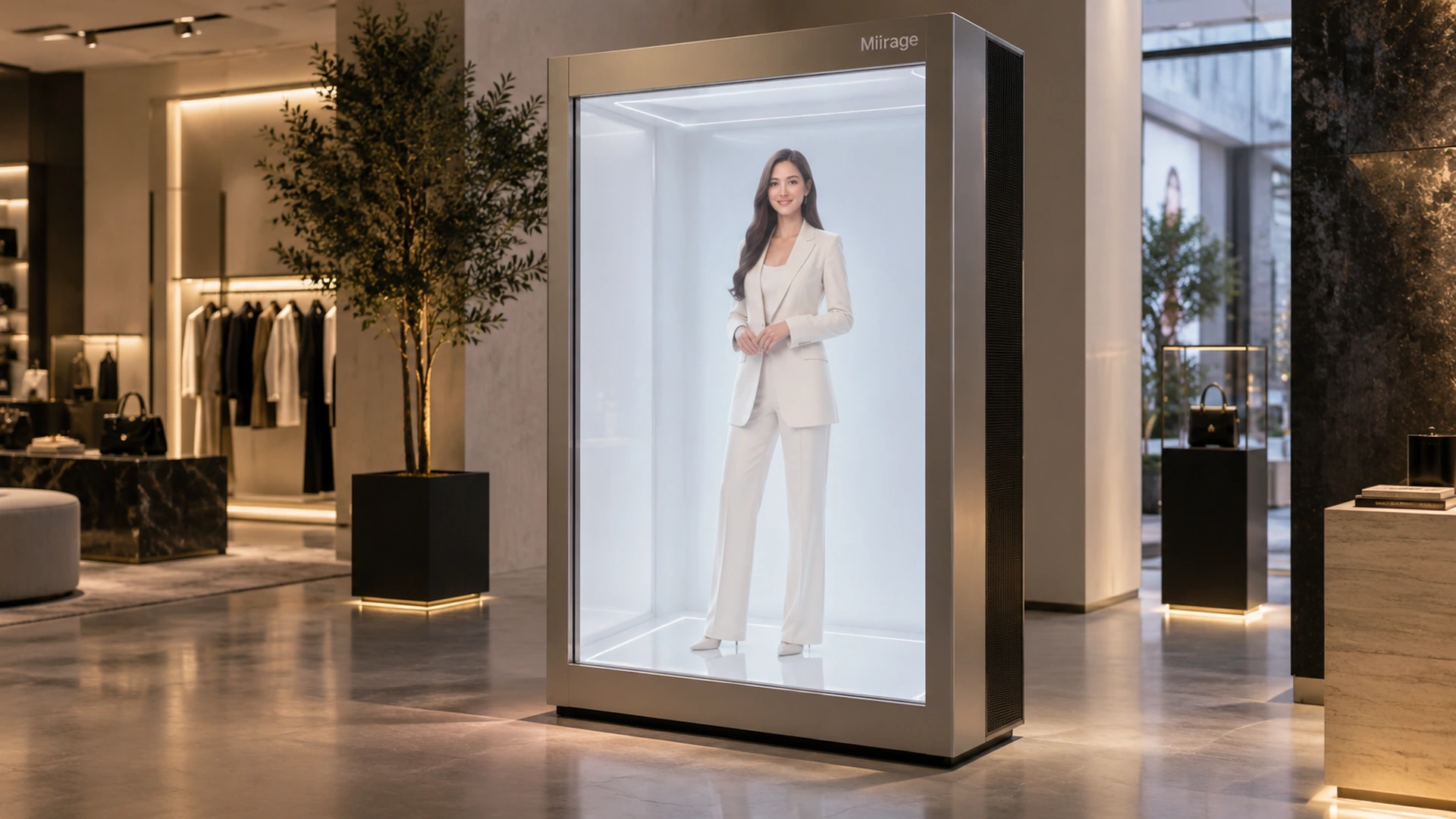
For Miirage, the ultimate holographic display is not the one that makes people notice the technology. It is the one that makes them forget it is there.
Miirage is built around a simple belief: today, we deliver the most convincing holographic presence available anywhere in the world.
We do not see that as a future target. It is the standard we believe Miirage delivers now. Our job is to protect that position and keep extending it. That belief affects almost everything we do, from the technology we choose and the physical dimensions of our displays to the way we light the interior, create shadows and reflections, film people, animate digital characters and decide how much physical space the hologram should occupy.
Because for Miirage, the objective has never simply been to build an impressive piece of technology. The objective is to make the technology disappear.
When somebody stands in front of a Miirage hologram, we want them to stop thinking about the screen, the enclosure or the engineering behind it. We want them to look at the person, product, character or object appearing in front of them and engage with that instead.
For those few moments, the technology should become irrelevant. That is what we mean by holographic presence.
The best technology is sometimes the technology you stop noticing
Technology companies naturally talk about specifications. Resolution. Brightness. Processing power. Screen size. Connectivity.
All of those things matter, but audiences do not experience specifications. They experience what those specifications create.
Nobody walks away from an extraordinary live experience talking about the type of processor running the installation. They remember what they saw, how it made them feel and whether the experience was worth stopping for.
That idea sits at the heart of Miirage because our founding partners came from events, live experiences and audience engagement. We understand environments where brands have seconds to attract attention. We understand that getting somebody to stop is different from getting them to engage, and getting them to engage is different again from creating something they will actually remember.
There is strong evidence that physical experiences matter. Freeman research conducted with The Harris Poll found that 95% of attendees trusted brands more after participating in an in-person event. It also found that 92% of working professionals said live events had a positive impact on their perception of brands, while 87% visited the brand's website and expressed a desire to engage further after attending an event.
For us, that is important because a hologram is not just a new type of screen. Done properly, it is an experience.
What is holographic presence?
Holographic presence is difficult to describe until you experience it. It is the moment when an image stops feeling like content being displayed and starts feeling as though it occupies the physical space in front of you.
Resolution contributes to that. Depth contributes to it. Scale contributes to it. Movement contributes to it. Lighting, shadows, reflections and the physical dimensions of the environment contribute to it. The content itself contributes enormously.
None of those elements works in isolation.
The human visual system combines multiple signals to understand three-dimensional space. Research into depth perception shows that cues can include binocular disparity, perspective, texture, motion parallax, accommodation and convergence. A peer-reviewed study in Virtual Reality describes how environmental context and the availability of these depth cues influence perceived distance.
The brain is not simply asking whether an image looks good. It is continuously interpreting whether what it sees makes sense.
Holograms can change how content is experienced
There is also emerging research suggesting that holographic presentation can affect audience immersion.
A peer-reviewed study published in npj Heritage Science in August 2026 compared holographic displays with photographs and 3D-printed objects in a simulated museum environment.
The researchers monitored 24 adults aged between 18 and 55, combining questionnaires with EEG measurements. Participants reported significantly higher subjective immersion when viewing the holographic presentations than when viewing photographs or 3D-printed objects.
The researchers correctly cautioned that the results should not be treated as causal proof. Even so, the findings demonstrate that the format through which information is presented can alter the way an audience experiences it.
That is exactly the opportunity we see. But not all holographic experiences are equal.
For Miirage, creating a convincing hologram comes down to three major elements working together: image quality, physical depth and content.
1. Image quality has to survive close inspection
Miirage uses a high-resolution 4K transparent LCD display.
The International Telecommunication Union defines 4K UHD as 3840 x 2160 pixels. That means more than 8.29 million pixels are being used to construct the image. Standard Full HD at 1920 x 1080 contains about 2.07 million pixels, so 4K UHD contains four times as many pixels.
That matters enormously with holographic content because a Miirage hologram invites people towards it.
Someone may first notice the display from several metres away, then approach it until they are eventually standing within a metre of the image. With an interactive AI avatar, that proximity becomes even more important. You are effectively asking somebody to stand close to a digital human and have a conversation.
At that distance, weaknesses become visible quickly. Poor edges, compression, soft facial features, bad hair detail, weak keying, unnatural skin and low-resolution textures all remind the brain that it is looking at an image.
We want the opposite.
As you approach a Miirage hologram, we want the image to continue to feel sharp, detailed and convincing. Getting closer should reveal more detail, not reveal the trick.
2. Physical depth is not wasted space
This is an area where Miirage deliberately takes a slightly different approach.
Across consumer technology, we have been trained to believe that thinner automatically means better. Thinner televisions. Thinner phones. Thinner laptops. Thinner displays.
That philosophy makes perfect sense when the objective is to create a conventional screen. It does not necessarily make sense when the objective is to convince the human brain that a three-dimensional person occupies the space in front of you.
Miirage deliberately places significant importance on the physical depth of the display.
Because depth is not simply empty space inside the enclosure. Depth is part of the illusion.
You can simulate depth, but you cannot fake everything
There are technologies available today that can create the impression of considerable depth inside a relatively shallow physical space.
Some of those effects are extremely clever. Some look fantastic. Perspective, reflections, lighting, animation and other visual techniques can all create powerful impressions of three-dimensional depth.
But we believe there is a limit to how much should be simulated, particularly when you are displaying a human being.
Imagine looking at a life-sized person apparently standing inside a space that you instinctively know is too shallow to contain a real person.
Something does not quite add up.
You may never consciously measure the enclosure. You may not even understand why the illusion feels slightly wrong. But your brain has spent your entire life learning approximately how much physical space another human occupies.
You understand the width of shoulders. You understand the distance between somebody's chest and their back. You understand how far an elbow travels when a person gestures. You understand that someone turning sideways requires physical space. You understand that clothing has volume. You understand that a person has a front, a middle and a back.
So when we place a full-sized human figure inside a Miirage display, we believe there should be enough physical space there for the proposition to make sense.
The hologram does not literally occupy that volume. But the volume should be believable.
The content says one thing. The physical space cannot say another.
This is where holographic presence can either become stronger or begin to break down.
The content is telling your brain: there is a person standing here.
If the physical enclosure simultaneously tells your brain: a person could never physically fit inside this space, those two pieces of information begin competing with each other.
Vision science provides useful context for why this matters. Human depth perception is constructed from multiple visual and physiological signals rather than one single cue.
A 2024 peer-reviewed study published in IEEE Transactions on Visualization and Computer Graphics examined the vergence-accommodation conflict found in immersive displays. When researchers modified visual stimuli to reduce the conflict, two user studies recorded statistically significant 36% and 48% reductions in distance-estimation error.
That research was conducted using immersive head-mounted displays, not Miirage hardware, so it should not be treated as a direct performance claim about our displays. But it illustrates a broader and important principle: conflicting depth signals can materially affect how accurately people perceive space.
Depth is not just something we see. It is something our visual system interprets.
Real space creates a believable possibility
This is why we do not simply ask: How thin can we make the display?
We ask: How convincing can we make the hologram?
Those questions can lead to very different design decisions.
If making an enclosure slightly deeper means that a life-sized human figure feels more believable within it, then that additional physical depth has value.
We are not trying to convince an engineering drawing. We are trying to convince a human being.
The space needs to feel possible.
3. The content can make or break the hologram
You can have outstanding hardware and still create a terrible hologram.
This is perhaps one of the most misunderstood parts of the industry. Holographic content is not simply normal video placed onto a transparent screen.
The way somebody stands matters. Their scale matters. Their position matters. Their eyeline matters. Their lighting matters. The softness of their shadows matters. The reflections beneath them matter. Their clothing matters. Their movement matters. The way their feet meet the perceived floor matters. The camera height and camera angle matter.
With animation, materials, rendering, perspective, motion, lighting, compositing and environmental interaction all become part of the illusion.
A mistake in any one of those areas can remind the audience that they are looking at a screen. Several things done correctly at the same time can make them forget.
Content expertise is part of the technology
This is one of the reasons Miirage approaches holograms differently.
Miirage's founder comes from a multidisciplinary creative background spanning film, animation, 3D, design and interactive media, having previously owned and operated creative studios internationally that worked regularly with some of the world's largest companies.
That experience matters because creating exceptional holographic content sits somewhere between filmmaking, visual effects, 3D animation, lighting design, product design, engineering and live experience.
A great filmmaker understands cameras and lighting. A great 3D artist understands materials, animation and rendering. A great engineer understands hardware. A great experiential team understands audiences. A great interaction designer understands behaviour.
Creating convincing holographic presence requires elements from all of them.
That combination is one of the reasons we believe Miirage currently delivers a level of holographic presence that no other comparable solution on the market matches.
A hologram should not look like a video on a transparent television
This distinction is fundamental.
Putting content onto a transparent display does not automatically make that content holographic. It makes it visible.
But visibility is not presence.
Presence comes from making the content feel connected to the physical space around it.
If we display a human being, we want that person to feel like they occupy the environment. If we display a product, we want it to feel like an object rather than a product video.
If we create a holographic AI avatar, we do not ultimately want somebody thinking, "I'm talking to an AI avatar running inside a holographic display."
We want them talking.
We want the conversation itself to take over.
Because the moment somebody stops thinking about how the technology works is the moment the technology is working at its best.
Sometimes making the hardware disappear means making the physical product deeper
This sounds contradictory, but it is an important part of the Miirage philosophy.
Making a holographic display physically thinner does not necessarily make the technology less noticeable.
If reducing its depth weakens the illusion, the viewer may actually become more aware that they are looking at a technological trick.
A deeper physical environment can sometimes allow the content to feel more natural. The more natural the content feels, the less attention the viewer pays to the technology creating it.
So our objective is not to physically minimise everything.
Our objective is to perceptually minimise the technology.
There is a difference.
The smallest details make some of the biggest differences
At this stage of Miirage's development, we are not expecting one breakthrough to suddenly make our holographic illusion 50% better overnight.
Instead, we obsess over marginal gains.
A slightly better shadow. A more convincing reflection. A small improvement in lighting. A tiny adjustment in contrast. A better camera angle. A slightly different position inside the enclosure. An improvement in skin rendering. More natural movement. Better colour. A stronger relationship between the feet and the floor. An adjustment to the physical depth. A small improvement in the way the interior absorbs or reflects light.
Individually, some of those changes might improve the experience by only a fraction.
That does not make them unimportant.
If you improve ten different elements by 1%, you begin creating a very different overall experience.
And then you start again.
That is how we approach product development. Not because we believe Miirage is still trying to catch the market, but because maintaining what we believe is the world's best holographic presence requires constant improvement. We look every day for another small gain that makes the illusion even stronger.
The goal is not perfection. The goal is disappearance.
No holographic display is literally placing a human being inside a box. There is an illusion taking place.
The challenge is deciding how many reminders of that illusion you allow the viewer to see.
Every poor edge is a reminder. Every strange shadow is a reminder. Every unrealistic movement is a reminder. Every incorrect proportion is a reminder. Every visual contradiction is a reminder.
Every time the brain notices one of those things, attention moves away from the person or object and back towards the technology.
Our job is to eliminate as many of those reminders as possible, one by one.
Why we believe Miirage delivers the world's best holographic presence today
There is no universally recognised independent benchmark that tests every holographic product in the world against the same criteria, so no manufacturer can point to a single global test that settles the question.
But Miirage's position is clear: we believe our displays currently deliver the strongest holographic presence of any comparable solution available on the market worldwide.
That belief is not based on one specification. We are not claiming leadership because we have the thinnest enclosure, the longest feature list or the most complicated technology.
We believe Miirage is the best because the entire system is designed around one outcome: making the holographic illusion as convincing as possible.
We combine more than 8.29 million pixels of 4K image resolution with genuine physical depth, carefully designed internal environments and content created specifically for holographic presentation.
We combine engineering with filmmaking. We combine animation with experiential design. We combine hardware with content. We combine technology with an understanding of how audiences actually behave.
That combination is what we believe puts Miirage at the front of the market today.
And then we keep refining it, because being the best today does not mean standing still tomorrow.
Because ultimately, the greatest compliment somebody can give a Miirage hologram is not: "That's an impressive screen."
It is not even: "That's impressive technology."
The goal is that they stop thinking about the screen altogether.
They look at the person. They look at the product. They listen. They respond. They interact.
And for a moment, they simply accept that what they are seeing is there.
That is holographic presence. We believe Miirage delivers it better than any other comparable holographic display in the world today, and we are working every day to make that lead even stronger.Further Reading
- npj Heritage Science: Quantifying audience perceptions of holographic displays in museums using EEG
- Freeman: 2025 Freeman Trust Report
- IEEE / PubMed: Improving Depth Perception in Immersive Media Devices by Addressing Vergence-Accommodation Conflict
- Virtual Reality: Contributions of pictorial and binocular cues to the perception of distance
- ITU: 4K UHD definition and imaging framework