Boston Logan's AI Hologram Assistants Show the Future of Airport Wayfinding
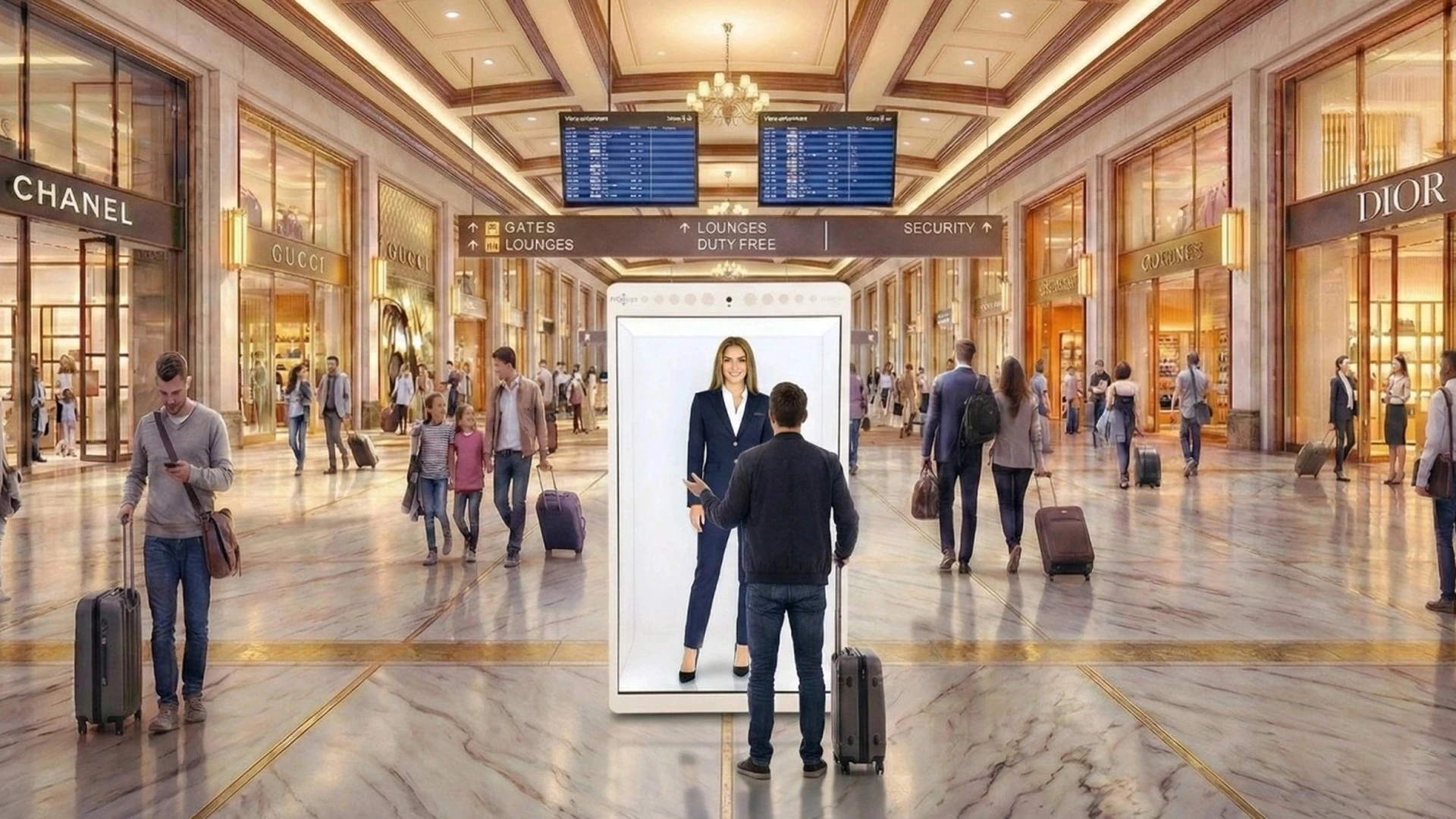
The airport information kiosk is becoming a person you can talk to
Walk into an airport in a few years' time and the person helping you find your gate might not actually be a person.
That future has already started arriving. Boston Logan International Airport has introduced Amelia, a life-size AI hologram passenger assistant designed to answer questions, provide directions and help travelers navigate the airport through natural conversation.
The important part is not that Amelia looks futuristic. It is that she is useful. According to WHDH 7News, Amelia is available at nine locations across Boston Logan's four terminals and can help passengers navigate hundreds of airport points of interest in multiple languages. Passenger Terminal Today reports that the system can provide step-by-step directions, live mapping, real-time TSA wait-time information, multilingual support and access to live customer-service agents when needed.
That makes the Boston Logan AI hologram story much bigger than another unusual display installation. It is evidence that airport AI assistants, holographic wayfinding and conversational digital humans are beginning to move from demonstrations into operational passenger environments.
Boston Logan is a serious test for AI airport wayfinding
Boston Logan is not a small proving ground. Massport's 2025 Annual Comprehensive Financial Report states that the airport handled approximately 43.9 million passengers in fiscal year 2025, including about 10 million international passengers.
At that scale, even apparently simple questions become a major operational challenge. Where is my gate? How long is the security queue? Where is baggage claim? Which terminal do I need? Where can I eat? Is there a lounge nearby? How do I get to ground transportation?
An AI airport wayfinding assistant can turn those questions into a conversation rather than forcing passengers to interpret a static map, search through a touchscreen directory or download another app.
That change matters. The interface is no longer a menu. The interface is language.
The airport information kiosk is evolving into a conversational assistant
Airports have spent decades digitising passenger information. Flight information displays became digital. Printed maps became interactive directories. Mobile apps added gate information and push notifications. QR codes spread through terminals.
But most of those systems still make the passenger learn the interface first.
A holographic airport assistant reverses the relationship. Instead of learning where information is stored, passengers can simply ask for it.
"Where is Gate C34?"
"How long will it take me to get there?"
"Where can I get coffee on the way?"
"Can you explain that in Spanish?"
This is why the idea of the AI avatar airport assistant is potentially much more important than the novelty of a hologram. A conversational digital human gives passengers a familiar way to interact with an increasingly complex information environment.
Boston is not the only airport moving in this direction
The Logan Airport hologram deployment follows a wider shift in aviation.
In May 2026, LaGuardia Terminal B launched an interactive AI guest experience hologram called Bridget. Passenger Terminal Today reported that passengers can ask the assistant for live directions to gates, shops, lounges and baggage claim. The system also supports live mapping, multilingual communication, closed captioning and wheelchair-accessible controls.
In April 2026, Miami International Airport announced four AI-powered hologram chatbots positioned at key airport entry points, bringing conversational assistance into another major US airport.
LaGuardia's deployment uses Proto Hologram hardware with Holomedia AI's concierge and wayfinding software. The Boston Logan pilot was also created through a partnership involving Massport, Proto Hologram and Holomedia AI, according to the project announcement distributed by GlobeNewswire.
That is relevant for people specifically searching for Proto Hologram Logan Airport, but the bigger story is the category itself. Airports are beginning to test whether a life-size digital human airport assistant can become a practical layer of passenger infrastructure.
From hologram spectacle to AI infrastructure
Holographic displays have appeared in airports before. They have been used for entertainment, destination marketing, advertising, celebrity appearances and prerecorded welcome messages.
What is changing is the intelligence behind the image.
Once a holographic display becomes conversational, its role changes dramatically. The question is no longer simply, what can we show on this display?
The more valuable question becomes, what can a passenger do with it?
That opens the door to wayfinding, multilingual guidance, live airport information, retail discovery, accessibility support, customer service, tourism information, airline assistance and interactive advertising.
In other words, AI hologram airport technology can evolve from visual spectacle into useful infrastructure.
Why airports are almost perfect environments for holographic AI
Airports combine many of the conditions that make a holographic concierge compelling. They are large, complex, multilingual, high-footfall environments where people frequently need information immediately.
Passenger volumes also continue to grow. Airports Council International World forecasts global airport passenger traffic will reach 10.2 billion passengers in 2026 and approximately 18.8 billion by 2045.
That means airports face a dual challenge. They must process more people through increasingly sophisticated environments while maintaining a passenger experience that still feels understandable and human.
A visible, conversational multilingual airport assistant could help bridge that gap.
Wayfinding could be only the beginning
Suppose a passenger asks, "Where is Gate 21?" An AI passenger assistant provides directions. Simple.
But suppose the passenger instead asks, "I've got two hours before my flight. Where can I eat?"
Now the interaction becomes commercially relevant.
The assistant could potentially explain which restaurants are nearby, which options are on the route to the gate, how long the walk will take and where the passenger can find particular types of food.
The same logic applies to duty-free, electronics, lounges, airport services, tourism offers and retail.
That starts to blur the boundary between airport wayfinding, customer service, retail discovery and airport advertising.
For airports, retailers and media owners, that combination could be particularly powerful. A touchpoint that solves a passenger problem can also create a relevant commercial opportunity without forcing advertising into the experience.
From airport digital signage to conversational airport media
Traditional airport digital signage largely works in one direction. A brand displays an advert and passengers see it.
Holographic AI introduces interaction.
A tourism board could present a life-size destination ambassador and then allow arriving passengers to ask questions. A technology company could introduce a product through holographic content and switch into an AI product specialist. An airline could create a branded assistant for baggage policies, lounge locations and connections. A retailer could use a holographic AI brand ambassador to answer questions and direct passengers towards a store.
The display is no longer simply showing media. It can become part of the customer journey.
That is also why Miirage sees strong potential in combining holographic airport advertising with AI wayfinding assistants. The same physical format can potentially create attention when passive and provide useful assistance when a passenger chooses to engage.
AI holograms do not need to replace airport staff
The strongest case for airport AI is not a simple staff-replacement argument.
Passengers will still need experienced people when flights are cancelled, connections are missed, bags disappear or a situation requires judgement, empathy and authority.
The more compelling role for an AI passenger assistant is handling high-volume, repeatable questions while helping human teams focus on more complicated situations.
LaGuardia explicitly positioned its holographic ambassador as a complement to its existing human Guest Experience Ambassadors. Boston's system can also connect passengers to live customer-service agents when necessary.
That distinction matters. The future airport is unlikely to be entirely automated. It is much more likely to combine human hospitality with intelligent digital assistance.
Multilingual AI could become one of the strongest airport use cases
Language may ultimately prove to be one of the clearest arguments for holographic AI in international airports.
Passenger Terminal Today reports that Boston Logan's system can support up to 40 languages, with English, Spanish and French included initially. LaGuardia launched with English and Spanish, with further languages planned.
For global hubs receiving millions of international travelers, the potential is obvious.
A physical AI avatar airport assistant could welcome a passenger, recognise the language being spoken and continue the conversation naturally. That can make the technology more than a novelty. It can become an accessibility and inclusion tool for people navigating an unfamiliar airport in an unfamiliar country.
Where Miirage sees the opportunity
At Miirage, we believe holographic displays become considerably more valuable when the technology goes beyond the visual effect.
A life-size digital human attracts attention because it is unusual. An intelligent life-size digital human creates utility.
Miirage holographic AI avatar assistants combine branded digital humans with controlled conversational AI, multilingual communication and physical holographic presence. In airports, that can support wayfinding, FAQs, passenger guidance, product discovery, brand engagement and other customer-service journeys.
For an airport, the display could provide assistance. For a retailer, it could support customer service. For a media owner, it could create premium interactive advertising inventory.
And because those roles are not mutually exclusive, the same deployment can potentially become more valuable over time.
Miirage has previously explored why airports are particularly strong environments for holographic advertising. The rise of conversational AI adds another layer. The technology is no longer only competing for attention. It can now help people do something once that attention has been won.
Airport advertising could become genuinely interactive
Airports are already premium advertising environments. Passengers encounter airlines, travel retail, food and beverage, financial services, tourism campaigns, telecoms and luxury brands throughout their journey.
Holographic displays introduce a visually distinctive format into that environment. AI introduces conversation.
Bring the two together and hologram advertising in airports can move from impression to interaction.
Instead of simply seeing an advertisement for a car, a traveler could potentially ask the holographic brand ambassador questions about it. Instead of seeing a tourism campaign, they could ask what to do when they arrive. Instead of seeing an advert for a product, they could ask where it is sold inside the terminal.
This does not replace traditional airport media. It adds another layer to it.
For locations that adopt advertising-funded models, holographic technology could potentially become a revenue-generating asset as well as a passenger-service interface.
The real significance of the Boston Logan AI holograms
It would be easy to look at Amelia and focus on the novelty. A life-size AI hologram in an airport still feels futuristic.
But that misses what is actually important.
Boston Logan is testing the technology across multiple locations in all four terminals. LaGuardia is developing a similar model. Miami has introduced its own holographic AI system. The conversation is moving quickly from can this work? to what should we use it for?
Wayfinding is an obvious starting point. Multilingual customer service follows. Then accessibility, retail discovery, tourism, advertising, brand engagement and passenger communications.
The hologram itself may be what attracts someone's attention. The intelligence behind it is what could make the technology useful enough to become part of everyday travel.
And that is why the next major transformation in airport technology might not be another app or another touchscreen. It might simply be someone you can walk up to and talk to, even if that someone is digital.
The airport information kiosk is not disappearing. It is becoming conversational.Frequently asked questions
What is the AI hologram at Boston Logan Airport?
Boston Logan International Airport has introduced Amelia, a life-size AI avatar concierge available at nine locations across the airport's four terminals. It can help travelers with directions, airport points of interest, TSA wait times and multilingual passenger assistance.
Who makes the holograms at Boston Logan Airport?
The Boston Logan pilot was created through a partnership involving the Massachusetts Port Authority, Proto Hologram and Holomedia AI. The system combines holographic display technology with conversational AI, live mapping and wayfinding functionality.
Are AI holograms being used at other airports?
Yes. LaGuardia Terminal B launched an interactive AI holographic guest experience ambassador in 2026, and Miami International Airport introduced AI-powered hologram chatbots at key airport entry points.
How can holographic AI help airport passengers?
A holographic airport assistant can support wayfinding, multilingual guidance, airport information, retail discovery, accessibility features, customer service and handoff to human staff.
Can AI holograms replace airport information desks?
They are better viewed as complementary technology. AI can handle repetitive information requests and provide support during busy periods or outside normal staffing hours, while human employees remain essential for complex situations.
Can holographic displays be used for airport advertising?
Yes. Holographic displays can support advertising, brand experiences and AI assistance. Combining holographic content with conversational AI can turn a display into an interactive product discovery, wayfinding or customer-service touchpoint.
Further Reading
- Passenger Terminal Today: Boston Logan deploys Amelia AI hologram for passenger wayfinding
- WHDH 7News: Meet Amelia, the AI hologram helping travelers navigate Logan Airport
- Passenger Terminal Today: AI guest experience holograms deployed in LaGuardia Terminal B
- Miami International Airport: AI-powered airport hologram chatbots
- Airports Council International World: Global airport traffic forecasts for 2026 and beyond
- Massport: 2025 Annual Comprehensive Financial Report