AI Just Became 100 Times Cheaper
What does that mean for the physical world?
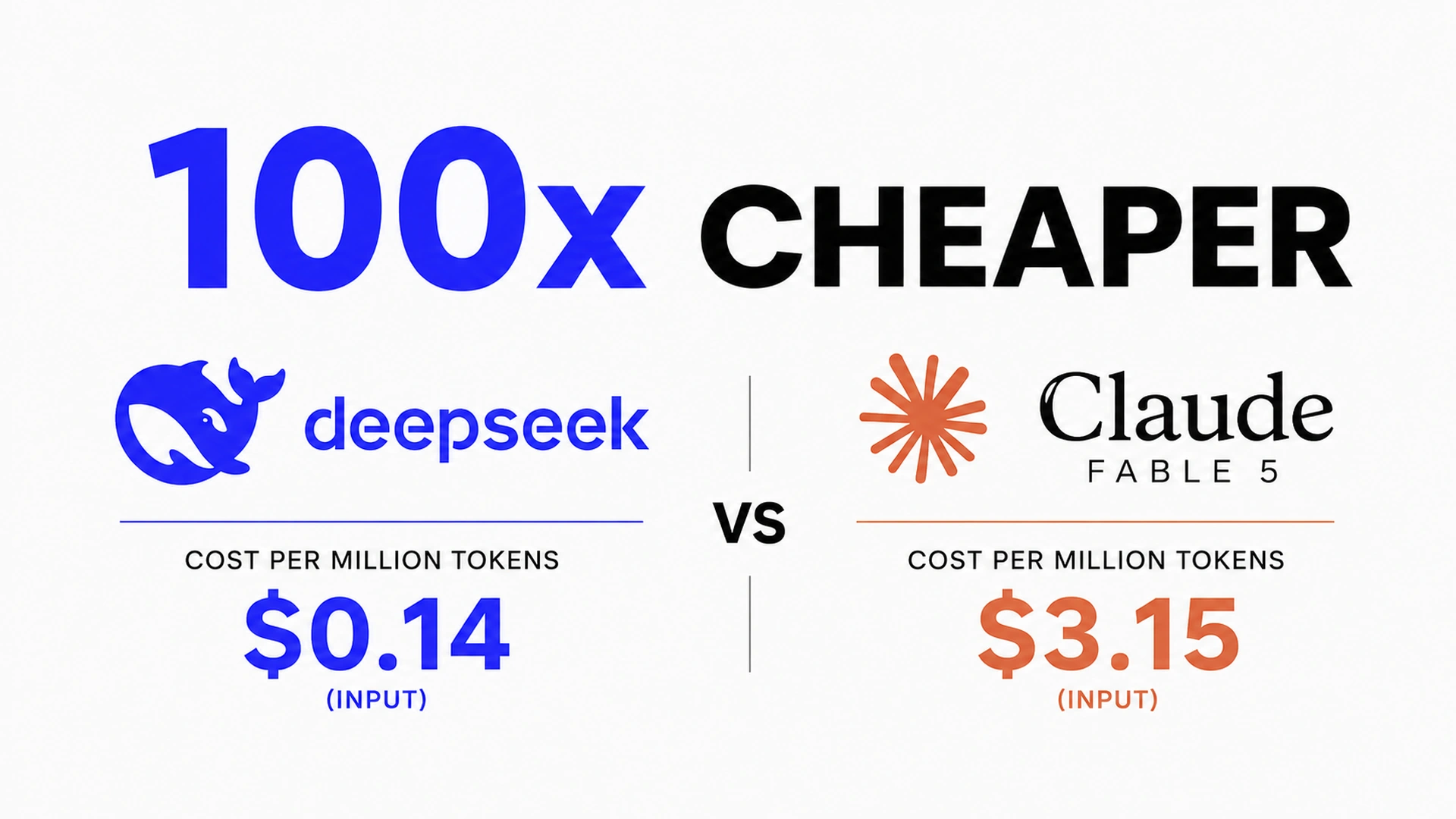
$0.03 vs $3.15
Estimated average benchmark cost: DeepSeek V4-Flash vs Claude Fable 5
AI Just Became
100 Times Cheaper
$0.03 vs $3.15
For years, the conversation around artificial intelligence has focused on a single question: How intelligent can it become?
The next phase may be defined by a different question: How cheaply can that intelligence be delivered—everywhere?
In August 2026, Chinese AI company DeepSeek provided a striking answer. Independent analysis of its V4-Flash model found that it cost approximately $0.03 to complete an average benchmark test, compared with $3.15 for Anthropic’s Claude Fable 5. On that measure, DeepSeek was approximately 105 times cheaper.
That does not mean DeepSeek is 105 times better, or even more capable overall. It means the cost of completing useful AI work is falling dramatically—and that could prove just as consequential as the race to build the most powerful model.
For businesses, the implications extend far beyond chatbots and software. When capable AI becomes inexpensive enough to deploy at scale, it can move out of laptops and phones and into stores, shopping centres, airports, hotels, museums, stadiums and public spaces.
AI is about to become part of the physical world.
The figures behind the headline
According to research reported by Reuters, DeepSeek V4-Flash was priced at $0.14 per million input tokens and $0.28 per million output tokens at launch. Artificial Analysis estimated an average cost of three cents per completed benchmark test. The equivalent estimated costs were:
- $0.86 for Moonshot AI’s Kimi K3
- $1.86 for OpenAI’s GPT-5.6 Sol
- $3.15 for Anthropic’s Claude Fable 5
The comparison matters because token prices do not tell the whole story. An inexpensive model can become costly if it needs significantly more reasoning, more attempts or more generated text to complete a task. Cost per completed task is therefore a much more useful commercial measure.
DeepSeek’s advantage remained extraordinary: approximately 29 times cheaper than Kimi K3, 62 times cheaper than GPT-5.6 Sol and 105 times cheaper than Claude Fable 5 on the tests examined.
There is, however, an important qualification. DeepSeek V4-Flash scored 50 out of 100 on Artificial Analysis’s Intelligence Index. That placed it alongside Google’s Gemini 3.6 Flash, but behind the leading Anthropic and OpenAI models, which scored at least nine points higher.
DeepSeek subsequently introduced the more capable V4 Pro and announced higher API prices for both V4 models. The precise price gap will therefore continue to change. But the wider direction is unmistakable: competition is driving down the cost of capable AI, and businesses now have a much broader range of price-to-performance options.
The most powerful model is not always the right model
Much of the AI industry is organised around leaderboards. Models compete on advanced mathematics, software engineering, scientific reasoning and autonomous tool use. Those capabilities matter—but most customer conversations do not require frontier-level reasoning.
A customer standing in a shopping centre may want to know:
- Where is a particular store?
- What time does the centre close?
- Is this product available in another colour?
- Which restaurant offers vegetarian food?
- How do I join the loyalty programme?
- Can I speak to someone in Arabic, Spanish or Mandarin?
These are valuable interactions, but they are usually bounded, repeatable and grounded in approved information. Using the world’s most expensive reasoning model for every exchange can be like sending a Formula One car to deliver a parcel: technically impressive, but commercially unnecessary.
The future is unlikely to belong to one AI model. Intelligent systems will select the most appropriate model for each task. A fast, economical model can handle routine enquiries. More complex requests can be routed to a higher-capability model. Sensitive or exceptional conversations can be escalated to a human.
This approach—sometimes called model routing—allows businesses to balance intelligence, speed, reliability and cost rather than paying a premium for every interaction.
From isolated pilots to entire estates
The economics become particularly important when AI moves into physical locations.
A retailer testing one AI assistant can tolerate relatively high usage costs. A multinational business deploying assistants across 500 locations faces a different calculation. If each location handles hundreds of conversations every day, even small differences in the cost of an interaction compound rapidly.
Consider a network of 1,000 AI assistants, each conducting 200 conversations per day. That is:
- 200,000 conversations every day
- Approximately 6 million conversations per month
- More than 73 million conversations per year
This is an illustrative scenario, not a prediction of DeepSeek or Claude costs. Actual expenditure would depend on conversation length, voice processing, system architecture, caching and the models selected. But it demonstrates why lower inference costs matter: a saving of only one cent per conversation becomes approximately $730,000 per year at that scale.
The AI price war can therefore change what businesses are willing to build. Projects that once made sense only as flagship installations can become viable across complete retail, hospitality or transport networks.
Intelligence still needs an interface
Cheaper AI does not automatically create a better customer experience.
Most AI remains trapped behind a search box or chat window. It may be capable, but in a physical environment it is often invisible. Customers must notice a kiosk, understand what it does, approach it and choose to interact.
This is where holographic AI becomes significant.
Miirage gives digital intelligence a physical presence. Instead of asking customers to engage with another flat screen, a Miirage holographic AI avatar can appear as a life-sized branded representative: visible from a distance, capable of attracting attention and ready to begin a natural spoken conversation.
The same installation can move between several roles:
- A high-impact holographic advertisement
- A multilingual customer-service assistant
- A product specialist or virtual salesperson
- A wayfinding and visitor-information guide
- A branded character or ambassador
- An interactive event host
- A bridge to loyalty programmes, product catalogues and live human support
That combination matters. Conventional digital signage can deliver a message. A holographic AI system can capture attention, respond to the individual standing in front of it and help move that person toward an action.
It turns media into a conversation.
What falling AI costs mean for Miirage
For Miirage, the significance of DeepSeek is not that every holographic avatar should immediately switch to a particular model. Enterprise AI decisions must also consider accuracy, latency, language performance, security, data location, regulatory requirements and long-term reliability.
The real opportunity is architectural flexibility.
Miirage’s future is not dependent on one AI company winning the model race. As DeepSeek, Anthropic, OpenAI, Google and others compete, Miirage can benefit from improvements across the entire market. Better models make avatars more capable. Faster models make conversations more natural. Less expensive models make large deployments more commercially viable.
This creates several possibilities.
More intelligence at every location
Lower operating costs allow organisations to deploy AI assistance beyond a small number of premium sites. A shopping-centre group could place different assistants at entrances, information points and commercial zones. An airport could provide multilingual guidance across several terminals. A retailer could give each department its own specialist avatar.
Longer and richer conversations
When each generated answer carries a substantial cost, businesses naturally limit usage. Lower costs make it easier to support more detailed product discovery, comparison, troubleshooting and guided selling.
Multilingual service at scale
A physical location rarely has human staff available in every language at every moment. Holographic AI can help close that gap, offering consistent information while switching languages during the interaction.
Smarter media networks
Miirage displays can become more than a network of advertising screens. They can form an intelligent engagement layer across physical locations—delivering campaigns, answering questions, directing visitors and responding to live information from approved systems.
More accessible entry points for businesses
Falling model costs reduce one of the barriers to experimenting with AI. Smaller organisations and individual venues can access capabilities that previously appeared viable only for the largest global companies.
Cheap intelligence still requires good governance
Cost should never be confused with readiness.
An AI avatar representing a business must provide accurate, brand-appropriate and safe answers. It needs a controlled knowledge base, clear restrictions, appropriate escalation and dependable monitoring. It must know what it is permitted to answer—and what it should not attempt.
In enterprise environments, the winning solution will not simply be the model with the lowest token price. It will be the complete system that combines:
- The right model for each type of request
- Approved and regularly maintained information
- Fast speech recognition and natural voice delivery
- Clear privacy and data-governance controls
- Integration with relevant business systems
- Remote monitoring and operational resilience
- A route to human assistance when required
The AI model is the engine. It is not the whole vehicle.
The physical AI era is approaching
DeepSeek’s latest releases are one part of a much larger transition. The cost of capable intelligence is falling, model choice is expanding and competition is forcing every major provider to deliver more value for less.
As that continues, AI will cease to be a scarce feature reserved for a handful of digital products. It will become an embedded layer in the environments around us.
The businesses that benefit most will not necessarily be those that choose a single “best” model. They will be those that understand where intelligence creates value, select the right level of capability for each task and give people an intuitive way to access it.
For the digital world, that interface may remain a chat window.
For the physical world, it could be a holographic person standing in front of you.
Miirage is building that interface: transforming rapidly advancing AI into visible, engaging and useful experiences—and turning attention into conversation, and conversation into customers.
Further Reading
- AI Just Became
100 Times Cheaper - What does that mean for the physical world?
- $0.03 vs $3.15
- Estimated average benchmark cost: DeepSeek V4-Flash vs Claude Fable 5
- For years, the conversation around artificial intelligence has focused on a single question: How intelligent can it become?
- The next phase may be defined by a different question: How cheaply can that intelligence be delivered—everywhere?
- In August 2026, Chinese AI company DeepSeek provided a striking answer. Independent analysis of its V4-Flash model found that it cost approximately $0.03 to complete an average benchmark test, compared with $3.15 for Anthropic’s Claude Fable 5. On that measure, DeepSeek was approximately 105 times cheaper.
- That does not mean DeepSeek is 105 times better, or even more capable overall. It means the cost of completing useful AI work is falling dramatically—and that could prove just as consequential as the race to build the most powerful model.
- For businesses, the implications extend far beyond chatbots and software. When capable AI becomes inexpensive enough to deploy at scale, it can move out of laptops and phones and into stores, shopping centres, airports, hotels, museums, stadiums and public spaces.
- AI is about to become part of the physical world.
- The figures behind the headline
- According to research reported by Reuters, DeepSeek V4-Flash was priced at $0.14 per million input tokens and $0.28 per million output tokens at launch. Artificial Analysis estimated an average cost of three cents per completed benchmark test. The equivalent estimated costs were:
- $0.86 for Moonshot AI’s Kimi K3
- $1.86 for OpenAI’s GPT-5.6 Sol
- $3.15 for Anthropic’s Claude Fable 5
- The comparison matters because token prices do not tell the whole story. An inexpensive model can become costly if it needs significantly more reasoning, more attempts or more generated text to complete a task. Cost per completed task is therefore a much more useful commercial measure.
- DeepSeek’s advantage remained extraordinary: approximately 29 times cheaper than Kimi K3, 62 times cheaper than GPT-5.6 Sol and 105 times cheaper than Claude Fable 5 on the tests examined.
- There is, however, an important qualification. DeepSeek V4-Flash scored 50 out of 100 on Artificial Analysis’s Intelligence Index. That placed it alongside Google’s Gemini 3.6 Flash, but behind the leading Anthropic and OpenAI models, which scored at least nine points higher.
- DeepSeek subsequently introduced the more capable V4 Pro and announced higher API prices for both V4 models. The precise price gap will therefore continue to change. But the wider direction is unmistakable: competition is driving down the cost of capable AI, and businesses now have a much broader range of price-to-performance options.
- The most powerful model is not always the right model
- Much of the AI industry is organised around leaderboards. Models compete on advanced mathematics, software engineering, scientific reasoning and autonomous tool use. Those capabilities matter—but most customer conversations do not require frontier-level reasoning.
- A customer standing in a shopping centre may want to know:
- Where is a particular store?
- What time does the centre close?
- Is this product available in another colour?
- Which restaurant offers vegetarian food?
- How do I join the loyalty programme?
- Can I speak to someone in Arabic, Spanish or Mandarin?
- These are valuable interactions, but they are usually bounded, repeatable and grounded in approved information. Using the world’s most expensive reasoning model for every exchange can be like sending a Formula One car to deliver a parcel: technically impressive, but commercially unnecessary.
- The future is unlikely to belong to one AI model. Intelligent systems will select the most appropriate model for each task. A fast, economical model can handle routine enquiries. More complex requests can be routed to a higher-capability model. Sensitive or exceptional conversations can be escalated to a human.
- This approach—sometimes called model routing—allows businesses to balance intelligence, speed, reliability and cost rather than paying a premium for every interaction.
- From isolated pilots to entire estates
- The economics become particularly important when AI moves into physical locations.
- A retailer testing one AI assistant can tolerate relatively high usage costs. A multinational business deploying assistants across 500 locations faces a different calculation. If each location handles hundreds of conversations every day, even small differences in the cost of an interaction compound rapidly.
- Consider a network of 1,000 AI assistants, each conducting 200 conversations per day. That is:
- 200,000 conversations every day
- Approximately 6 million conversations per month
- More than 73 million conversations per year
- This is an illustrative scenario, not a prediction of DeepSeek or Claude costs. Actual expenditure would depend on conversation length, voice processing, system architecture, caching and the models selected. But it demonstrates why lower inference costs matter: a saving of only one cent per conversation becomes approximately $730,000 per year at that scale.
- The AI price war can therefore change what businesses are willing to build. Projects that once made sense only as flagship installations can become viable across complete retail, hospitality or transport networks.
- Intelligence still needs an interface
- Cheaper AI does not automatically create a better customer experience.
- Most AI remains trapped behind a search box or chat window. It may be capable, but in a physical environment it is often invisible. Customers must notice a kiosk, understand what it does, approach it and choose to interact.
- This is where holographic AI becomes significant.
- Miirage gives digital intelligence a physical presence. Instead of asking customers to engage with another flat screen, a Miirage holographic AI avatar can appear as a life-sized branded representative: visible from a distance, capable of attracting attention and ready to begin a natural spoken conversation.
- The same installation can move between several roles:
- A high-impact holographic advertisement
- A multilingual customer-service assistant
- A product specialist or virtual salesperson
- A wayfinding and visitor-information guide
- A branded character or ambassador
- An interactive event host
- A bridge to loyalty programmes, product catalogues and live human support
- That combination matters. Conventional digital signage can deliver a message. A holographic AI system can capture attention, respond to the individual standing in front of it and help move that person toward an action.
- It turns media into a conversation.
- What falling AI costs mean for Miirage
- For Miirage, the significance of DeepSeek is not that every holographic avatar should immediately switch to a particular model. Enterprise AI decisions must also consider accuracy, latency, language performance, security, data location, regulatory requirements and long-term reliability.
- The real opportunity is architectural flexibility.
- Miirage’s future is not dependent on one AI company winning the model race. As DeepSeek, Anthropic, OpenAI, Google and others compete, Miirage can benefit from improvements across the entire market. Better models make avatars more capable. Faster models make conversations more natural. Less expensive models make large deployments more commercially viable.
- This creates several possibilities.
- More intelligence at every location
- Lower operating costs allow organisations to deploy AI assistance beyond a small number of premium sites. A shopping-centre group could place different assistants at entrances, information points and commercial zones. An airport could provide multilingual guidance across several terminals. A retailer could give each department its own specialist avatar.
- Longer and richer conversations
- When each generated answer carries a substantial cost, businesses naturally limit usage. Lower costs make it easier to support more detailed product discovery, comparison, troubleshooting and guided selling.
- Multilingual service at scale
- A physical location rarely has human staff available in every language at every moment. Holographic AI can help close that gap, offering consistent information while switching languages during the interaction.
- Smarter media networks
- Miirage displays can become more than a network of advertising screens. They can form an intelligent engagement layer across physical locations—delivering campaigns, answering questions, directing visitors and responding to live information from approved systems.
- More accessible entry points for businesses
- Falling model costs reduce one of the barriers to experimenting with AI. Smaller organisations and individual venues can access capabilities that previously appeared viable only for the largest global companies.
- Cheap intelligence still requires good governance
- Cost should never be confused with readiness.
- An AI avatar representing a business must provide accurate, brand-appropriate and safe answers. It needs a controlled knowledge base, clear restrictions, appropriate escalation and dependable monitoring. It must know what it is permitted to answer—and what it should not attempt.
- In enterprise environments, the winning solution will not simply be the model with the lowest token price. It will be the complete system that combines:
- The right model for each type of request
- Approved and regularly maintained information
- Fast speech recognition and natural voice delivery
- Clear privacy and data-governance controls
- Integration with relevant business systems
- Remote monitoring and operational resilience
- A route to human assistance when required
- The AI model is the engine. It is not the whole vehicle.
- The physical AI era is approaching
- DeepSeek’s latest releases are one part of a much larger transition. The cost of capable intelligence is falling, model choice is expanding and competition is forcing every major provider to deliver more value for less.
- As that continues, AI will cease to be a scarce feature reserved for a handful of digital products. It will become an embedded layer in the environments around us.
- The businesses that benefit most will not necessarily be those that choose a single “best” model. They will be those that understand where intelligence creates value, select the right level of capability for each task and give people an intuitive way to access it.
- For the digital world, that interface may remain a chat window.
- For the physical world, it could be a holographic person standing in front of you.
- Miirage is building that interface: transforming rapidly advancing AI into visible, engaging and useful experiences—and turning attention into conversation, and conversation into customers.
- Reuters: DeepSeek’s new AI model is by far the cheapest of well-known models to run
- Reuters: DeepSeek launches V4 Pro
- Reuters: DeepSeek raises API pricing for its V4 models
- NIST CAISI evaluation of DeepSeek V4 Pro