Advertising Should Serve the Game, Not Rewrite It
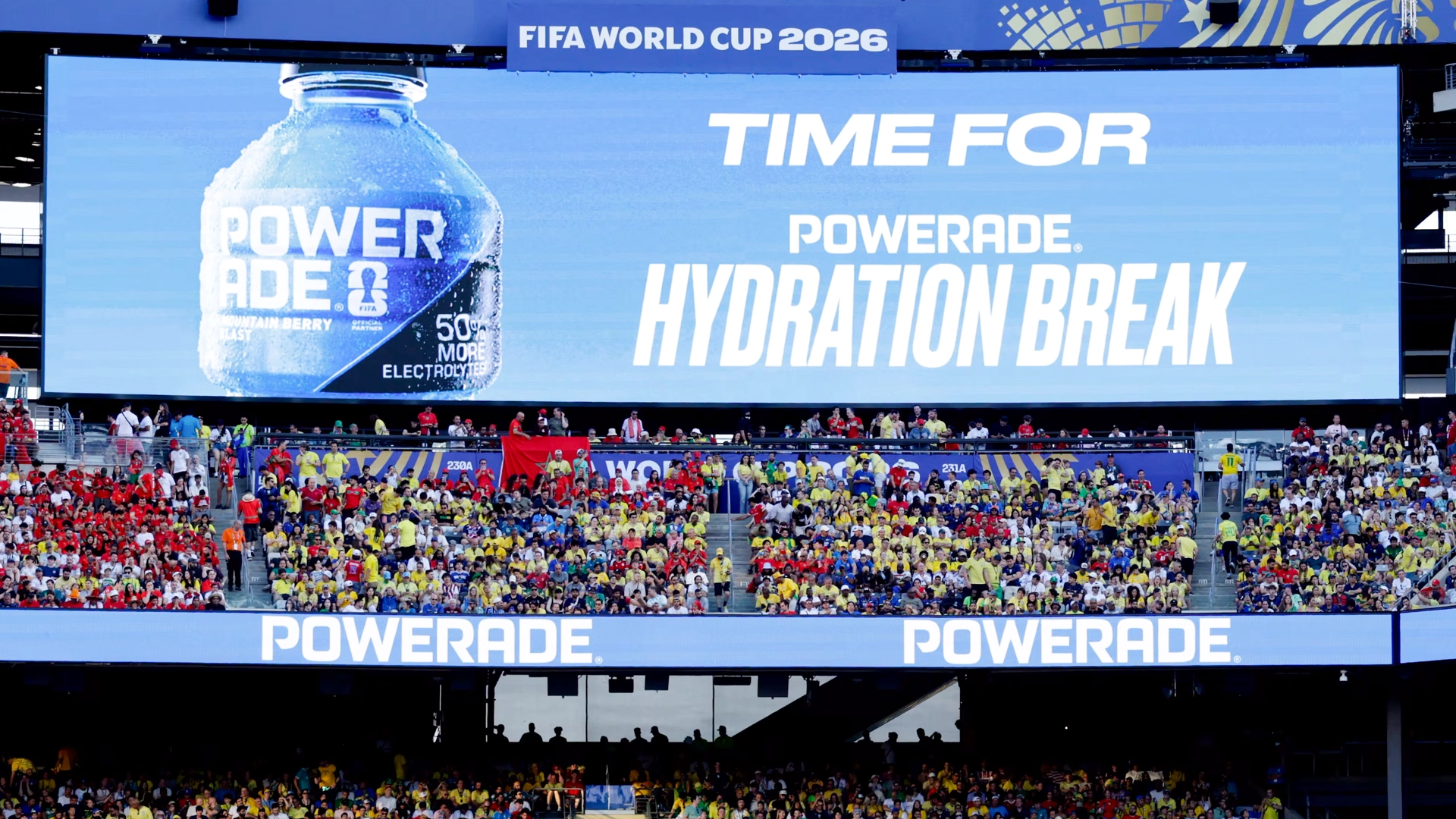
What the 2026 FIFA World Cup can teach brands about advertising without interruption
Advertising is an essential part of modern sport.
It funds tournaments, supports broadcasters, connects brands with enormous global audiences and helps transform major sporting events into cultural moments. As a company working within advertising and experiential technology, we understand its importance better than most.
But there must be a boundary.
Advertising should fit around the sport. The sport should not be reshaped to create more opportunities for advertising.
At the 2026 FIFA World Cup, hosted across the United States, Canada and Mexico, that boundary is beginning to look increasingly blurred.
From hydration breaks to advertising breaks
For the first time at a FIFA World Cup, every match has included a mandatory three-minute hydration break midway through each half.
These breaks take place at approximately the 22nd and 67th minutes, regardless of the temperature, weather conditions or whether the stadium has a roof. FIFA says the policy was introduced to protect player welfare and provide consistent conditions for every team.
Player safety must always come first.
Some matches during this tournament have been played in severe heat and humidity. Under those conditions, cooling and hydration breaks are entirely sensible. No football tradition is more important than protecting the health of the players.
The problem is the decision to impose exactly the same interruption during every match, including matches played in cooler conditions or beneath a roof.
A safety measure should respond to an actual safety risk. It should be based on temperature, humidity, playing conditions and medical advice. When the break is guaranteed in every match at almost exactly the same time, it becomes something else as well: predictable broadcast inventory
Broadcasters know when it is coming. Advertisers know how long it will last. Commercial slots can be sold in advance.
That perception has been reinforced by what viewers have already experienced. In the United States, Fox has shown full-screen commercials during hydration breaks. During the tournament’s opening match, its coverage returned after play had already restarted, causing viewers to miss several seconds of live action. Telemundo, by contrast, chose not to cut away to full-screen advertising during the same breaks.
That difference is important.
It proves that the interruption does not automatically have to become a conventional commercial break. It is a choice.
Football’s flow is part of its value
Football is different from many other major sports because of its continuity.
There are no timeouts after every few minutes. There is no pause whenever possession changes. Coaches cannot repeatedly stop the match to reorganise their teams. Once the whistle blows, the game develops organically.
Momentum matters.
A team may be applying relentless pressure. A player may be struggling physically. A defensive line may be losing concentration. Supporters may feel that a goal is becoming inevitable.
Then the game stops.
Players gather around their coaches. Tactical instructions are delivered. The team under pressure has an opportunity to recover. The rhythm of the match disappears.
Although the lost time can be added at the end of the half, the flow cannot be restored by simply adding three minutes to the clock.
Endurance has always been part of football. Players must manage their energy, concentration and decision-making over the full match. That does not mean they should be placed at risk in dangerous heat, but it does mean unnecessary scheduled interruptions can change the competitive character of the game.
Football’s simplicity is one of the reasons it became the world’s game. Its first universal Laws were drawn up in 1863, and one of its greatest strengths remains the fact that the same basic game can be recognised and played across countries, cultures and continents.
That inheritance should not be altered casually.
The World Cup is not the Super Bowl
The same concern now surrounds the 2026 World Cup final.
For the first time, FIFA is staging a dedicated World Cup Final Halftime Show. The performance itself is expected to last approximately 11 minutes, but broadcasters are preparing for the entire interval to last between 25 and 30 minutes because of the time required to construct and remove the stage.
Under IFAB’s Laws of the Game, players are entitled to a half-time interval that does not exceed 15 minutes, although it may be altered with the referee’s permission.
A pre-match performance is understandable. A closing ceremony is understandable. Fan festivals, concerts and cultural events surrounding the World Cup can add enormously to the occasion.
But why must a concert be inserted between the two halves of the match itself?
The World Cup final is already one of the greatest spectacles on Earth. It does not require an imported entertainment format to make it important.
This is not a criticism of American sport or the Super Bowl. The Super Bowl halftime show belongs to the traditions and structure of American football. That sport is designed around repeated stoppages, timeouts, changes of possession and commercial breaks.
Association football is not.
Trying to make football more like another sport does not necessarily make it more entertaining. It risks removing the qualities that made football globally successful in the first place.
Creative Advertising is the answer
Commercial investment makes global tournaments possible. Sponsors deserve visibility, broadcasters need revenue and brands should be able to participate in the enormous cultural conversation created by the World Cup.
But advertisers and rights holders should be more creative.
There are countless opportunities to reach supporters without manufacturing new interruptions:
- Brands can create immersive experiences in stadium concourses, fan zones, airports, shopping centres and host cities.
- They can use interactive displays, holographic content, augmented reality and digital installations to let supporters engage with players, products and tournament stories.
- They can sponsor match statistics, tactical analysis, replays and digital content that adds something useful to the viewer’s experience.
- They can develop second-screen experiences that allow audiences to explore the match without obstructing the live broadcast.
- They can create memorable pre-match and post-match activations, rather than extending the interval between the two halves.
- They can use existing natural stoppages intelligently without forcing viewers away from live action.
- They can build experiences that supporters actively choose to approach, photograph, share and remember.
This is where the advertising industry should be heading: away from interruption and towards participation.
The best advertising does not demand attention simply because an audience has nowhere else to look. It earns attention by being relevant, creative and valuable.
Protect the product that advertisers are buying
There is also a commercial contradiction at the heart of excessive interruption.
Brands want to advertise around football because people love football. Its emotion, unpredictability, tension and uninterrupted momentum create extraordinary audience engagement.
But if commercial demands gradually change those qualities, advertisers risk weakening the very product whose audience they are trying to reach.
Every additional scheduled pause may appear to create more inventory. Every extended interval may generate another sponsorship opportunity. But there is a point at which greater commercialisation produces a poorer experience.
Supporters notice when revenue appears to take priority over the competition. They notice when a safety measure conveniently becomes an advertising slot. They notice when the biggest match in football begins to resemble a television entertainment programme with a game attached.
That is not good for football, and ultimately it is not good for advertisers either.
Let football remain football
The 2026 World Cup should encourage an important conversation across sport, broadcasting and advertising.
How can brands reach enormous audiences without diminishing the experience those audiences came to enjoy?
The solution is not less ambition. It is greater creativity.
Use the stadium. Use the fan zone. Use technology. Use digital platforms. Create experiences before the match, after the match and throughout the host city. Give supporters something they genuinely want to interact with.
But when the match begins, let the game breathe.
Football has brought generations of people together precisely because of its simplicity, continuity and universal character. It has crossed languages, borders and cultures without needing to reinvent itself as something else.
Advertising should support that.
It should celebrate the moment, amplify the emotion and contribute to the experience.
It should never require the world’s game to rewrite itself merely to make room for another commercial break.