The Future of Guest Experience Is Intelligent, Connected, and Human
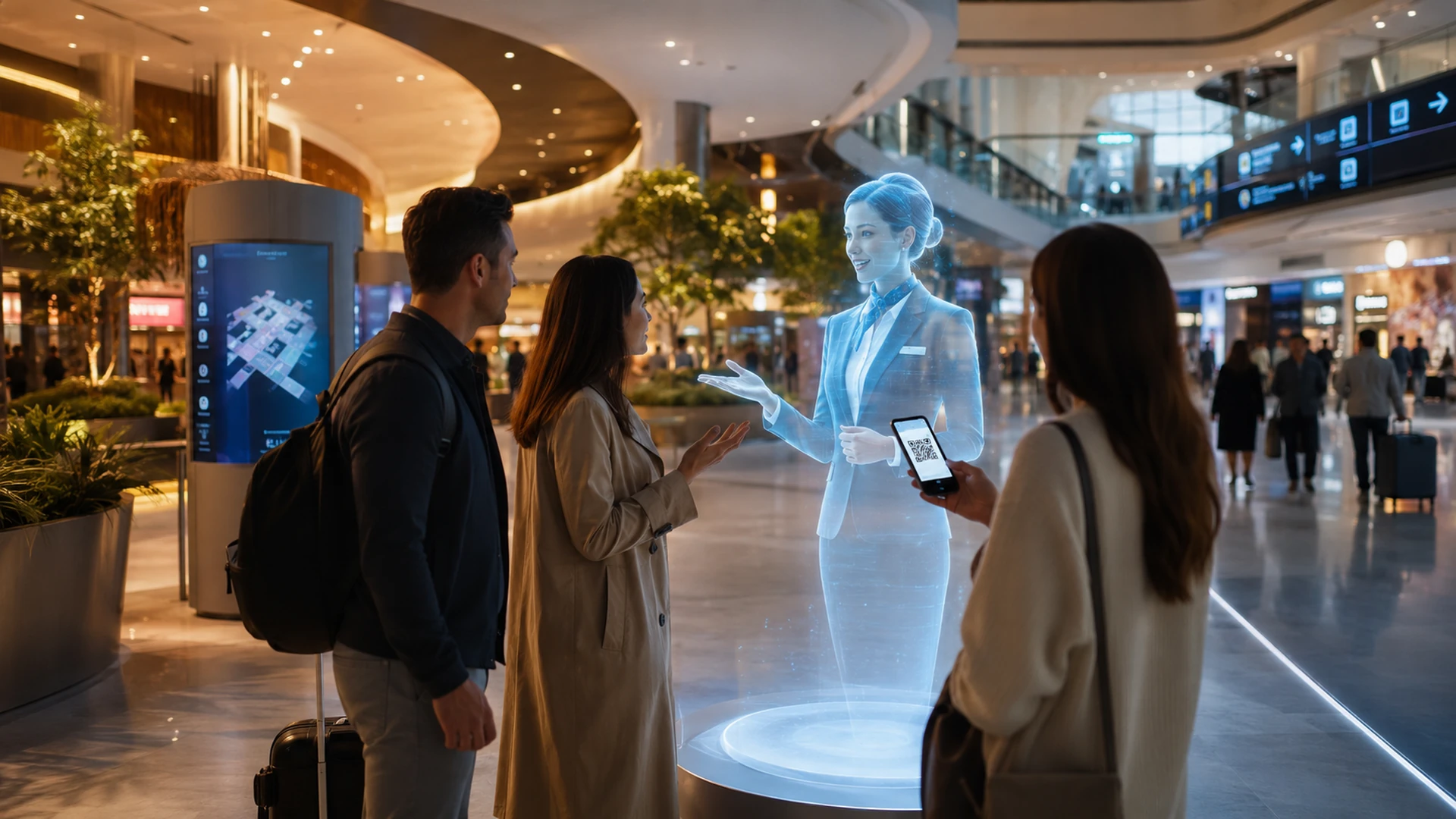
For years, shopping malls, airports, entertainment venues, and other high-footfall destinations have focused on one core challenge: how to help people move through large spaces efficiently while still creating memorable experiences.
Today, artificial intelligence is transforming that challenge into an opportunity.
The next evolution of guest experience is no longer just digital signage, static directories, or mobile apps hidden in app stores. It is intelligent, conversational, and connected. And at the centre of this transformation is the rise of holographic AI avatars integrated with mobile AI ecosystems.
In modern venues, guests no longer want to search. They want to ask.
They want instant answers, personalised recommendations, and seamless guidance that feels natural. They want technology that removes friction rather than creating it.
This is where AI-powered holographic assistants are redefining the visitor journey.
From Static Information to Intelligent Conversation
Traditional wayfinding systems rely on touchscreens, printed maps, or complex directories that force visitors to stop, search, and manually navigate.
AI holographic avatars change the interaction completely.
Instead of searching through menus or maps, guests can simply speak naturally:
“Where can I find sushi nearby?”
“Which restaurant is best for families?”
“What time does the next movie start?”
“Where is the closest bathroom?”
“Is there a children’s play area?”
The AI assistant responds instantly with conversational guidance, recommendations, directions, and contextual information tailored to the visitor’s needs.
This creates a guest experience that feels less like interacting with technology and more like speaking with a highly knowledgeable concierge.
In busy retail and entertainment environments, that shift matters enormously.
A More Human Experience in High-Footfall Venues
One of the biggest challenges in large public spaces is information overload.
Visitors are surrounded by screens, advertisements, promotions, announcements, and competing messages. The result is often frustration, confusion, and decision fatigue.
Holographic AI avatars introduce something different.
They create moments of calm interaction inside crowded environments.
Because the technology is visual, conversational, and engaging, people instinctively understand how to interact with it. The experience feels approachable rather than technical.
For venues focused on customer excellence, this represents a major evolution.
Guests are no longer left wandering through unfamiliar environments trying to interpret maps or search endlessly through directories. They receive direct assistance in real time.
The technology becomes less about automation and more about hospitality.
Extending the Journey Beyond the Venue
The real innovation happens when holographic AI assistants connect directly with mobile experiences.
The conversation no longer ends at the display.
Imagine a visitor asking a holographic AI concierge for restaurant recommendations inside a shopping mall. The AI assistant suggests options based on cuisine, dietary preferences, atmosphere, or proximity.
Once the guest chooses a restaurant, the AI assistant can instantly generate a QR code allowing the visitor to continue the experience on their mobile device.
The guest scans the code and immediately receives:
- Walking directions
- Restaurant details
- Booking links
- Menu information
- Exclusive offers
- Loyalty integration
- Parking guidance
- Estimated walking time
The journey becomes continuous and connected.
Instead of forcing guests to remember information or search for it again later, the venue creates a seamless transition between physical and digital touchpoints.
This is where AI stops being a novelty and starts becoming genuinely useful.
Personalisation at Scale
AI alone is powerful, but presentation matters.
In crowded public environments, visibility and engagement are critical.
Holographic displays naturally attract attention because they introduce depth, motion, and presence in ways traditional flat screens cannot replicate.
The result is technology that feels alive within the environment.
When combined with conversational AI, holographic presentation transforms passive displays into interactive guest service ambassadors.
This changes how people perceive technology inside public spaces.
Instead of another advertising screen competing for attention, the display becomes a service-oriented experience that actively helps visitors.
That distinction is important because consumers increasingly expect technology to provide value before demanding attention.
Operational Benefits for Venues
The impact extends beyond guest satisfaction.
AI-powered guest assistance can significantly improve operational efficiency across large venues.
Visitors can resolve common questions instantly without needing to locate staff members. Queue pressure at information desks can be reduced. Guests can navigate spaces more efficiently, reducing congestion in busy areas.
At the same time, venues gain valuable insight into visitor behaviour and preferences.
Understanding what guests are searching for, where they want to go, and what services they request most frequently helps operators improve layout planning, tenant strategy, and customer experience design.
The venue becomes more responsive, more intelligent, and more adaptive over time.
The Future of Guest Services
The future of guest experience will not be built around isolated technologies.
It will be built around connected ecosystems where AI, holographic presentation, mobile integration, and real-time assistance work together seamlessly.
The venues that succeed will be the ones that remove friction from the customer journey while creating experiences that feel intuitive, personalised, and memorable.
Guests increasingly expect environments to respond to them intelligently.
They expect assistance to be immediate.
They expect information to follow them across physical and digital channels.
And they expect technology to feel effortless.
Holographic AI avatars integrated with mobile AI services represent a significant step toward that future.
Not because they replace human hospitality, but because they enhance it.
In the most successful venues of the future, technology will not simply display information.
It will guide, assist, personalise, and elevate every stage of the guest journey.
Further Reading
- The Rise of Smart Airports: Enhancing Passenger Experience in 2025
- Conversational AI in Hospitality: Where 30% Higher Satisfaction Meets Revenue Growth
- How AI is redefining the role of physical stores, and what retailers should know
- The ultimate list of conversational AI statistics for 2025
- Gartner Survey Reveals 85% of Customer Service Leaders Will Explore or Pilot Customer-Facing Conversational GenAI in 2025