Holograms Are Transforming Museums and Changing How We Experience History
Museums are entering a new era. For decades, the standard format has been static: objects behind glass, text on the wall, and visitors moving quietly from one display to the next. That model is now being challenged by a shift in how audiences, especially younger generations, consume information. We live in an age of spatial computing, augmented reality, and immersive media. Museums are adapting to this reality by integrating technologies that don't just display history, but bring it to life.
Holographic displays are emerging as a key tool in this transformation. They allow institutions to present artifacts, stories, and historical figures with a level of presence and interactivity that traditional exhibits cannot match. This isn't just about spectacle; it's about solving long-standing challenges in museum engagement and education.
Bridging the Attention Gap
One of the most pressing issues for modern museums is attention. Recent surveys indicate that 70 percent of museum visitors expect interactive or immersive elements during their visit. The passive consumption of text labels is declining. In fact, the average dwell time at a traditional museum display text label is just 8 seconds. This "glance and go" behavior makes it difficult to convey complex historical narratives.
Holograms disrupt this pattern. By presenting content in 3D, often with motion and sound, they capture attention immediately. But more importantly, they hold it. Data from early adopters shows that dwell times significantly increase when digital or holographic media is used to tell the story of an object. Instead of reading about a tool or a weapon, a visitor can see a holographic representation of how it was used, rotated in 3D space, or placed in its original context. This shifts the experience from reading history to witnessing it.
Bringing the Unseen to Light
Museums typically display only a fraction of their collections. The vast majority of artifacts remain in storage due to space constraints or preservation concerns. Fragile items, such as ancient textiles or decaying manuscripts, cannot be exposed to light for long periods. Holography offers a solution.
Through high-resolution 3D scanning and holographic reproduction, museums can display digital twins of these rare items. A holographic replica can be on public display 24/7 without risk of damage. It can be scaled up to show minute details that are invisible to the naked eye, or animated to show the object's internal structure. This effectively expands the museum's floor space without building new galleries, allowing them to showcase their hidden treasures in a way that is safe for the artifact and compelling for the visitor.
The Melbourne Museum T-Rex: A Case Study in Scale
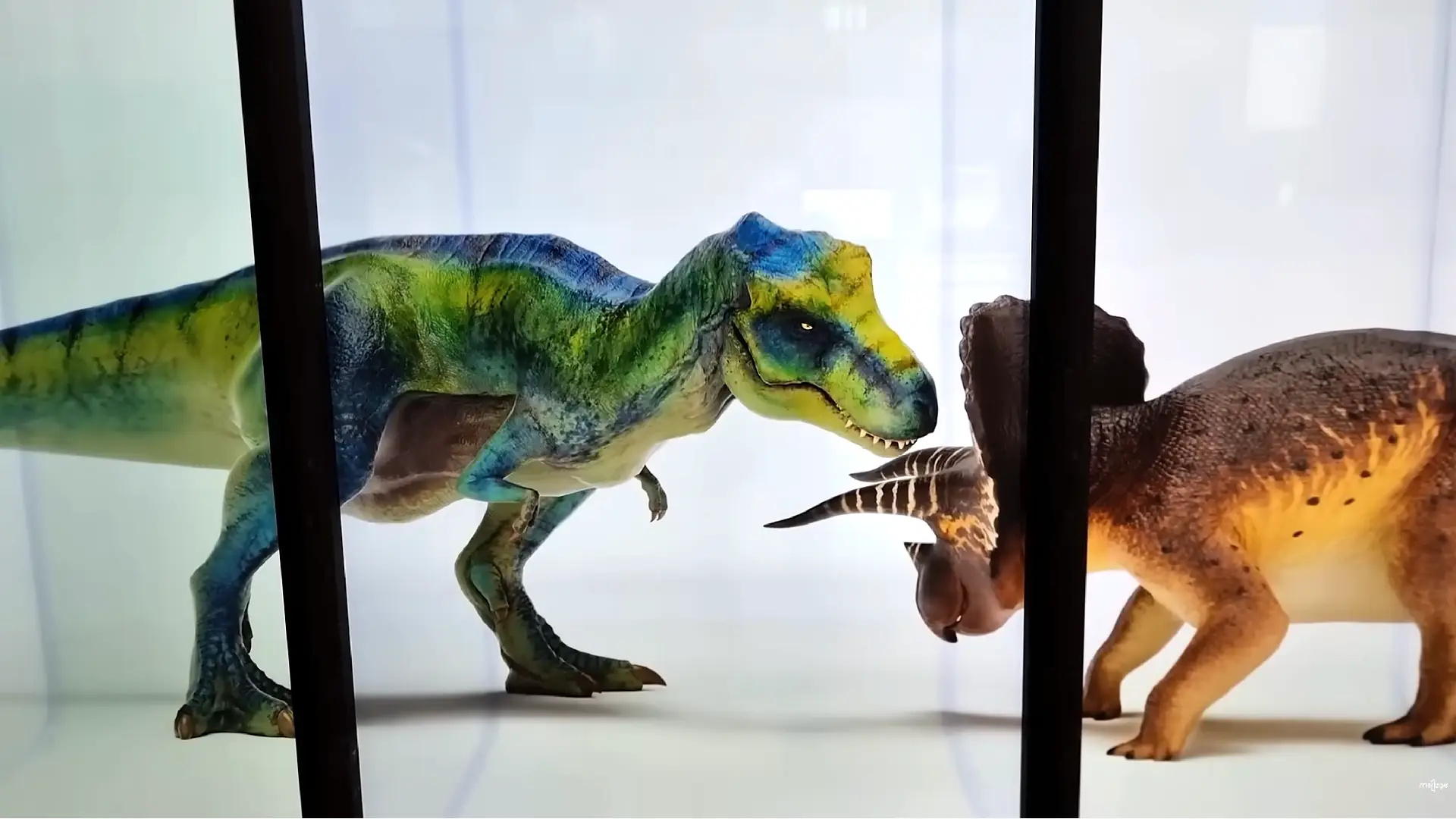
A prime example of this technology in action is the Melbourne Museum's recent T-Rex exhibition. The museum needed a way to showcase the scale and presence of a Tyrannosaurus Rex in a way that felt immediate and physical, without relying solely on skeletal mounts. They utilised three of the patented Miirage modular holographic displays to create a life-sized, high-fidelity holographic experience.
The installation allowed visitors to see the T-Rex not just as a skeleton, but as a living, breathing creature. The modular nature of the Miirage system meant the display could be increased in size to fit the scale of the subject matter. It provided a "wow" moment that anchored the exhibition, driving social sharing and word-of-mouth attendance.
At first the holographic installation created a bottleneck at the museum entrance because so many visitors stopped to watch it. The experience had to be moved deeper into the lobby simply to manage foot traffic.
Miirage has developed specially adapted units for installations of this kind. These units include anti reflective glass to ensure clarity in bright environments and directional audio to focus sound precisely where it is needed. There are additional proprietary features that Miirage has engineered specifically for cultural institutions. These remain discreet by design. Holographic displays may look similar from the outside, much like mobile phones, but the internal differences and exyernal experience can be vast.
Humanising History
Beyond artifacts and dinosaurs, holograms are bringing the human element back to history. We are seeing a rise in holographic presenters - historians, curators, or even re-created historical figures who can speak directly to visitors. This adds a layer of personal storytelling that text panels lack. This approach combines the emotional connection of live performance with the reliability of digital delivery. For educators, it creates predictable learning outcomes. For visitors, it helps them take ownership of their own attention and engage more deeply with the material.
The Global Trend
The adoption of holographic technology is not limited to a single region. We are seeing implementations across Europe, the US, the Middle East, and Asia. In the Middle East specifically, where new museums are being built with a "digital-first" mindset, holography is often integrated into the architectural planning stage. These institutions are setting a new standard for what a museum can be: a hybrid of physical heritage and digital immersion.
As the technology matures, it is becoming more accessible. Modular systems like those from Miirage allow museums of various sizes to deploy holographic exhibits without needing custom, permanent construction. This flexibility is crucial for temporary exhibitions and touring shows.
Holograms are not replacing the physical artifact; they are enhancing it. They provide the context, the motion, and the story that turns an object into an experience. For museums looking to remain relevant in a screen-dominated world, this technology is no longer just a futuristic concept, it is a present-day necessity. Miirage is proud to be part of this evolution, supporting museums as they redefine what it means to engage the public and bring the past into the present.
Further Reading
- Sixteen:Nine - Cranky Virtual T-Rex Greets Visitors (Miirage Installation)
- Museums Victoria - Meet the Finest Real T. rex Ever Seen in Australia
- MuseumNext - How Seamless Technology Will Transform Museum Visits
- Weatherspoon Art Museum - Exploring "Slow Looking" vs 8-Second Attention Span
- University of Liverpool - Emotional Engagement with Holographic Displays in Museums (PDF)
- YouTube - Holograms in Museums: Captivating Exhibits