When Will the AI Bubble Burst? And What Happens When It Does?
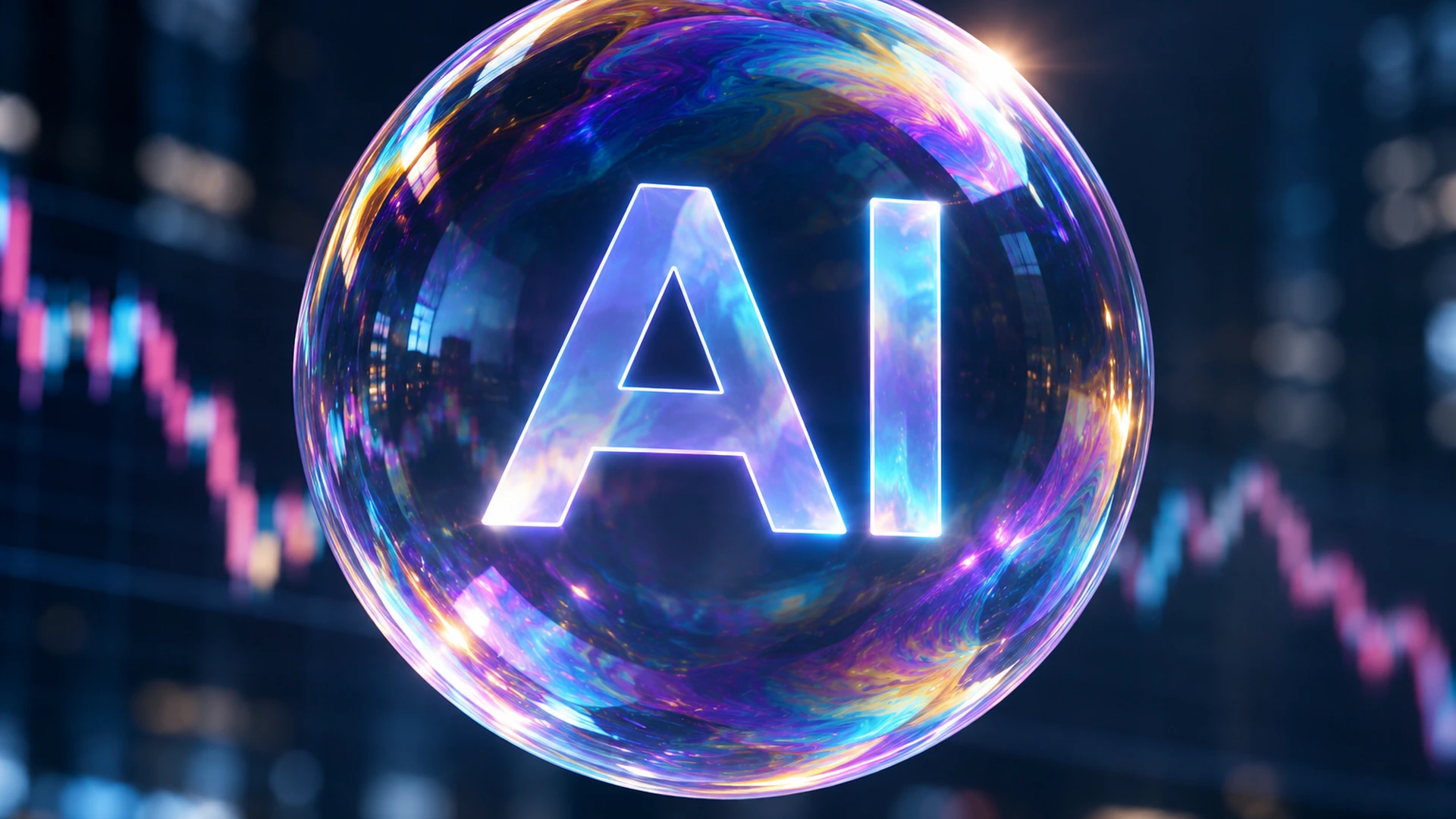
Artificial intelligence may be transformative and still be surrounded by a financial bubble. History suggests that if valuations fall, the technology that survives could become cheaper, more useful and more deeply embedded in the real economy.
Every great financial bubble begins with a truth. Railways really did transform transportation, the internet really did transform commerce, media and communication, and artificial intelligence is almost certainly going to transform large parts of the global economy too. The mistake investors make during bubbles is not necessarily believing in the technology. It is believing that because a technology will change the world, almost any price can be justified for the companies building it.
That distinction matters because the question facing markets in 2026 is no longer whether artificial intelligence is important. The evidence overwhelmingly suggests that it is. The more difficult question is whether the extraordinary amounts of capital being invested into AI can produce financial returns large enough, and quickly enough, to justify the valuations and infrastructure being built around it. If the answer is no, the consequences for AI stocks could be severe without implying that AI itself has failed.
The numbers are becoming extraordinary
It is difficult to argue that there is no speculative element around artificial intelligence when looking at the scale and speed of capital entering the sector. According to the Stanford Institute for Human-Centered AI's 2026 AI Index, global private investment in AI reached $344.7 billion in 2025, an increase of 127.5% in a single year. Generative AI alone attracted approximately $170.9 billion, more than triple the previous year's level.
The spending has continued to accelerate. Gartner forecasts worldwide AI expenditure of approximately $2.7 trillion in 2026, representing growth of almost 50% year on year. Around $1.48 trillion of that is expected to be AI infrastructure alone. This is not merely a software boom. It is becoming one of the largest capital expenditure cycles in modern corporate history.
The sums being committed by the world's largest technology companies are equally striking. Reuters reported in October 2026 that Microsoft, Alphabet, Amazon, Meta and Oracle generated a combined $542.9 billion in operating cash flow during the first nine months of the year while capital expenditure rose to $556.9 billion. That does not mean those companies are in financial trouble, but it illustrates the scale of the bet. Investors are being asked to accept enormous expenditure today in exchange for potentially enormous profits tomorrow.
A bubble does not mean the technology is fake
This is where comparisons with the dot-com bubble are useful, but also frequently misunderstood. The internet bubble did not burst because the internet turned out to be useless. It burst because investors became willing to pay extraordinary prices for businesses based on expectations that could not possibly be met within the timescales implied by those prices.
Nasdaq's historical analysis estimates that the Nasdaq-100 had an implied trailing price-to-earnings ratio of approximately 104 at the end of 1999, and may have reached somewhere between 150 and 200 times earnings around the market peak in early 2000. Yahoo's valuation was estimated at roughly 2,000 times earnings. From Netscape's IPO in August 1995 to the technology boom's peak in March 2000, the Nasdaq-100 increased by roughly 718%. The subsequent collapse erased most of those gains.
Some companies disappeared completely, while others became some of the most successful businesses in history. Amazon lost more than 90% of its share price during the collapse and later became one of the world's largest companies. Cisco continued producing real profits, but investors who bought at extreme valuations waited years for the economics of the company to catch up with the price they had paid. The lesson is uncomfortable but important: a revolutionary technology can be a great technology and a terrible investment at the same time.
Is AI another dot-com bubble?
There are similarities, but there are also important differences. Unlike many companies at the height of the internet boom, today's largest AI beneficiaries generate enormous amounts of revenue, cash and profit. Nasdaq's comparison found that almost the entire modern Nasdaq-100 by market exposure was profitable, whereas the dot-com era included a much larger concentration of companies with negative or very thin margins. That makes the current cycle fundamentally different from thousands of businesses attaching “.com” to their names and hoping a viable business model would eventually appear.
Profitability, however, does not eliminate valuation risk. The Bank of England warned in its July 2026 Financial Stability Report that AI-related companies had grown to represent roughly half of the S&P 500's market capitalisation, compared with around a quarter in 2022. It noted that valuations had become increasingly dependent on assumptions about future earnings, continued financing, infrastructure development and widespread AI adoption.
The International Monetary Fund has also identified an AI-driven market correction as a risk to global financial stability. Gartner estimates that more than $3.5 trillion of AI infrastructure spending could potentially be exposed to impairment by 2030 if revenue growth fails to justify the investment. The point is not that a crash is inevitable. It is that the hurdle for future returns is becoming extraordinarily high.
So when will the AI bubble burst?
Nobody knows, and that is precisely the nature of bubbles. Anyone claiming to know the exact date at which an investment cycle will peak is probably offering more certainty than markets allow. Prices can remain optimistic for far longer than valuation models suggest, particularly when revenue is still increasing and the underlying technology genuinely is improving.
The more useful question is what could cause expectations to change. AI revenues could keep growing but fail to grow quickly enough to justify infrastructure spending. Competition could compress margins. New architectures could make today's data centres or processors less strategically valuable than investors expect. Enterprise customers could also become more disciplined about demanding measurable returns before approving another wave of AI spending.
That transition is already visible. McKinsey's global State of AI research has found widespread adoption but much more limited enterprise-level earnings impact, with only a minority of organisations reporting material EBIT contribution from AI. That does not mean AI is failing. It suggests the market is moving from fascination towards economics, which is usually where speculative narratives begin to face harder tests.
What happens if the bubble does burst?
The first impact would almost certainly be financial. AI-related share prices could fall sharply, venture capital funding would become more selective, infrastructure projects could be cancelled, and companies without sustainable revenues might disappear or consolidate. Investors would begin asking considerably harder questions about cash flow, margins and return on invested capital.
The language surrounding AI would probably change too. During a boom, simply adding AI to a product can attract attention. After a correction, the letters “AI” become less impressive and buyers begin asking what the system actually does. Corporate customers who once wanted an AI strategy because everyone else had one would increasingly demand evidence that the technology saves money, produces revenue or improves the customer experience. That could be healthy for the industry.
The dot-com crash removed enormous amounts of speculative capital, but it did not stop people going online. Internet usage continued growing, broadband expanded, infrastructure improved and technology became cheaper. Weak companies disappeared while genuinely useful services became embedded into everyday life. Eventually people stopped talking about “internet companies” because almost every serious company became an internet company. AI may follow a similar trajectory.
The technology could become less visible, not less important
Successful technologies rarely remain exciting forever. Nobody walks into an office today and marvels that the computers are connected to the internet, chooses a retailer because its payment system uses cloud computing, or describes GPS as revolutionary when asking a smartphone for directions. Technologies succeed precisely because people stop thinking about the technology and start expecting the utility.
The Stanford AI Index reports that organisational AI adoption has already reached very high levels, while generative AI has spread faster than the early adoption curves of either personal computers or the internet. Those numbers do not suggest AI is simply going to disappear. They suggest the technology is transitioning from novelty into infrastructure, while the financial bubble question sits around how much that infrastructure is worth and who captures the profit.
Why an AI correction does not necessarily change the Miirage proposition
Miirage sits much further downstream from the AI infrastructure arms race. Its commercial proposition does not require investors to believe that every AI model deserves a hundred-billion-dollar valuation, nor does it require data-centre expenditure to rise indefinitely. Miirage operates where technology meets a physical audience, in shopping centres, retail environments, airports, venues and other places where businesses still need to attract attention, communicate information and serve customers.
AI expands what a Miirage display can do. A digital person can answer questions, provide directions, explain products, switch languages, access live information and interact with someone in real time. But the underlying commercial problems existed before the current AI investment boom and would continue to exist after it. Retailers still need customers, airports still need wayfinding, brands still compete for attention, and physical locations still need better ways to communicate.
This is an important distinction for investors. AI is a capability inside the Miirage proposition, not the financial premise on which the proposition depends. A correction in AI valuations could change the cost and competitive landscape around the technology without eliminating the customer need being served.
Advertising will not disappear with an AI correction
There is also a danger of confusing the AI investment market with the advertising market. They are connected through the economy, but they are not the same market. WARC continues to forecast a global advertising market measured in well over a trillion dollars, while retail and commerce media remain among the fastest-growing areas of advertising. IAB raised its 2026 US advertising growth forecast to 12.3%, with commerce media and digital out-of-home among the growth categories.
None of these markets requires AI company valuations to remain high. There is, however, a genuine downside risk that should not be ignored. If an AI collapse became large enough to trigger a recession, credit contraction or broad corporate retrenchment, advertising budgets could fall because advertising is economically sensitive. During the global financial crisis, worldwide advertising expenditure contracted before rebounding with the economy. The realistic risk for Miirage is therefore less about people suddenly rejecting AI and more about a severe financial correction reducing corporate investment generally.
Even then, downturns tend to change the commercial argument rather than eliminate it. When budgets tighten, advertisers become more concerned with performance, measurement and return on investment. Technologies that can demonstrate attention, engagement, service value or commercial outcomes become easier to defend than expenditure based purely on novelty.
An AI crash might even make AI better
There is another possibility that receives considerably less attention. An AI correction could ultimately benefit companies that use AI rather than companies whose valuations depend on owning the underlying infrastructure. Competition between model providers is already driving performance higher while pushing costs lower. If the investment cycle cools, providers may compete even more aggressively for enterprise customers, and AI capabilities that once required enormous development budgets could become commoditised services available to thousands of businesses.
For an application company, that can be attractive. If intelligence becomes cheaper, faster and easier to access, value moves further up the stack towards businesses that know what to do with it. The question stops being “Who has the most powerful AI model?” and becomes “Who can turn intelligence into something people actually want to use?”
For physical AI, that means giving intelligence a useful interface. Sometimes that interface will be a screen, sometimes a voice, sometimes glasses, vehicles or robots. In public environments, one of the most natural interfaces may simply be another human being, or a digital person that looks, speaks and responds like one. The artificial intelligence increasingly happens invisibly in the background while the customer experiences a conversation.
The real test comes after the hype
Investment bubbles are destructive because capital becomes detached from economics, but they also have a habit of financing infrastructure that survives them. Railway mania left railways. The telecom bubble left fibre-optic networks. The dot-com bubble helped finance infrastructure, talent and experimentation from which the modern internet economy emerged.
An AI investment correction could leave behind vast computing capacity, dramatically better models, cheaper inference, millions of trained developers and an entire generation of businesses that have learned how to integrate artificial intelligence into everyday operations. The winners after the correction may therefore look very different from the winners during the boom. During a bubble, capital rewards scarcity, growth and possibility. After a bubble, markets rediscover cash flow, customers and utility.
For Miirage, that distinction matters. The company does not need AI stocks to keep rising forever, every AI start-up to survive, or artificial intelligence to remain fashionable. It needs businesses to continue competing for human attention, physical locations to continue needing information and service, and increasingly intelligent software to require increasingly natural ways for humans to interact with it. Those are much broader bets than the valuation of the AI sector itself.
Perhaps the most important question, therefore, is not when the AI bubble will burst. It is what will still be useful when nobody cares about the bubble anymore. History suggests that is where the real companies are usually found.
A financial bubble can burst without the underlying technology disappearing. What survives is utility.Further Reading
- Stanford HAI: 2026 AI Index, Economy
- Gartner: Worldwide AI Spending Forecast for 2026
- Reuters: Big Tech cash flow and AI capital expenditure
- Nasdaq: Is AI Another Bubble for the Nasdaq-100?
- Bank of England: Financial Stability Report, July 2026
- IMF: Global Financial Markets Face Rising Risks
- McKinsey: The State of AI
- Stanford HAI: 2026 AI Index Report
- IAB: 2026 U.S. Ad Spend Forecast
- WARC: Global advertising market research