China’s $480 Billion AI Crash: Has the AI Bubble Finally Burst?
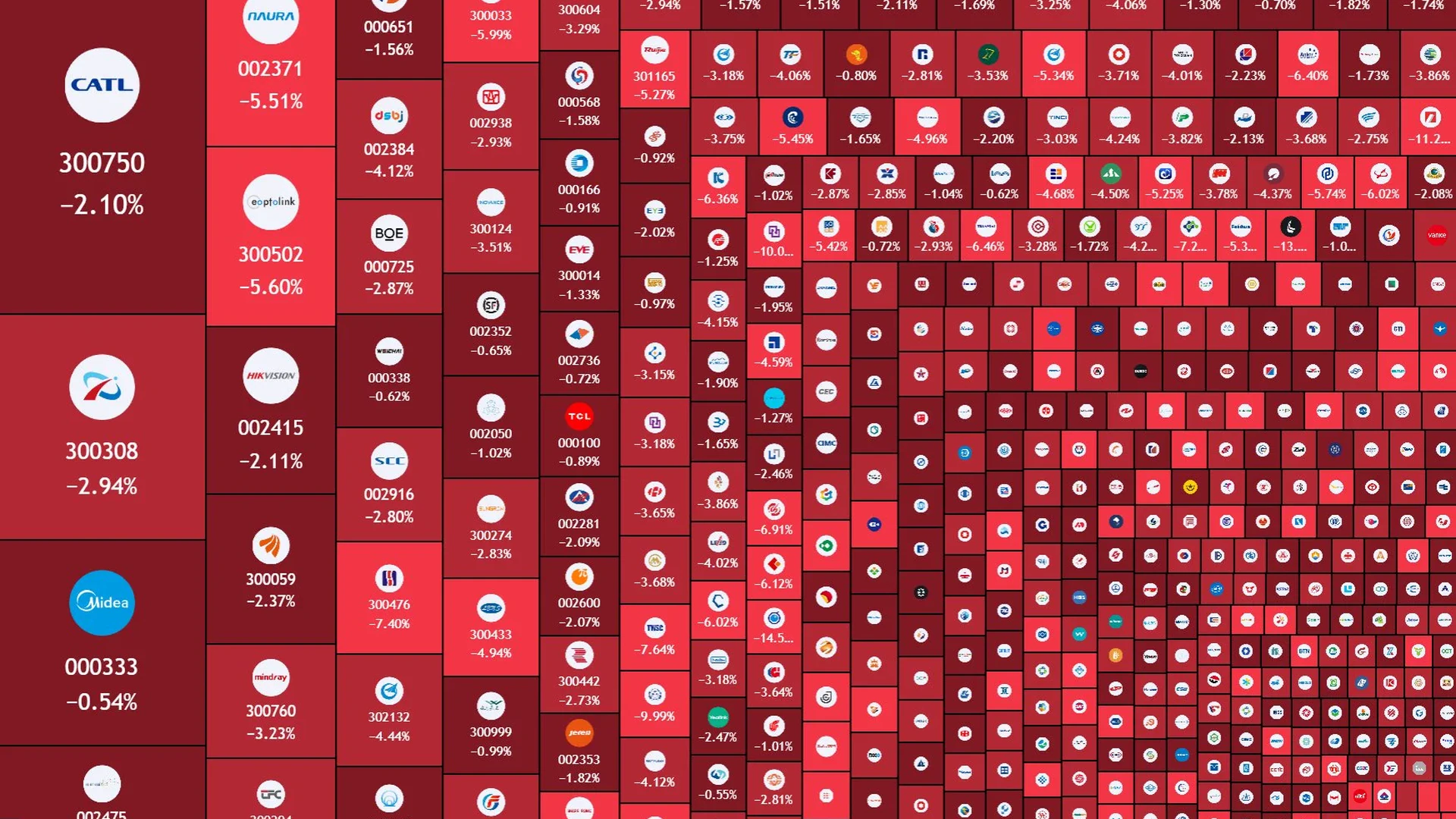
China’s AI boom has suffered a dramatic reversal. The bigger question is whether investors everywhere are starting to demand proof that extraordinary AI valuations can become real revenue and profit.
For the past few years, investors have been asking the same question: is artificial intelligence in a bubble?
In China, we may finally be getting an answer. Hundreds of billions of dollars have been wiped from some of the country’s biggest AI and semiconductor companies as investors begin questioning whether extraordinary valuations can be justified by actual revenue, demand and profits.
China’s STAR50 index, which includes many of the country’s leading technology and semiconductor companies, has fallen around 40% in less than four months, erasing approximately $480 billion in market value, according to Reuters.
Some of China’s hottest AI stocks have been cut in half
A number of companies that became symbols of China’s AI boom have suffered even larger falls.
Robotics company Unitree has lost around half its value since its market debut in August. Chinese chipmakers MetaX Integrated Circuits and Moore Threads Technology have also fallen roughly 50% from their recent highs, while optical-component suppliers serving AI data centres have suffered similarly steep declines.
It is a dramatic reversal. Only months ago, investors were pouring money into almost anything connected with artificial intelligence, robotics, semiconductors or data centres.
According to figures cited by Reuters, AI-related stocks had grown to represent approximately 42% of the market capitalisation of mainland- and Hong Kong-listed Chinese shares and around 57% of trading turnover. The AI trade had become enormous.
Now investors are asking a much less exciting question: where is the money actually going to come from?
AI has reached the revenue stage
This may be the most important part of the story.
The first phase of the AI boom was driven largely by possibility. Investors were buying into what artificial intelligence could become. Companies developing chips, models, robots and AI infrastructure were rewarded with extraordinary valuations because investors expected them to dominate enormous future markets.
But eventually every technology cycle reaches the same point. Potential has to become revenue. Revenue has to become profit. And investment has to produce a return.
China’s AI correction suggests investors are becoming significantly less willing to accept the promise of future growth without evidence that customers are willing to pay for it.
Being an AI company is no longer enough
This does not necessarily mean the AI revolution is ending. Quite the opposite.
Artificial intelligence is continuing to spread into almost every industry, from advertising and retail to manufacturing, healthcare, transportation, customer service and entertainment.
But the next phase could look very different from the last one. Simply attaching “AI” to a company may no longer be enough to justify an extraordinary valuation. Investors may increasingly distinguish between companies that are building AI because AI is fashionable and companies using the technology to solve genuine commercial problems.
That distinction matters. If an AI system reduces staffing costs, improves customer service, increases advertising engagement, automates a process or creates a completely new revenue stream, its economic value can be measured.
If billions are being invested into technology without a clear customer, business model or path to profitability, eventually the numbers become much harder to defend.
China also faces another problem: competition
Valuation is not the only pressure facing Chinese AI companies. Competition is becoming intense.
Dozens of companies are attempting to build competing chips, AI platforms, robots and infrastructure, creating the possibility of aggressive price competition as businesses fight for customers.
Chinese technology companies must also contend with the continuing possibility of US restrictions affecting access to technology and international markets.
That combination of high valuations, increasing competition and geopolitical uncertainty has given investors plenty of reasons to reconsider how much they are prepared to pay for future AI growth.
Even after the recent collapse, Reuters reported that the STAR50 was still trading at around 100 times trailing earnings, compared with roughly 30 times for the Nasdaq 100. So despite a 40% decline, parts of China’s technology market remain expensive by conventional measures.
And the damage is spreading
The selloff is not confined to artificial intelligence.
China’s wider stock market has lost an estimated $2.4 trillion in value since May, according to The Guardian. China’s CSI300 blue-chip index has also fallen sharply from its June high.
That matters because technology had become such a large part of the market. When investors pile into one theme, it can lift an entire market on the way up. The same concentration can accelerate losses on the way down.
Is the US next?
That is now the uncomfortable question.
China is not the only country where AI valuations have exploded. Across the United States, technology companies are spending extraordinary amounts on data centres, computing infrastructure, AI models and semiconductor capacity.
Some businesses are generating enormous revenues from that investment. Others are still betting that demand will eventually catch up with spending.
China’s experience does not prove that the global AI market is about to crash. The Chinese and US markets are very different, and many of the world’s largest American technology companies already generate substantial profits from established businesses.
But China’s correction demonstrates something investors everywhere are likely to pay increasing attention to: eventually, AI has to pay for itself.
The technology can be revolutionary while individual AI companies remain dramatically overvalued. Those two things can be true at the same time.
What this means for applied AI
The correction also highlights an important distinction between speculative AI investment and applied AI: technology that is deployed in the real world to perform a measurable job.
In retail, advertising, hospitality, transport and public environments, the value of AI will increasingly be judged by outcomes rather than novelty. Can it improve the customer experience? Can it answer questions, provide guidance, increase engagement, reduce operational friction or create new commercial opportunities?
This is particularly relevant to areas such as AI-powered digital humans and interactive holographic displays, where AI is not simply presented as an abstract technology. It becomes an interface between a business and its customers.
For Miirage, that is where the long-term opportunity sits: not in AI for AI’s sake, but in combining AI with physical experiences where businesses can see and measure what the technology actually does.
The AI boom isn’t over. The easy money might be.
Every major technology revolution produces winners, losers and periods of excessive optimism. The internet did. Smartphones did. Electric vehicles did. Artificial intelligence will almost certainly be no different.
The collapse in Chinese AI stocks does not mean artificial intelligence has failed. It may simply mean the market is entering a more mature phase, where spectacular demonstrations and ambitious forecasts are no longer enough.
The companies that ultimately justify today’s AI boom will probably be the ones capable of demonstrating something much simpler: real customers, real demand and real revenue.
The technology can be revolutionary while individual AI companies remain dramatically overvalued.Further Reading
- Reuters: In China, the AI bubble has already burst
- The Guardian: Chinese markets lose trillions as race for AI supremacy with US takes its toll
- Financial Times: The AI bubble already popped — in China
- Bloomberg: Chinese stocks tumble into bear market as $2.4 trillion vanishes
- South China Morning Post: Biwin and Moore Threads plunge despite surging AI revenue
- MarketWatch: Chinese stocks hit 14-month low as tech slides