Why Are We Queuing for Average Things?
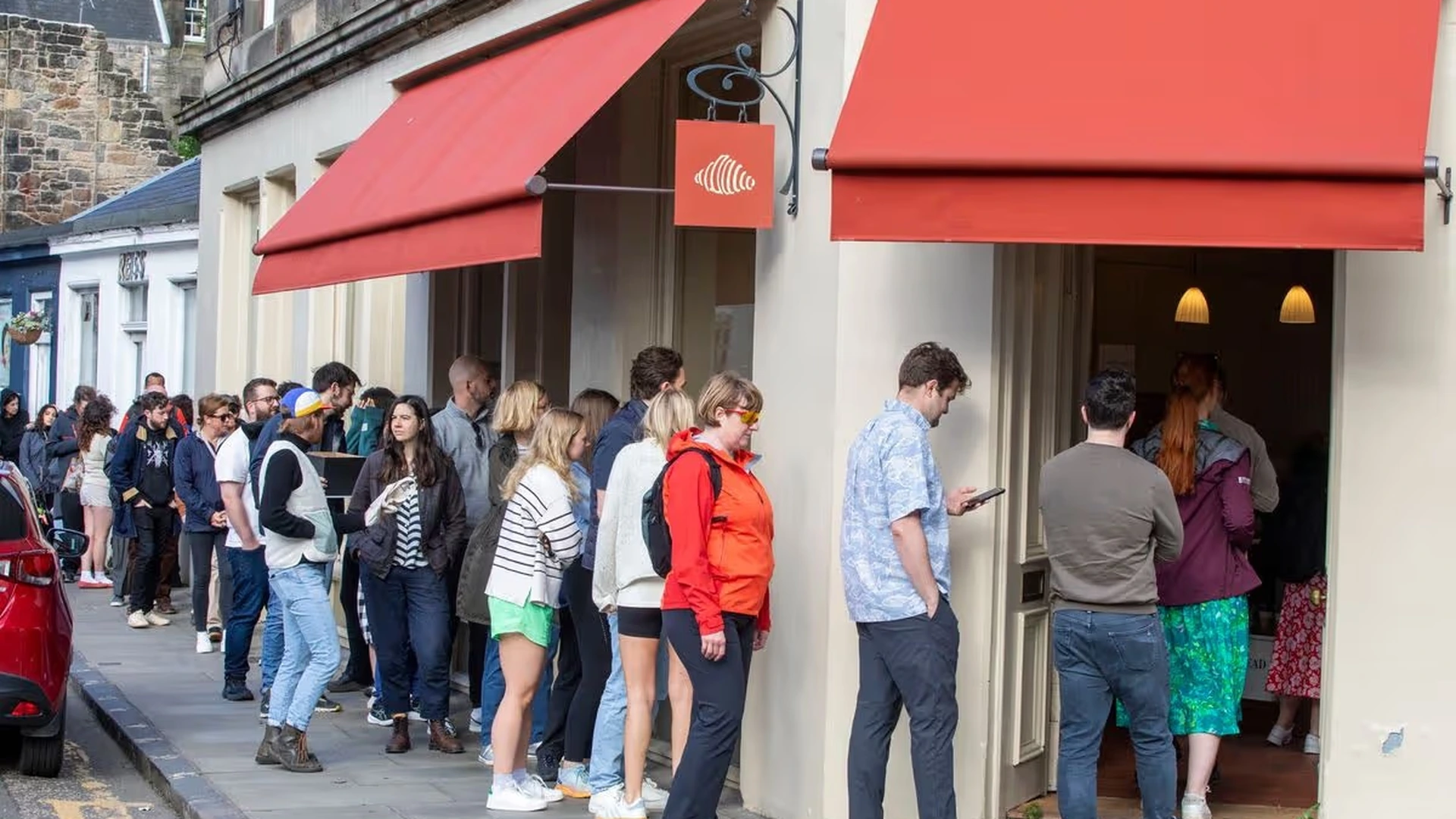
Social media has changed the psychology of waiting. The queue was once a warning that somewhere was too busy. Now it can be the reason we want to go.
There was a time when seeing a long queue outside a cafe was a perfectly good reason to find another cafe. Today, something strange is happening. Across London, Amsterdam, New York and other major cities, people are willingly standing in line for cookies, pastries, sandwiches, matcha, frozen yoghurt, bubble tea and even jacket potatoes. Sometimes they wait for 30 minutes. Sometimes an hour. Occasionally, considerably longer.
These are not necessarily Michelin-starred restaurants or once-in-a-lifetime experiences. Often the object at the end of the queue is something remarkably ordinary: a sandwich, a coffee, a pastry or a potato. What has changed is not necessarily the product. What has changed is the meaning of the queue.
In the age of TikTok and Instagram, a queue can function as advertising, social proof and entertainment simultaneously. Seeing dozens of people waiting outside an unfamiliar bakery no longer necessarily tells us that the bakery is inconveniently busy. Increasingly, it tells us that there must be something there worth discovering.
We really are queuing more
There is now data behind the phenomenon. Research published by The New Consumer and Coefficient Capital, based on a survey of 3,452 US consumers, found that 60% of Gen Z respondents had waited at least 30 minutes during the previous year to eat a particular food or visit a particular restaurant.
For millennials, the figure was 48%. Among Gen X it fell to 31%, while only 14% of boomers and older consumers reported doing the same. More revealing still, among the Gen Z consumers surveyed who had waited, 92% said the experience was worth it and 74% said they would do it again. Among Gen Z and millennials, 60% said they were likely to share a photograph or video of a fun food experience on social media. The New Consumer's 2025 trends report and Axios both highlighted the generational gap.
That difference matters. We are not simply witnessing the continuation of an ancient human willingness to wait for good things. Younger consumers appear significantly more prepared to treat waiting itself as part of an experience.
Businesses are responding. OpenTable's 2026 research into dining behaviour found that 77% of Gen Z consumers in Britain consider a restaurant's Instagram or TikTok worthiness important when deciding where to eat, alongside 71% of millennials. OpenTable's restaurant trends research suggests that the visual and shareable character of a venue has become part of the purchasing decision.
Food has always been visual. Restaurants have always cared about atmosphere. But this is something different. A restaurant is increasingly being judged not simply by whether it serves good food, but by whether visiting it produces content worth sharing.
From inconvenience to status symbol
Perhaps nowhere is this more visible than London. In September 2026, The Guardian examined the increasingly common sight of long queues outside British cafes, bakeries, dessert shops and restaurants. One of the businesses it profiled was CZER, a London operation based largely around chicken Caesar salad wraps.
When CZER opened in May 2026, its founders reportedly expected to sell around 50 wraps per day. Instead, after documenting the business on social media and attracting viral attention, they were selling around 400 a day almost immediately, with queues around the block seven days a week for months.
Another example is August Bakery in south-west London. After an influencer account with almost 300,000 followers featured the bakery in February 2026, its owners said the queues became effectively continuous.
Then there is SpudBros in Preston. It sells jacket potatoes. Yet its founders told The Guardian that queues have reached 2,000 people, with some customers even camping overnight and waiting close to 24 hours. The Guardian's investigation into viral food queues captures how dramatically social media can transform demand for very simple products.
Whatever anyone thinks about the relative merits of a particular sandwich, pastry or potato, something important is happening here. The economic value is no longer being generated solely by the quality or scarcity of the product. It is being generated by attention.
The arrival of the TikTok queue
Researchers have now started studying this phenomenon academically. In April 2026, researchers from Erasmus University Rotterdam published a paper in Current Issues in Tourism with an unusually direct title: "TikTok queues in tourism."
The researchers surveyed 147 tourists standing in queues at five popular food destinations in Amsterdam, including Fabel Friet, Chun Cafe, Van Stapele Koekmakerij and Saint-Jean bakery. The average participant was only 25.7 years old, and 89% were visiting the business for the first time. Most significantly, among respondents for whom social-media data was available, 84% had seen a social-media video about the food destination before visiting it. The academic paper found that social-media content contributed to perceptions of the destination's attractiveness.
That phrase, TikTok queue, captures something much bigger than a food trend. A digital recommendation system is producing a physical object in the real world. The algorithm produces the queue. And then the queue produces more content for the algorithm.
The feedback loop
Imagine someone in London watching TikTok on a Thursday night. They see a video of a new bakery. There is a queue outside. The pastry looks good. The comments say it is incredible. Another video of the same bakery appears ten minutes later. Then another appears the following day.
By Saturday morning, the viewer has decided to go. When they arrive, there are 40 people outside. That should theoretically make the proposition less attractive. Instead, the queue validates everything they have seen online. It really must be good.
They join. While waiting, they photograph the queue. They record the shopfront. When they finally reach the counter, they film the pastry being handed over. Perhaps they record the first bite. That content goes back onto TikTok or Instagram. Hundreds or thousands of other people see it. Some of them visit the following weekend. The queue gets longer, which makes the next video look even more convincing.
Social media exposure → curiosity → physical visit → queue → social proof → purchase → user-generated content → more exposure → more visitors.
The remarkable thing is that the queue, which should represent friction in the customer journey, becomes part of the marketing engine.
Why a queue makes something look better
This is not just a product of TikTok. It taps into much older human psychology. A 2024 study published in the International Journal of Hospitality Management examined whether waiting lines can act as a form of social proof.
The researchers found that simply seeing a queue for an unfamiliar brand can increase perceptions of that brand's popularity. That perceived popularity can then transfer into higher expectations of quality. In other words, before we have even eaten the food, the presence of other people waiting for it can make us expect it to taste better. The study also found that the positive effect diminishes when waiting becomes excessively long.
Human beings frequently use other people as shortcuts when making decisions. If a restaurant is empty while the restaurant next door is full, many of us instinctively assume the second restaurant is better. Social media has industrialised that instinct.
Instead of observing 20 people inside a restaurant, we can now observe millions of views, thousands of likes, hundreds of comments and a queue stretching halfway down the street. Every signal reinforces every other signal.
But is the food actually better?
Sometimes it undoubtedly is. Many viral bakeries, cafes and restaurants produce excellent products. Skilled bakers and chefs are benefiting from an unprecedented ability to reach enormous audiences without traditional advertising.
But quality alone cannot explain the scale of what is happening. There simply cannot be an objective culinary difference large enough to explain why one perfectly good pastry deserves a five-minute walk while another deserves a 45-minute queue.
What social media has done is change what is actually being purchased. The customer is no longer necessarily buying only a cookie. They may be buying participation in a cultural moment.
The traditional consumer question was: "Is this the best cookie?" The new question can be: "Have you tried that cookie everyone is talking about?" Those are two completely different forms of value. One is based primarily on product quality. The other is based on cultural relevance.
The affordable experience economy
There may also be an economic explanation for why food has become such fertile territory for this behaviour. For a younger consumer, many traditional experiences have become expensive. A weekend away can cost hundreds of pounds. A major concert can cost considerably more than £100 before travel and food are included. Fine dining can easily cost £100 per person. Even a night out can become expensive quickly.
A viral pastry, matcha or sandwich is different. Someone can spend £8 or £12 and still feel that they have done something. They have travelled somewhere. Waited with friends. Taken photographs. Tried the thing everyone has been discussing. Posted about it. Compared opinions. Participated in a trend.
The product is relatively inexpensive, but the experience surrounding it can occupy an entire afternoon. That makes these businesses unusually well suited to the social-media economy. They offer something that is affordable enough to copy, and copying is exactly what viral culture requires.
The physical world is becoming algorithmic
This is where the story becomes much bigger than food. For the first decade of the social-media era, we mostly discussed algorithms as systems that determined what happened on our screens. Which video appeared next. Which photograph we saw. Which creator became famous. Which story was recommended.
Increasingly, those systems are affecting what happens away from the screen. They determine which restaurants become crowded, which tourist destinations suddenly receive thousands of visitors, which products disappear from shelves, which neighbourhoods become fashionable and, increasingly, where human beings physically congregate.
A recommendation engine running inside a data centre can now create a queue on a pavement thousands of kilometres away. That is an extraordinary development. The boundary between digital behaviour and physical behaviour is disappearing.
Attention has become visible
For brands, retailers and physical destinations, there is another lesson. The most valuable thing about a queue may not be the people standing in it. It is what the queue communicates to everyone else.
A crowd is visible attention. Online, popularity is represented through numbers: views, followers, likes, comments and shares. In the physical world, popularity has traditionally been harder to see. The queue changes that. It turns demand into architecture.
Someone walking past does not need to know anything about the brand. The presence of 50 people outside immediately communicates that something interesting may be happening. That same principle extends beyond restaurants.
Retail stores, product launches, entertainment venues, shopping centres, exhibitions, pop-ups and brand activations are all competing for one increasingly scarce resource: human attention in the physical world. The winners will not necessarily be the businesses with the largest screens or the loudest advertising. They will be the ones capable of making people stop, look, interact, photograph, share and perhaps even wait.
The strange new value of waiting
Modern technology was supposed to eliminate waiting. Amazon reduced delivery from days to hours. Uber reduced the uncertainty of finding a taxi. Streaming eliminated television schedules. Mobile banking removed the need to visit a branch. Artificial intelligence is now reducing tasks that once took hours to minutes.
Almost every major technology trend is pushing towards immediacy. Yet at exactly the same moment, hundreds of people are voluntarily standing in the rain for a pastry.
That apparent contradiction tells us something. Perhaps people are not really queueing for food at all. They are queueing for meaning, participation and belonging.
The waiting itself becomes evidence that the experience matters. Completing it creates a small sense of achievement. Sharing it demonstrates membership of a group that knows what is currently relevant. The irony is that the more frictionless our lives become, the more intentionally chosen friction may begin to feel valuable.
Are we queuing for the product, or for everyone else?
This does not mean every queue is manufactured or every viral business is overrated. Quite the opposite. Social media has allowed brilliant independent businesses to attract audiences that previous generations of entrepreneurs could only dream of reaching.
But it has also created a new mechanism through which popularity can generate popularity almost independently of the underlying product. A queue can make something look desirable. That desirability creates content. The content generates another queue. Eventually it becomes difficult to establish where the original enthusiasm ended and the social proof began.
The cookie might be excellent. The sandwich might be average. At some point, it almost does not matter, because the product being consumed is no longer simply what comes in the bag. The experience is the product.
And perhaps that is the most interesting lesson of all. We used to believe that the internet would replace physical experiences. Instead, something stranger is happening.
The internet is beginning to choreograph them.