Tesla’s Flying Car Makes the Future Feel Real
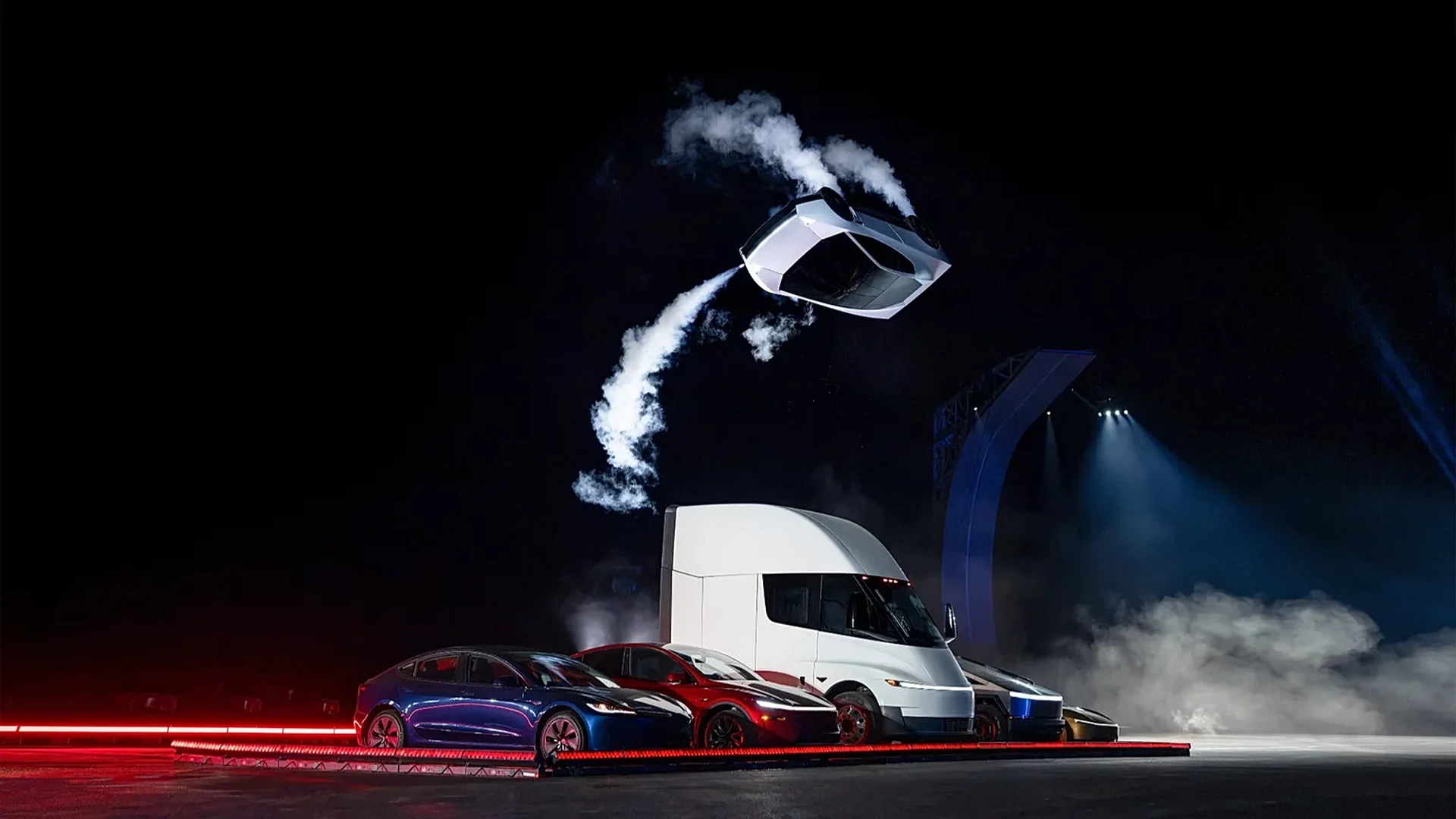
Tesla Roadster demonstration image used for editorial illustration.
For decades, flying cars and holograms were visual shorthand for the future. Increasingly, neither belongs only to science fiction.
For more than a century, the flying car has occupied a peculiar place in our imagination. It has appeared in concept sketches, world fairs, cartoons and science-fiction films as a symbol of a future that always seemed to remain a few decades away. Holograms have lived in much the same territory, appearing in stories long before most people expected to encounter anything resembling them in everyday life.
This week, Tesla made one of those ideas look considerably less fictional. At SpaceX’s test facility in McGregor, Texas, the company unveiled its redesigned Roadster and demonstrated a prototype doing something normal cars do not do. It climbed an inverted structure, left the ground, rotated in mid-air and returned to the surface using a combination of powerful fans and cold-gas thrusters. Tesla also demonstrated the vehicle jumping over a line of other Tesla vehicles.
It would be misleading to describe the Roadster as a conventional flying car. It cannot leave a driveway and carry its occupants across a city like an aircraft, and Tesla’s most extreme Rocket configuration is not approved for public-road use. But that technical distinction may not be the most interesting part of the story. The demonstration took an idea that millions of people associate with science fiction and made it physical, visible and real enough to reconsider.
The moment possibility becomes visible
Tesla’s new Roadster is an extraordinary piece of theatre, but theatre and technological progress have always had a complicated relationship. A breakthrough can exist in a laboratory for years without changing public perception. Then a single demonstration can compress years of technical explanation into a few seconds that almost anyone can understand.
According to Reuters, Tesla demonstrated the Roadster accelerating from 0 to 60 mph in under one second, with a top speed exceeding 230 mph, while production is currently targeted for 2028. TechCrunch reported that the Rocket version uses 10 thrusters connected to around 600 litres of compressed air, giving the car the ability to generate upward and rotational movement as well as extreme acceleration.
A specification sheet can explain those numbers. Watching a car physically rise into the air communicates something different. It transforms engineering into an experience. The audience no longer needs to imagine what the technology might look like because it has seen it happen.
That transition matters. There is a point in the development of every futuristic technology when the public question changes from “could this ever exist?” to “when will I see one?” Tesla may not have produced a practical flying car, but it has pushed the idea across an important psychological boundary.
Flying mobility is already becoming an industry
Tesla is not creating the airborne mobility market from scratch. Around the world, aviation companies and start-ups are already developing electric vertical take-off and landing aircraft, usually shortened to eVTOL, for passenger transport, cargo, emergency services and specialist logistics.
The numbers show how seriously the sector is being taken. Deloitte estimates that the US advanced air mobility market could reach approximately $115 billion in annual economic activity by 2035 and support more than 280,000 jobs. Its modelling divides that opportunity almost equally between passenger mobility, at around $57 billion, and cargo mobility, at around $58 billion.
Regulators are no longer discussing the technology only in theoretical terms either. In July 2026, the US Federal Aviation Administration announced that BETA Technologies and United Therapeutics had flight-tested an electric aircraft on an organ medical-transport route between Virginia and Maryland as part of the FAA’s eVTOL Integration Pilot Program. The programme exists specifically to work out how a new generation of aircraft can be integrated safely into existing airspace.
Tesla’s Roadster belongs to a different technical category, but culturally it lands in the same moment. Machines that move people through three-dimensional space are shifting from futuristic illustrations towards test programmes, regulation, infrastructure and real-world demonstrations.
Science fiction is arriving from several directions at once
The more interesting story is that flying mobility is not arriving alone. Several technologies that spent decades as science-fiction motifs are becoming commercially credible at roughly the same time.
Robotics is one example. The International Federation of Robotics reported that 542,000 industrial robots were installed worldwide in 2024, more than double the number installed a decade earlier. The total operational stock reached approximately 4.66 million robots, up 9% in a single year. The important shift now is that increasingly capable AI systems are beginning to give physical machines better vision, language understanding and decision-making ability.
Artificial intelligence is undergoing a similar change. The first generative-AI boom was overwhelmingly screen based. People typed into a box and software replied. The next phase will increasingly give AI a physical presence, whether through robots, vehicles, wearables, smart environments or digital humans that can appear in the spaces around us.
That is why the Roadster demonstration feels bigger than a sports-car launch. The technologies that defined the future in fiction are beginning to converge. Vehicles are becoming intelligent machines. Robots are becoming conversational. Digital information is becoming spatial. Displays are becoming more immersive. AI is starting to inhabit the physical world.
Holograms have followed a remarkably similar journey
For decades, holograms occupied almost exactly the same cultural territory as flying cars. They were an instantly recognisable way for filmmakers and designers to tell an audience that a story was taking place in the future. A person could appear digitally in another location. Information could seemingly occupy the air. Physical space itself could become an interface.
Today, that idea is moving into real commercial environments. Holographic displays can place life-sized digital people, products and animated content into retail spaces, airports, events, workplaces and experience centres. When combined with conversational AI, the display is no longer only a visual object. It can become an interface that listens, responds and interacts with the person standing in front of it.
The market surrounding these technologies is expanding quickly. Fortune Business Insights valued the global holographic display market at $4.31 billion in 2025 and projects it to grow from $5.42 billion in 2026 to $33.36 billion by 2034, equivalent to a compound annual growth rate of 25.52%. Market definitions vary between research firms, but the broader direction is difficult to ignore. Spatial and holographic display technology is moving from novelty towards a serious category of visual computing.
This is the connection that makes Tesla’s flying Roadster particularly interesting from Miirage’s perspective. The flying car and the hologram have spent decades performing the same cultural job. They told us we were looking at tomorrow. Now both are crossing into the physical world.
The future is moving off the screen
For much of the past 20 years, technological progress has meant putting more of life onto flat screens. The web moved onto computers, computers moved into smartphones, services became apps, entertainment became streaming and social interaction increasingly became digital. Even the first mass-market experience of generative AI arrived as another interface inside a screen.
The next wave may be very different. AI is beginning to move into robots, vehicles and physical environments. Advanced mobility is changing what machines can do in space. Spatial computing and holographic displays are giving digital information depth and presence. The physical world is becoming programmable in ways that once belonged only to fiction.
That shift creates a new design challenge for technology companies and brands. It is no longer enough to ask how an experience looks on a phone, laptop or conventional display. Increasingly, the question will be how technology behaves when it occupies the same physical space as the people using it.
A holographic concierge is not simply a video played on a different type of screen. An intelligent robot is not simply an AI chatbot with legs. A vehicle capable of leaving the road, even briefly, is not simply a faster car. Once software acquires presence, movement and spatial context, people relate to it differently.
Why physical demonstrations change what we believe
Humans are not persuaded by specifications alone. We respond to scale, movement, sound, surprise and physical presence. That is why some demonstrations become cultural moments even when the underlying product remains expensive, limited or years away from mass adoption.
Tesla could have published a technical document explaining compressed-air storage, fan-generated suction and directional thrust. Instead, it put a car in the air. The demonstration instantly converted an abstract engineering proposition into something that millions of people could understand without knowing anything about propulsion.
The same principle applies to other emerging technologies. A presentation about conversational AI is different from speaking to an AI character. A rendering of a robot is different from seeing one move through a real building. A description of a holographic display is different from standing in front of a life-sized digital person who appears to share the room with you.
Physical experience reduces the distance between imagination and reality. Once people have seen something happen, the future becomes easier to believe.
The future rarely arrives exactly as we imagined it
Tesla’s Roadster is not the flying car that generations of science-fiction writers promised us. It cannot yet rise above a traffic jam and carry a family across a city. Its Rocket configuration may remain rare, expensive and tightly constrained by regulation. Production itself is not expected to begin until 2028, and Tesla has a long history of shifting Roadster timelines.
But perhaps that is how the future normally arrives. Not fully formed, and rarely in exactly the shape fiction predicted. A capability appears. Then another. The technology improves, the economics change, regulation catches up and what once looked impossible gradually becomes ordinary.
For decades, the flying car and the hologram were two of the clearest visual symbols of the future. One is now launching itself into the air. The other is appearing in shops, airports, events and workplaces. Around them, AI and robotics are adding intelligence and agency to the physical world.
The most interesting thing about Tesla’s flying Roadster may therefore not be whether it technically qualifies as a flying car. It is what happened during those few seconds in Texas when a familiar object behaved in an unfamiliar way and millions of people saw an idea from science fiction become tangible.
For decades, flying cars and holograms told us what the future might look like. Increasingly, we no longer have to imagine it.Further Reading
- Reuters: Tesla’s new Roadster turns in air with SpaceX thrusters
- TechCrunch: Tesla reveals SpaceX-powered Roadster
- FAA: Major milestone in eVTOL technology use
- Deloitte: Advanced air mobility and the $115 billion US opportunity
- International Federation of Robotics: Global robot demand doubles over 10 years
- Fortune Business Insights: Holographic Display Market 2026 to 2034