The Night Tupac Changed Holograms Forever
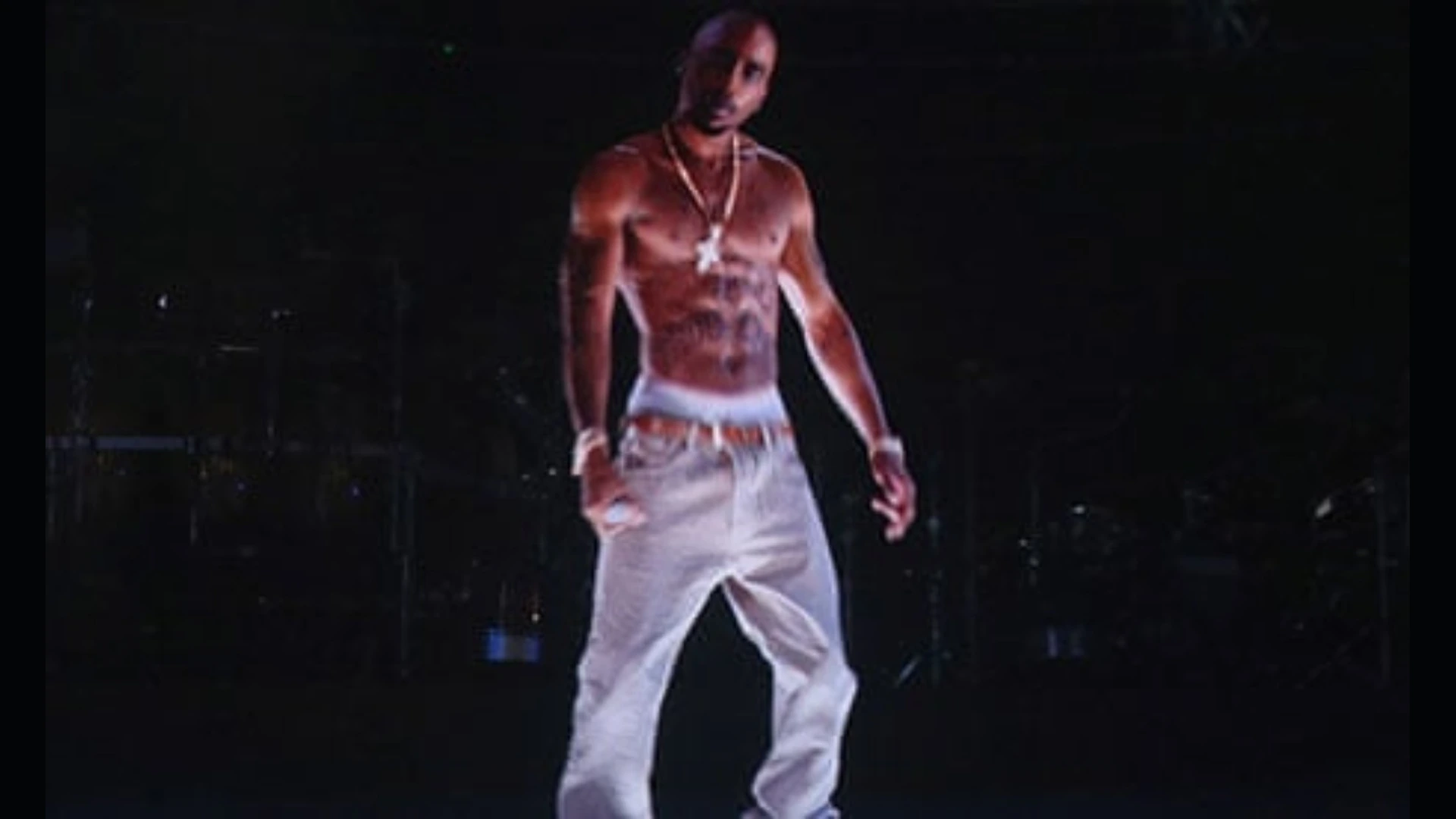
Coachella 2012 did not invent holograms. It did something more important: it made millions of people believe in their power to entertain.
There are moments when a technology stops feeling like technology and simply becomes an experience.
For holograms, one of those moments happened in the California desert on 15 April 2012. Dr. Dre and Snoop Dogg were performing at Coachella when another figure appeared on stage: Tupac Shakur, who had died nearly 16 years earlier.
For the tens of thousands of people in front of the stage, and the millions who watched the footage afterwards, the idea of a hologram suddenly moved beyond science fiction. It was no longer only Princess Leia, futuristic films or a laboratory demonstration. It had become mass entertainment.
More importantly, it showed that holographic technology could do something much more valuable than simply impress people. It could make them feel something.
The moment the crowd realised what it was seeing
Watching the footage today, it is easy to forget how different the technology landscape was in 2012. There was no mainstream generative AI. Deepfakes were not part of everyday vocabulary. Photorealistic AI avatars were not answering questions in shops, airports or visitor attractions.
Then Tupac appeared on one of the world's biggest festival stages, addressed the crowd and performed alongside Snoop Dogg.
The reaction was enormous. According to Musion, around 90,000 festivalgoers witnessed the virtual performance and videos generated 15 million YouTube views in just 48 hours.
Digital Domain, which created the computer-generated likeness, reported that Google results for “Tupac hologram” exceeded 50 million, Tupac album sales increased by 500%, and downloads of “Hail Mary” rose by 1,500% following the Coachella shows.
That is what made the moment important. The technology did not merely attract attention. It generated conversation, searches, video views, media coverage and commercial activity.
It was not technically a hologram, and that almost does not matter
There is an important technical footnote. The Tupac effect was not a hologram in the strict scientific sense of the word.
The performance used a modern form of the Pepper's Ghost illusion, a technique with roots in nineteenth-century theatre. Digital Domain created a new computer-generated performance rather than simply replaying old footage, and the image was projected into a carefully arranged stage system to create the illusion of a life-sized performer occupying physical space.
The Los Angeles Times noted at the time that the technique drew on the same concept as Pepper's Ghost. Similar projection ideas had appeared before, including performances involving Gorillaz and Madonna.
So Coachella did not invent virtual performance. It did something different. It gave the format a cultural breakthrough.
Nobody left that festival talking about projection geometry or optical engineering. They talked about seeing Tupac.
When the technology disappeared, the entertainment took over
The best technology often becomes invisible.
When someone watches a great film, they rarely spend the entire time thinking about the camera sensor. When someone attends an extraordinary concert, they do not usually go home analysing the loudspeakers.
The Tupac performance demonstrated the same principle for holographic experiences. For a few minutes, the audience stopped looking at a display technology and started looking at a performer.
Before Coachella, the public conversation around holograms was often about whether something like this was really possible. After Coachella, the more interesting question became: what else could we do with it?
A new category of virtual entertainment followed
The entertainment industry noticed immediately. Within days, there was speculation that virtual Tupac could tour with Dr. Dre and Snoop Dogg. Digital Domain's Ed Ulbrich described the performance as only the beginning in contemporary coverage by The Guardian.
In the years that followed, virtual and holographic performances involving artists including Roy Orbison, Maria Callas, Frank Zappa and Whitney Houston pushed the concept further.
The clearest evidence of how far virtual performance has evolved may now be ABBA Voyage. It uses advanced digital avatars rather than the same projection system used for Tupac, but the underlying proposition is related: a digital performer can create a live, shared, physical entertainment experience at enormous scale.
In 2024, ABBA Voyage staged 374 performances at its purpose-built 3,000-capacity London arena, averaged occupancy above 90%, and its operating company reported turnover of approximately £104.34 million, according to Music Business Worldwide.
What looked like a remarkable technological stunt in 2012 helped normalise an idea that is now capable of supporting an entire entertainment business model.
The real breakthrough was presence
The most important lesson from Coachella is not that technology can recreate an artist who has died. That remains ethically complex and requires clear permission, rights management and respect for the person being represented.
The bigger lesson is about presence.
Humans respond differently when digital content appears to share our physical space. A life-sized person standing in front of us creates a different psychological response from the same person appearing inside a conventional rectangular screen.
That principle extends far beyond music. The digital person could be a fashion model introducing a collection, a historical figure explaining an exhibition, a sports personality welcoming fans, a brand ambassador presenting a product, or an AI assistant answering questions in multiple languages.
The underlying objective is the same: make something digital feel physically present.
From resurrection to interaction
There is also one major difference between the virtual performers of 2012 and the holographic experiences being developed today.
Virtual Tupac could perform. Today's digital humans can respond.
Advances in real-time rendering, artificial intelligence, speech recognition and synthetic voices mean a holographic character no longer has to follow a completely fixed performance. It can answer a question, change language, explain a product, provide directions or adapt the experience to the person standing in front of it.
That changes holographic technology from spectacle into interface.
Why the Tupac moment still matters to brands and retail media
Retail and out-of-home environments have an attention problem. Consumers move through spaces filled with screens, posters, phones, product packaging and advertising, all competing for the same limited attention.
Adding another conventional rectangle does not automatically solve that problem.
Creating something unexpected can.
The Tupac performance interrupted the audience's expectations. A concert stage contained performers, then suddenly it appeared to contain someone who could not possibly be there. That moment of surprise made people stop, look and talk about what they had seen.
This is one of the principles behind Miirage's approach to holographic displays in retail, advertising, airports, events, museums and experience centres. Holographic technology should not be deployed simply because it looks futuristic. Its value comes from its ability to create presence, attract attention and turn passive viewing into a more memorable experience.
It does not replace every conventional screen, nor should it. But there are moments when a conventional screen is no longer enough.
The night holograms became real to millions
Ask someone to name a famous fictional hologram and Princess Leia will often come up. Ask for a real-world hologram moment and Tupac at Coachella remains one of the first examples many people remember.
That is why the performance matters.
Coachella did not invent holographic projection. It did not create the first virtual performer. Strictly speaking, it was not even a true hologram.
But it changed what holograms meant to the public.
On one night in April 2012, the idea escaped science fiction and specialist demonstrations and walked onto one of the world's biggest music stages. It performed. It shared the stage with a living artist. It made a crowd erupt. Then millions more watched it online.
The future of holograms was never going to be determined solely by how the technology worked. It would be determined by whether people cared enough to look.
Tupac proved that they would.