When AI Does the Shopping, Who Will See the Ads?
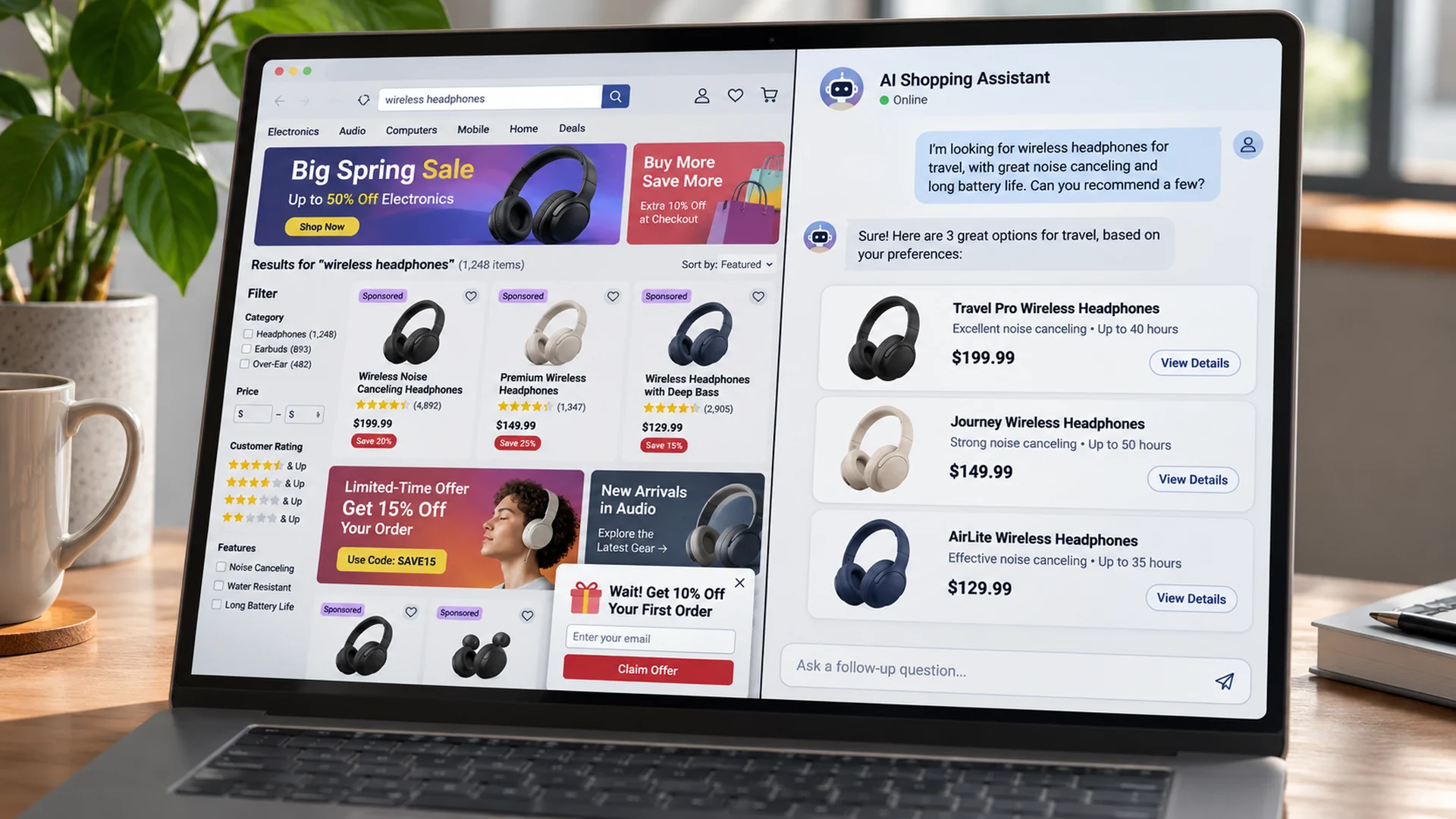
AI shopping agents could transform a $74 billion advertising industry. But as algorithms take control of online purchasing, the physical world may become more valuable to brands than ever.
Imagine buying a new television without visiting a single retailer's website, scrolling through product listings or seeing an advertisement.
You simply tell an AI assistant what you want, how much you're prepared to spend and which features matter most. Within seconds, it compares products, reads reviews, checks prices and recommends the best option. Eventually, it may even complete the purchase.
For consumers, this sounds remarkably convenient. For advertisers, it presents a rather uncomfortable question.
If artificial intelligence does the shopping, who is left to see the advertisements?
For decades, digital advertising has been built around influencing human behaviour. Search results, sponsored products, promotional banners and personalised recommendations are designed to attract attention and encourage purchases.
But what happens when the customer browsing those websites is no longer a human being?
A $74 Billion Industry Faces a New Reality
The scale of potential disruption is enormous.
According to Reuters reporting from November 2026, Amazon and Walmart collectively account for approximately 88% of the estimated $74.4 billion US retail media advertising market.
These businesses earn substantial revenue from brands paying to appear prominently in search results, product recommendations and shopping experiences.
Now imagine an AI agent researching hundreds of products without ever looking at those advertisements in the traditional sense.
Morgan Stanley estimates that AI shopping agents could account for 10% to 20% of US e-commerce spending by 2030, according to Reuters. If that forecast materialises, billions of dollars in consumer spending could follow shopping journeys very different from those advertisers currently understand.
The industry is already preparing.
Research published by Boston Consulting Group found that 68% of retailers surveyed expect agentic commerce to have a significant or transformational impact within two years.
This is no longer simply a discussion about whether AI can recommend products. It is about who controls the relationship between consumers, retailers and brands.
Advertising to Machines Instead of People
Traditionally, advertisers have competed for attention.
A beautifully photographed product, a clever headline or an eye-catching video might persuade somebody to stop scrolling and investigate further.
An AI shopping agent works differently.
It may prioritise product specifications, availability, independent reviews, price comparisons and suitability for the customer's requirements.
Suddenly, the most visually compelling advertisement may matter less than having accurate, accessible product information.
Brands could increasingly find themselves marketing to two entirely different audiences: humans and the algorithms acting on their behalf.
There are already signs of this transition. Reuters reports that Amazon and Walmart are experimenting with advertising inside their own AI shopping assistants, while manufacturers are adapting product information for AI discovery.
This does not necessarily mean digital advertising disappears. It could evolve into a new marketplace where brands compete for inclusion in AI-generated recommendations.
However, advertising inside an AI assistant creates its own challenge: maintaining consumer trust when commercial sponsorship influences what is supposed to be an objective recommendation.
The fundamental question becomes whether consumers will trust AI recommendations that are increasingly shaped by advertising.
The Unexpected Opportunity for Physical Retail
While online shopping becomes more automated, something fundamentally different happens inside a physical store.
People still walk through shopping centres. They browse displays, examine products, interact with staff and make spontaneous purchasing decisions.
Those environments create opportunities for brands to communicate directly with human beings, without relying entirely on search engines, shopping algorithms or digital intermediaries.
And the advertising industry is beginning to recognise their potential.
According to IAB UK, UK digital retail media advertising expenditure grew 32% year on year to £2 billion during the first half of 2026.
That figure covers online retail media rather than in-store advertising specifically, but it demonstrates the momentum behind advertising connected directly to shopping environments.
Meanwhile, IAB Europe has identified in-store advertising as an important growth opportunity, noting that physical retail audiences can rival those of major broadcast television networks while receiving comparatively little advertising investment.
This presents an interesting possibility.
As artificial intelligence makes online advertising less dependent on human attention, physical retail could become an increasingly valuable environment for capturing it.
Not because physical advertising is immune to technological disruption, but because it offers something fundamentally different: a direct connection with people in the real world.
From Digital Screens to Intelligent Holographic Experiences
Of course, simply installing more advertising screens is unlikely to solve the problem.
Consumers already encounter enormous amounts of advertising. Adding another conventional display to a crowded shopping centre does not automatically make a brand more memorable.
The opportunity lies in creating experiences that people actively choose to engage with.
This is where holographic displays and conversational AI become particularly interesting.
Imagine walking into a shopping centre and encountering a life-sized holographic AI assistant.
Rather than displaying another repetitive advertisement, it welcomes visitors, answers questions, recommends products, provides directions and introduces relevant promotions.
A shopper looking for running shoes could ask which retailers stock a particular brand. Someone searching for a birthday present could receive suggestions based on their budget. A visitor could discover a nearby restaurant, receive directions or scan a QR code to continue an interaction on their phone.
Advertising becomes part of a useful conversation rather than something interrupting it.
For retailers and shopping centre operators, this creates the possibility of combining digital out-of-home advertising, customer service, product discovery and AI-powered engagement within a single physical installation.
At Miirage, this convergence of holographic technology and conversational AI is central to how we see the future of retail environments.
The aim is not simply to make advertising more visually impressive. It is to make interactions between brands and people more natural, useful and memorable.
The Future of Advertising May Be Conversational
There is another important consequence of this transition.
Traditional advertising has generally measured success through impressions, clicks, reach and conversions.
But conversational advertising introduces different possibilities.
Instead of simply recording whether somebody encountered an advertisement, retailers could understand which questions customers asked, which products attracted interest and whether interactions led to measurable outcomes.
A holographic AI assistant might help shoppers discover products they did not know existed, identify the correct store or find a promotion relevant to their immediate needs.
Success would depend on genuine usefulness, accurate information, appropriate privacy safeguards and evidence of additional sales, not simply the novelty of the technology.
This could represent an important evolution from advertising that competes for attention to advertising that earns engagement.
Two Shopping Economies, One Customer
The rise of AI shopping agents does not mean physical stores are guaranteed to benefit, nor does it suggest the end of online advertising.
In fact, BCG’s research found that 65% of brands surveyed expect to increase retail media spending as shopping agents become more common.
What seems increasingly likely is that brands will need to operate across two complementary environments.
In the digital world, they will need accurate product data, competitive offerings and visibility within AI-powered recommendations.
In the physical world, they will need to give people compelling reasons to notice, explore, interact and remember.
The most successful retailers may be those that connect both experiences seamlessly, allowing technology to make shopping more convenient without removing the human element that makes discovery enjoyable.
Artificial intelligence is changing how products are discovered, compared and purchased. But it is not eliminating the importance of human attention.
If anything, as more purchasing decisions become automated, authentic opportunities to influence people directly could become increasingly valuable.
The next great advertising opportunity may not be another advertisement displayed on somebody's phone. It may be an intelligent, life-sized hologram standing in front of them, ready to start a conversation.
Further Reading
- Reuters: AI shopping agents could threaten Amazon and Walmart's ad business (4 November 2026)
- Boston Consulting Group: How retailers can reinvent the digital flywheel for agentic commerce (21 October 2026)
- IAB UK: Six months of UK digital adspend now exceeds the whole of 2020 (29 September 2026)
- IAB Europe: Retail media's next chapter (5 October 2026)