AI Stocks Are Falling. Why Is Out-of-Home Advertising Still Growing?
| Market Analysis | Miirage
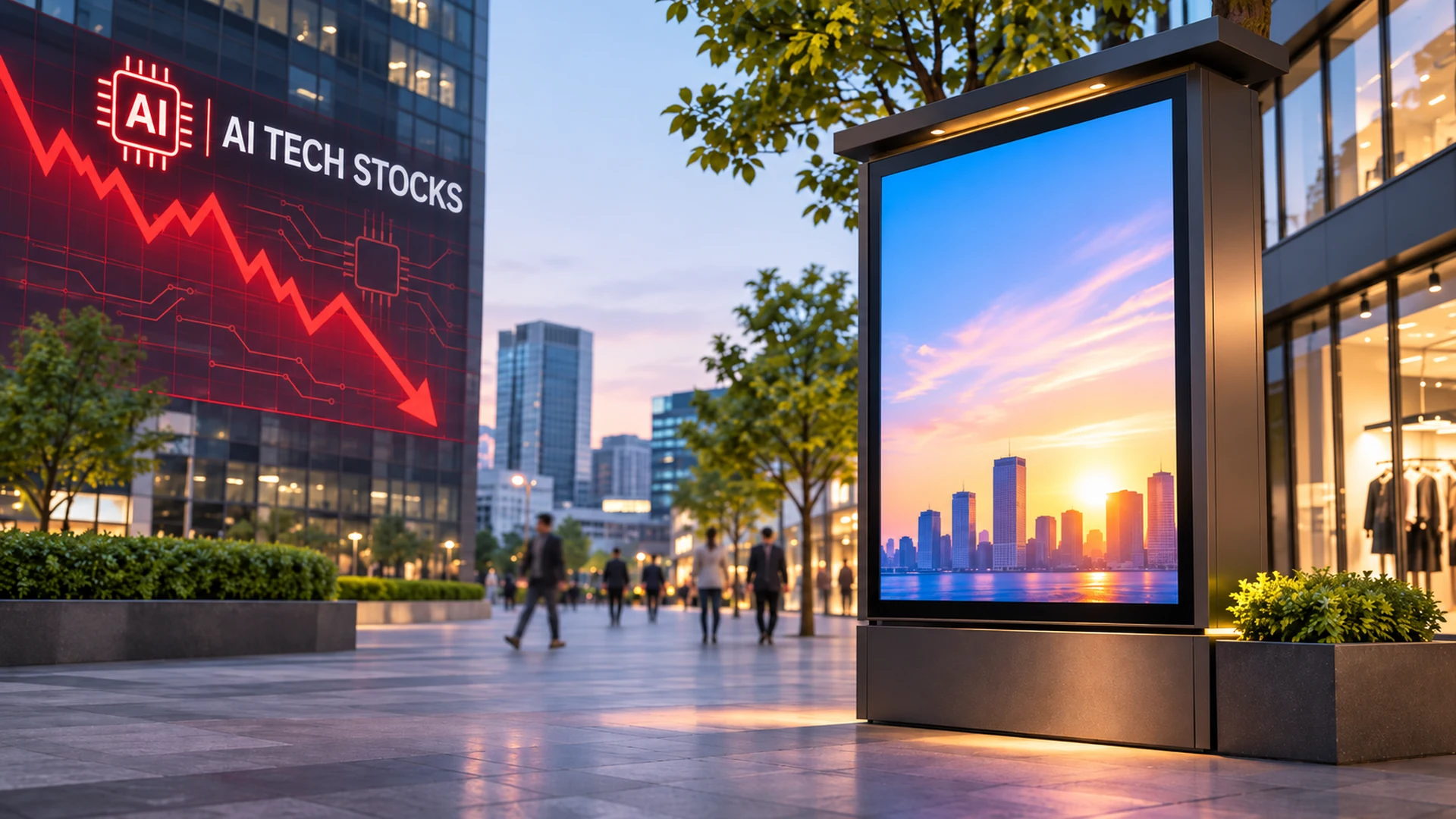
As technology stocks suffer a dramatic sell-off, the global out-of-home advertising industry is telling a surprisingly different story. Could physical advertising, digital displays and holographic AI become a more resilient growth opportunity?
On 5 November 2026, Wall Street experienced a dramatic sell-off. The technology-heavy Nasdaq Composite plunged 5.5%, the S&P 500 lost 4.4%, and semiconductor stocks fell sharply in a single trading session. Trillions of dollars in market value evaporated as investors questioned the extraordinary sums being poured into artificial intelligence infrastructure. The declines were documented in Associated Press market reporting and Reuters analysis of AI investment concerns.
Yet while technology shares were falling, something rather interesting was happening in the advertising industry. JCDecaux, one of the world's largest outdoor advertising companies, saw its shares rise 5.77% on the same day, following financial results that showed strong revenue growth, accelerating digital advertising and increasing programmatic trading. The closing move is recorded in the Financial Times share-price history.
At a time when investors are questioning the future of technology valuations, could out-of-home advertising offer a more resilient growth story? The answer requires looking beyond stock prices at advertising expenditure, digital infrastructure and the changing ways brands engage with consumers.
The AI Boom Meets a Financial Reality Check
For several years, artificial intelligence has dominated technology investment. Semiconductor manufacturers, data centre operators, cloud infrastructure businesses and AI developers have attracted enormous amounts of capital, often accompanied by extraordinary valuations.
The investment thesis has been relatively straightforward. Artificial intelligence will transform almost every industry, and the companies supplying the technology required to make that possible should enjoy exceptional growth. But investors are increasingly asking a more difficult question: when will the returns justify the expenditure?
The November sell-off reflected concerns about the sustainability of AI infrastructure investment, financing costs and possible political restrictions on data centre development. Reuters reported that the one-day sell-off erased around $2.5 trillion from the Nasdaq 100's market value. That does not mean artificial intelligence is failing. It means financial markets are beginning to distinguish the potential of AI from the valuations attached to companies attempting to commercialise it.
That distinction becomes particularly interesting in industries already generating substantial revenue from established commercial activity.
Out-of-Home Advertising Is Showing a Different Set of Numbers
While AI infrastructure stocks were experiencing a dramatic correction, major outdoor advertising companies were reporting healthy financial results.
On 4 November, JCDecaux announced third-quarter revenue of €1.01 billion, representing 6.6% organic growth year over year. Its digital out-of-home advertising revenue grew 15.3% organically, while programmatic digital advertising revenue increased 37.5%. Digital advertising now accounts for 45.4% of group revenue, according to the company's Q3 2026 trading update.
The American market tells a similar story. Lamar Advertising reported third-quarter revenue growth of 6.6% and a 9.3% increase in adjusted EBITDA. Its management cited demand from national advertisers, digital inventory and political advertising as important drivers. The figures appear in Lamar's November 2026 results.
OUTFRONT Media reported revenue of $511.1 million, up approximately 9.3% year over year. The company expects double-digit revenue growth for the full year, as detailed in its third-quarter earnings announcement.
These businesses are not immune to financial market volatility. Their share prices can fall during periods of economic uncertainty or rising interest rates. Nevertheless, their operating performance demonstrates something important: commercial demand for physical advertising does not disappear simply because investors reconsider their exposure to AI.
The contrasting signals in November 2026
Nasdaq Composite, 5 November
JCDecaux shares, 5 November
JCDecaux Q3 digital organic revenue
Stock-price changes and revenue growth represent different measures and should not be interpreted as directly comparable investment returns.
A $57.5 Billion Industry That Continues to Expand
The broader market forecasts provide additional context. According to WPP Media's June 2026 global advertising forecast (PDF), global out-of-home advertising revenue is expected to grow 5.0% in 2026 to approximately $57.5 billion, followed by 5.3% growth in 2027. That implies a market of roughly $60.5 billion next year.
The World Out of Home Organization's Global OOH Expenditure Report 2026 uses a different research methodology but points in the same direction. It estimates global OOH expenditure at $54.2 billion in 2025, forecasting $56.4 billion in 2026. Digital out-of-home advertising represented 47% of OOH expenditure in 2025 and is forecast to reach 49% in 2026.
These forecasts were published before November's market correction and are not guarantees. They also differ in coverage and measurement, so their dollar totals should not be treated as interchangeable. The underlying trend, however, is consistent: digital advertising is becoming a more important component of physical media, supported by better displays, more flexible networks and demand for higher-impact experiences.
Why Physical Advertising Has an Advantage in a Digital World
There is a certain irony in the growth of outdoor advertising. Consumers have never spent more time interacting with digital platforms, yet the competition for their attention has become increasingly intense.
Social media feeds are crowded. Online advertising is frequently ignored or blocked. Search and discovery are changing as AI assistants begin answering questions directly, potentially reducing conventional website visits. For advertisers, reaching an audience digitally is not necessarily the same as capturing its attention.
Physical advertising offers something different. A digital display inside a shopping mall, airport or railway station occupies physical space that cannot be skipped, scrolled past or removed with a browser extension. Its audience is determined partly by location, footfall and context rather than exclusively by an algorithm.
That does not guarantee an advertisement will be noticed, remembered or acted upon. Creative quality, placement and relevance remain essential. But it offers the opportunity to engage consumers at particular moments in everyday life, including when they are already shopping, travelling or considering a purchase.
This is especially relevant to retail media. A display inside a shopping centre can communicate with consumers while they are physically close to the stores, restaurants and products being promoted. Influence near a commercial decision is something purely online advertising cannot always replicate.
China Offers an Important Warning
It would be misleading to suggest that every out-of-home advertising market is experiencing the same growth. China illustrates why investors must distinguish the structural opportunity in outdoor advertising from the short-term conditions facing particular businesses.
Focus Media, one of China's largest building and elevator advertising operators, reported an 8.62% year-over-year decline in third-quarter 2026 revenue, while net profit attributable to shareholders fell 14.48%. The figures are set out in its October 2026 quarterly filing.
These results illustrate exposure to softer advertiser demand, cautious marketing budgets and regional economic pressures. The industry also faces higher operating costs, financing risk and competition for brand spending. Growth will not be uniform, and the strongest operators may increasingly separate themselves from weaker competitors.
A $6.2 Billion Vote of Confidence in Outdoor Advertising
One notable sign of institutional interest arrived just weeks before November's sell-off. On 14 October 2026, Mubadala Capital completed its acquisition of Clear Channel Outdoor Holdings in a transaction valued at approximately $6.2 billion. Following the transaction, the US advertising operator was taken private and its shares ceased trading on the New York Stock Exchange.
The official acquisition announcement confirms the transaction's value and completion. One takeover cannot establish that an entire industry is undervalued. Nevertheless, a deal of this scale demonstrates that substantial investment capital continues to see long-term value in physical advertising networks.
Perhaps that is where the most interesting opportunity lies: not in traditional billboards alone, but in the convergence of physical infrastructure, digital content, advertising technology and artificial intelligence.
The Next Evolution: When Advertising Displays Become Intelligent
For decades, outdoor advertising has operated around a straightforward proposition: place compelling creative in locations where people are likely to see it. Digital displays have enhanced the model by allowing messages to change dynamically, schedules to become more flexible and multiple advertisers to share a physical location.
But the next stage could be considerably more transformative. Imagine entering a shopping mall and encountering a life-sized holographic AI ambassador. Rather than only displaying an advertisement, the system could greet visitors, answer questions, recommend stores, provide directions and introduce products.
A fashion retailer could use a holographic AI avatar to present a new collection. A technology store could offer conversational product demonstrations. An airport could provide multilingual information alongside contextual brand experiences.
These are possibilities rather than guaranteed results. Any business deploying such systems must demonstrate actual engagement, measurable commercial outcomes, user trust and operating economics that justify the investment. Still, there is a difference between investing in technology in anticipation of a future market and introducing useful new capabilities into places where visitors and advertising budgets already exist.
Will Outdoor Advertising Stocks Rise Over the Next 12 Months?
Predicting share prices is difficult, particularly during financial market volatility. Over the next six months, OOH equities may remain volatile or trade sideways. If the AI-led sell-off develops into a broader economic slowdown, marketing budgets may come under pressure regardless of recent company performance. Highly indebted operators could also be sensitive to interest rates and refinancing costs.
Over a twelve-month horizon, there are reasons for cautious optimism about the industry's commercial performance. Advertising expenditure is forecast to increase, digital formats are gaining share and programmatic technologies are making physical inventory more accessible. New display formats may also create opportunities in retail and public spaces.
But there are counterarguments. Some 2026 results benefited from the FIFA World Cup and US political advertising, which may not recur at the same level in 2027. A slowing economy would also undermine current forecasts. The defensible conclusion is not that every OOH stock will rise, but that well-run companies with strong digital revenue and manageable debt may be better positioned than weaker operators.
The distinction between an industry's long-term growth and the short-term valuation of its publicly traded companies remains essential.
The Bigger Picture: AI Needs to Move Beyond the Screen
Perhaps the most important lesson from the market turbulence is not that investors are abandoning artificial intelligence. It is that they increasingly want evidence of commercial returns.
For companies developing AI infrastructure, that means proving enormous capital investments can generate sustainable profits. For the advertising industry, it creates an opportunity to explore how AI can enhance existing commercial environments rather than simply produce more digital content.
At Miirage, we believe artificial intelligence will increasingly become a physical presence in the world around us, with holographic displays and AI avatars providing a more natural way for people to interact with technology. Shopping malls, airports, retailers and public spaces could become important environments for that next generation, combining the visibility of physical advertising with the responsiveness of conversational technology.
The opportunity is not simply to replace traditional advertising screens with more sophisticated displays. It is to make them more useful, engaging and commercially valuable. The market may be questioning how much the AI revolution is worth, but outdoor advertising continues to demonstrate that physical audiences, real-world locations and established commercial demand matter.
As digital displays, holographic technology and artificial intelligence converge, the future of advertising may become considerably more interesting than another billboard or another banner on a screen.
Market data and forecasts are reported as of their stated dates. This article provides industry commentary, not investment advice.
Further Reading and Sources
- Reuters: Nasdaq correction and the AI investment debate
- Associated Press: 5 November 2026 US market close
- JCDecaux: Q3 2026 trading update
- Lamar Advertising: Q3 2026 operating results
- OUTFRONT Media: Q3 2026 results
- WPP Media: Global Midyear Forecast 2026 (PDF)
- World Out of Home Organization: Expenditure Report 2026
- Focus Media: Q3 2026 financial report
- Clear Channel Outdoor: Mubadala acquisition completion
- Financial Times: JCDecaux historical share prices