Holographic Wayfinding: Multilingual, Human-Centric Navigation for Busy Public Spaces
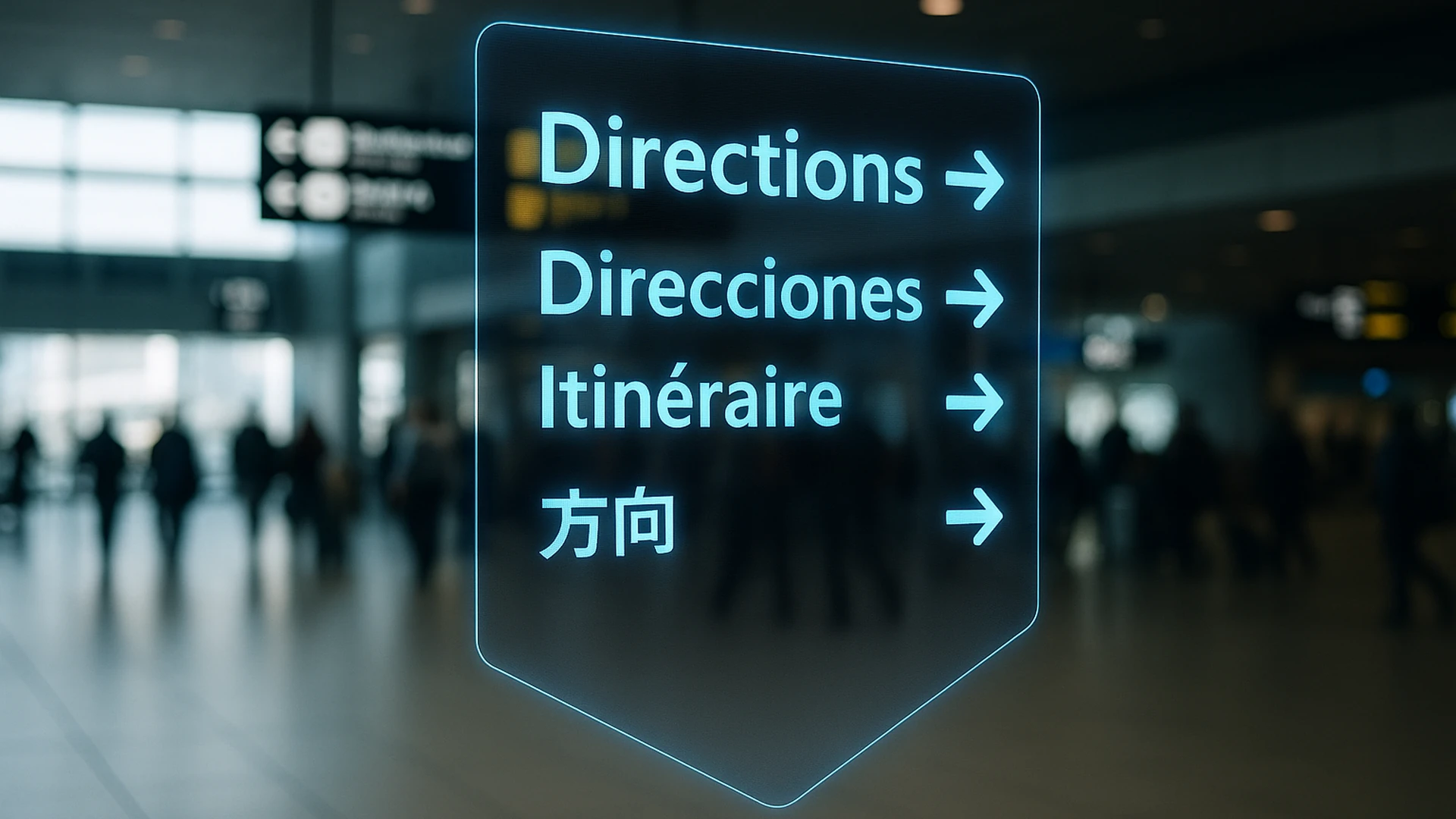
Airports, rail hubs, shopping malls, and stadiums are louder, busier, and more multilingual than ever. In that chaos, a holographic display acting as a visual AI agent becomes a beacon: walk up, speak your language, get clear directions (or product help), see the route, and move on—without hunting for a staff member or deciphering unfamiliar signage.
Why now
Air travel and large-venue footfall are surging past pre-pandemic levels, intensifying the need for fast, inclusive wayfinding. IATA reports 2024 global traffic grew 10.4% year-on-year with a record 83.5% load factor, and international travel jumped 13.6%. Translation: more people in motion, tighter terminals, and more pressure on operations.
That crowd is multilingual. At Seattle-Tacoma International Airport, travelers in a single year spoke 200+ languages; 15% didn’t speak English as a primary language, and ~1.5% were Deaf or hard of hearing—groups that benefit disproportionately from clear, visual guidance.
Retail hubs see similar patterns: better wayfinding reduces stress and improves journeys, which typically correlates with higher dwell time and sales in digital-first shopping centers (vendor-reported, but directionally useful).
What holographic wayfinding looks like
A lifelike, on-screen guide: A holographic (depth-rich) display presents a human or branded character that talks, gestures, and visually points the way. These “virtual staff” concepts aren’t theoretical—UK airports experimented with hologram assistants years ago for security guidance—today’s systems add real dialogue, live data, and personalization.
Multilingual, conversational AI: Modern speech-to-speech systems can translate with high accuracy in good conditions, and continue improving under noise and accent variability. (Peer-review reviews and industry roundups chart the trend; exact accuracy depends on environment, mics, and languages.)
Instant visual directions: The avatar can speak and also render maps, step-by-step arrows, and estimated walk times—right on the holographic display. In a mall or airport, that might include live elevator status, gate changes, or an accessible path around maintenance closures. Wayfinding research consistently links better navigation to lower traveler stress.
Task beyond “where is Gate 42?”
-
“Where can I buy noise-cancelling headphones? Show me the route.”
-
“I need gluten-free lunch options near my gate.”
-
“Find a Manchester United jersey in my size.”
The agent cross-references venue inventory/tenant data to answer product-level queries and guide people to the right storefronts—gold for retail media monetization.
Accessibility built in
Good wayfinding is inclusive by default. Captions, on-screen transcripts, tappable language selection, high-contrast UI, and sign-language handoffs (e.g., live VRS links) help Deaf and hard-of-hearing travelers—an area airlines and airports are actively addressing.
Standards-aligned design matters: multiple transport studies (ACRP, GAO) stress that clearer, multimodal information reduces barriers for older adults and travelers with disabilities. Holographic agents can surface wheelchair-friendly routes and step-free alternatives automatically.
Where it fits: airports, rail, malls, stadiums
-
Airports & rail terminals: Short, high-stakes decisions under time pressure. Better wayfinding reduces missed connections and spreads traffic across concourses. (Industry and research literature point to stress reduction when navigation is improved.)
-
Shopping malls: Smarter navigation increases dwell time and store discovery; several commercial studies (vendor-reported) associate improved wayfinding with longer stays and uplift in engagement/sales.
-
Stadiums & arenas: Real-time routing to gates, concessions, and restrooms, dynamic crowd flow, and multilingual info for international fixtures.
Operational gains you can measure
-
Fewer basic queries for staff: Let the holographic agent handle “where/when/how” so teams focus on exceptions and care. (Early “virtual assistant” deployments in airports specifically targeted queue friction.)
-
Higher wayfinding success & lower stress: Human-factors and transport studies show that clearer navigation improves perceived experience. Expect knock-on effects in CSAT/NPS.
-
Retail media revenue: Every useful interaction is a chance to present relevant, contextual offers (e.g., “grab-and-go near you,” “10% off at the shop on your path”). Longer dwell time reported in digital-first centers suggests potential spend uplift when paired with helpful guidance.
How a deployment works (playbook)
-
Language + ASR stack: Prioritize top-traffic languages for the venue, then expand. In noisy concourses, use beamforming mics and echo cancellation to hit reliable recognition levels. (Modern systems report 85–95%+ in optimal conditions; test onsite.)
-
Knowledge + maps: Connect to indoor maps, tenant directories, product catalogs, and live ops (gates, lifts, closures).
-
Accessibility by design: Always-on captions, easy language switching, readable UI, and sign-language service links.
-
Safety & privacy: Keep interactions on-device or edge where feasible, anonymize logs, and post clear notices about data use.
-
KPIs: Time-to-answer, successful routes started/completed, language mix, staff handoffs avoided, NPS, and retail conversions attributed to the agent.
A quick look at scale
-
Passenger growth = pressure on clarity: 2024 air traffic up 10.4% YoY; international up 13.6%; record load factor 83.5%.
-
Language diversity is real: 200+ languages at a single US hub; 15% of passengers not primarily English-speaking; ~1.5% Deaf/HoH.
-
Digital-first venues see more engagement (vendor-reported): +15–20% dwell time, typically tied to more interactions and sales opportunities.
Holographic, AI-powered wayfinding turns a confusing moment into a helpful micro-conversation—in your language, with a friendly visual guide, and with clear steps on the screen. It shortens lines, calms journeys, and nudges shoppers toward what they actually want. In the busiest public spaces, that’s not just nice to have—it’s a competitive advantage.
Further Reading
- IATA: 2024 global air traffic up 10.4%, record 83.5% load factor (press release, Jan 30, 2025)
- Case study: Sea-Tac serves 200+ languages; 15% non‑English primary; ~1.5% Deaf or Hard of Hearing (Apr 9, 2024)
- London Luton 'virtual assistants' reduced incorrectly packed bags by ~5% (Future Travel Experience, 2011)
- Review of multilingual speech-to-speech translation and ASR challenges in noisy environments (2025)
- NREL (Dec 2023): The Evolution of Wayfinding Within Airports (technical report)
- ACRP Research Report 177: Enhancing Airport Wayfinding for Aging Travelers and Persons with Disabilities