Why Interactive Holographic AI Displays Earn Their Floor Space
Walk through a shopping mall, transport hub, or stadium and the visual pattern is familiar. Large 2D screens mounted on walls or pillars, delivering looped content to passersby who rarely stop for more than a glance. Behind many of these displays sits unused space that delivers no experience, no interaction, and no measurable value.
This is where interactive holographic AI displays change the equation.
The question is often framed around floor space. Does a holographic display take up more room than a traditional screen? Sometimes, yes. But that question misses the more important one. What does that space actually do?
Floor space should be measured by value, not footprint
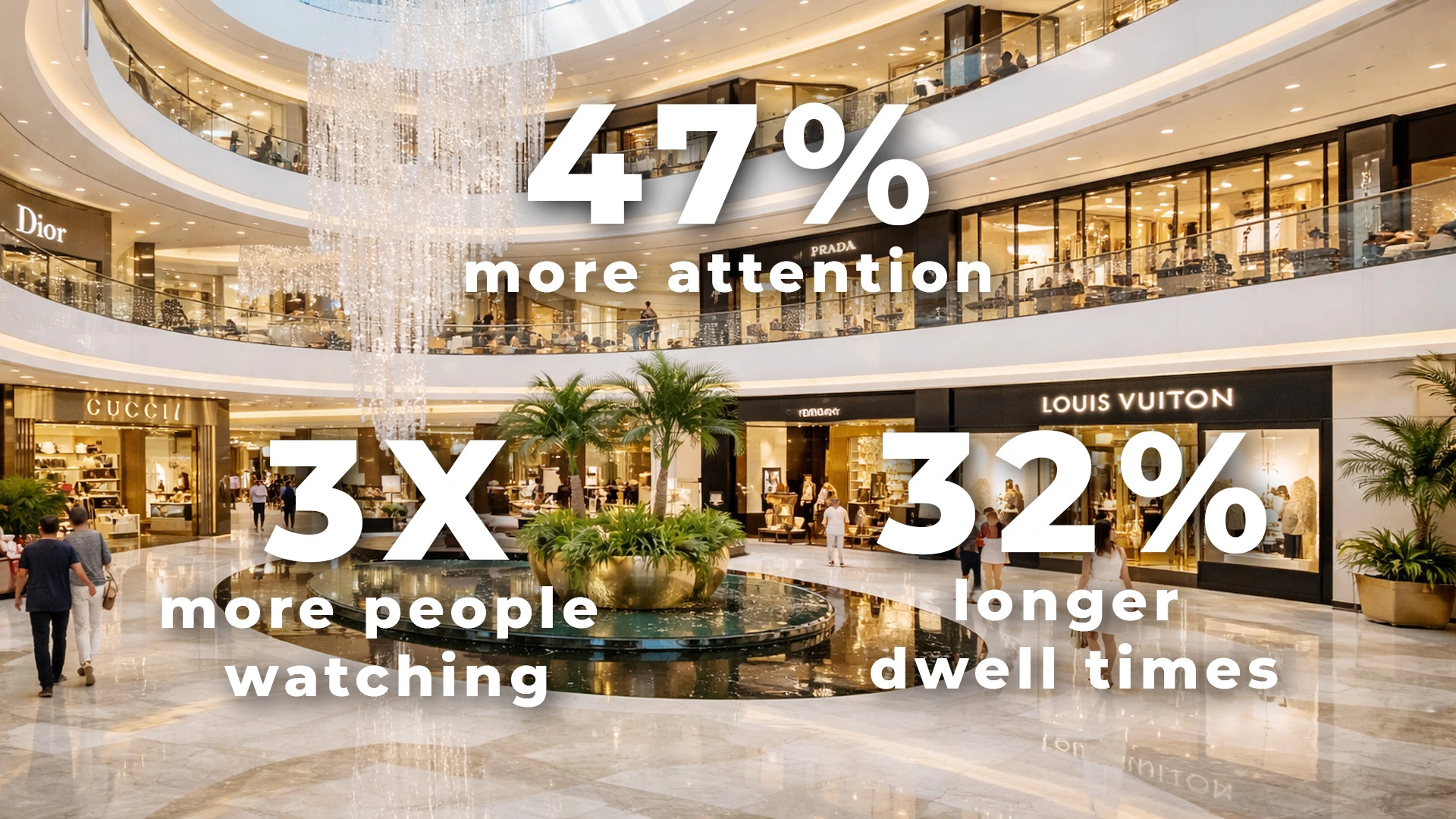
High-footfall locations exist to capture attention, guide movement, and influence behavior. Research consistently shows that novel and immersive formats significantly outperform standard digital signage. Nielsen OOH studies show that non-traditional and 3D formats can deliver up to 47 percent higher attention and substantially longer dwell times compared to standard 2D screens.
Attention and dwell time are the currencies of physical space. When people stop, look, and engage, the space is working.
Holographic displays are designed for exactly that. They introduce depth, motion, and realism that cuts through visual clutter, making them naturally suited to environments where competition for attention is intense.
One footprint, two screens, greater efficiency
Modern holographic display designs are no longer single-purpose units. A holographic canvas on the front is paired with a high-resolution 2D digital display on the rear, effectively doubling usable screen real estate within a single installation.
This means messaging can be targeted to different audiences moving in different directions. It also means that space which previously had no visual function becomes part of a premium media asset.
In practical terms, the same footprint now delivers both a high-impact holographic experience and a traditional digital screen, increasing inventory, flexibility, and return per square meter.
From advertising to intelligent utility with AI avatar
The real transformation happens when AI avatar assistants are introduced.
At this point, the display stops being just a media surface and becomes an intelligent, interactive tool. A holographic AI avatar can act as an information point, a digital concierge, a brand ambassador, or a sales assistant. It can answer questions, provide directions, explain products, promote events, and adapt messaging in real time.
According to PwC, 73 percent of consumers say customer experience plays a significant role in purchasing decisions, yet fewer than half believe businesses deliver a good one. AI avatars help close that gap by providing consistent, engaging, and scalable interaction without the constraints of staffing.
This added utility fundamentally changes the value of the space. The display is no longer occupying floor area for advertising alone. It is actively improving wayfinding, reducing friction, supporting sales, and enhancing the overall visitor experience.
Engagement that converts across high-footfall location
Interactive experiences are proven to influence behavior. Retail studies show that interactive digital touchpoints can increase dwell time by over 30 percent and lift conversion rates by 10 to 20 percent, depending on category and context.
These benefits are not limited to retail. In airports, holographic AI assistants can help passengers navigate terminals, discover services, and reduce congestion. In train stations, they can provide real-time travel information and local guidance. In stadiums and arenas, they can entertain, educate, and direct crowds while promoting sponsors and concessions.
Entertainment also plays a critical role. In high-footfall environments, people are more likely to stop for something that feels alive and responsive. A human-like holographic avatar creates moments of surprise and delight that static screens simply cannot replicate.
A smarter use of space for modern environments
High-footfall locations are under increasing pressure to deliver measurable outcomes from physical space. Attention, engagement, data, and experience all matter more than ever.
Interactive holographic AI displays earn their floor space because they do more with it. They combine high-impact visual storytelling, dual-sided digital inventory, intelligent interaction, and entertainment into a single installation.
When space is judged by the value it generates rather than the area it occupies, the case becomes clear. This is not about taking up space. It is about making space work harder.
Further Reading
- 2025 Digital Signage Trends: What Businesses Need to Know
- Interactive Digital Signage and Customer Engagement Research
- Digital Signage Trends 2025
- Engaging Retail Customers with Interactive In-Store Displays
- 5 Powerful Ways Digital Signage Boosts Customer Engagement in Retail
- Digital Signage Statistics and Trends