Meta Put AI on a Keychain. Muse Charm Shows Where AI Is Going Next
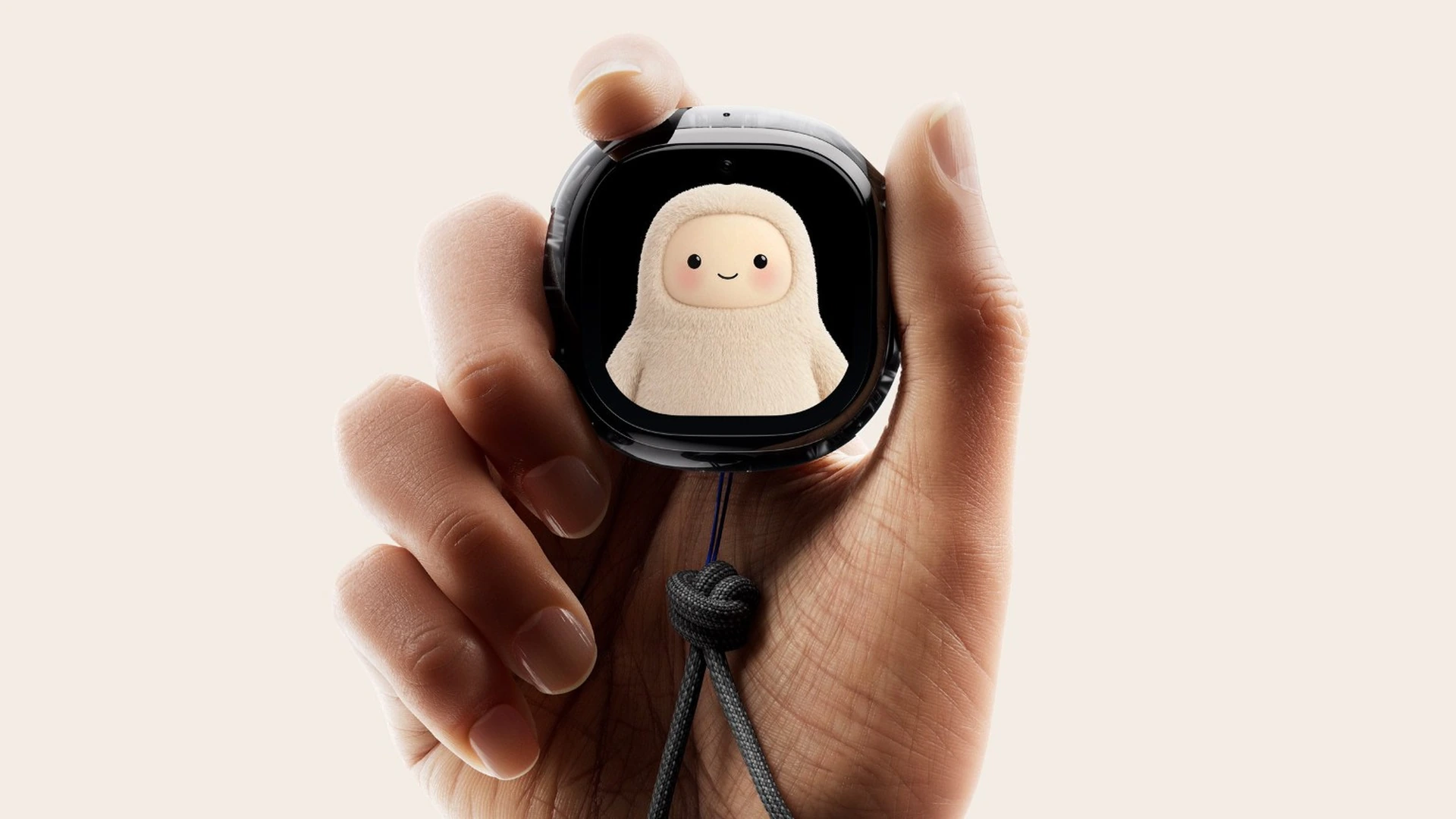
AI has spent years getting smarter. Now technology companies are trying to give it a face, a voice and somewhere to exist in the real world.
For most people, artificial intelligence still lives inside a rectangle. You open a laptop, unlock a phone, type something into a box and wait for the answer. Meta's new Muse Charm suggests that the next phase may look very different.
Unveiled at Meta Connect 2026, Muse Charm is a small device designed to give users direct access to Meta's newly launched Muse personal AI agent. Meta describes it as a pocket-sized way to talk and interact with Muse using its real-time voice technology. TechCrunch reported that the device can be carried in a pocket or attached to a keychain, with a small screen showing the animated character representing the user's agent and a fingerprint sensor that starts the interaction without first unlocking a phone or opening an app. Meta's Connect announcement and TechCrunch's coverage make the intention clear: Meta wants AI to be available without requiring the familiar ritual of opening another screen and navigating to another application.
It looks like a tiny gadget. The more interesting story is what it represents. Artificial intelligence is beginning to move from something we deliberately open to something that is designed to be continuously present around us.
We are giving AI characters
When ChatGPT helped push generative AI into the mainstream, the interface was remarkably simple: a text box. That simplicity made powerful technology accessible to hundreds of millions of people, but the industry is now experimenting with a different idea. AI is being given voices, personalities, memories, faces and visual identities.
Meta has an unusually direct name for this direction. Its AI research team describes the technology behind Muse's visual character as embodiment. The company's Muse Realtime Avatar research combines conversational intelligence, voice and a visual avatar into a single streaming system. According to Meta, the avatar can respond with facial expressions, hand movements, gestures and full-body movement in real time.
That word matters. Embodiment implies that the challenge is no longer only to make AI more intelligent. It is also to decide how humans should experience that intelligence. A voice is more natural than a command line. A face can communicate emotion and attention in ways text cannot. A visible character can create the impression that there is something, or someone, present on the other side of the conversation.
The numbers show why the interface matters now
Muse itself is moving quickly. Meta launched the personal AI agent on September 8, 2026. Just 12 days later, it had recorded 2.8 million downloads, according to Apptopia data reported by Reuters. Over the same period, Meta shares rose by more than 20%, adding more than $200 billion in market value as investors reacted to the early traction. The download figure does not prove that Muse will become a permanent part of people's lives, but it shows how quickly a capable personal agent can attract attention when it is placed in front of a huge consumer audience.
The wider market is heading in the same direction. Gartner predicted that 40% of enterprise applications would include task-specific AI agents by the end of 2026, up from less than 5% in 2025. Its 2026 Hype Cycle for Agentic AI reported that only 17% of organisations had deployed AI agents, but more than 60% expected to do so within the following two years. Gartner described this as the most aggressive adoption curve among the emerging technologies measured in its survey.
This matters because an agent is fundamentally different from the chatbot that many people associate with AI. A chatbot answers. An agent can act. Meta says Muse can send emails, book travel, fill out forms, make purchases and continue working after the user closes the app. Once AI starts doing things on our behalf, rather than simply telling us things, the quality of the interface becomes far more important.
The screen may not be the destination
There is a strange contradiction at the centre of modern AI. The intelligence behind these systems is becoming extraordinarily sophisticated, yet the main interface is still often a keyboard and a flat screen. Those behaviours made sense when computers were tools we deliberately operated. They may make less sense if AI becomes an agent that understands context, observes the world around us and remains available throughout the day.
Meta is already testing several possible answers. Muse can operate through its own app and through WhatsApp. At Connect, Meta announced that Muse is also coming to its AI glasses, allowing the agent to respond to what the wearer is looking at and take action without the user having to describe everything in front of them. Muse Charm provides another form factor again. The common thread is that Meta is trying to reduce the distance between needing help and accessing the intelligence capable of providing it.
There is already evidence that consumers will adopt useful AI when it is integrated into familiar physical products. EssilorLuxottica reported that more than 7 million AI glasses were sold during 2025. Earlier that year, the company said Ray-Ban Meta sales were up more than 200% in the first half of 2025. That does not mean every dedicated AI device will succeed, but it does show that AI hardware can reach mass-market volumes when the technology fits naturally into something people already understand and want to use.
Muse Charm still has to prove itself. The history of standalone AI hardware is littered with devices that generated headlines but struggled to establish a reason to exist alongside the smartphone. TechCrunch has already compared the challenge with products such as Humane's AI Pin, Rabbit and Friend. The success or failure of one keychain-sized device, however, is not the most interesting part of the story. The experiment tells us where the interface is heading.
From artificial intelligence to artificial presence
There is a significant difference between an AI that responds and an AI that appears to be present. Humans naturally react to faces. We notice expressions, interpret gestures, follow eye contact and recognise when something appears to be addressing us. Those behaviours existed for thousands of years before anyone invented a touchscreen.
That makes the idea of embodied AI particularly interesting. For an individual, the best interface might eventually be a voice in a pair of glasses, a character on a wearable device or an agent that follows them across their existing technology. In public and commercial environments, the answer could look very different.
Imagine walking into an airport and asking a visible AI assistant for the fastest route to your gate. Imagine entering a hospital and speaking to a multilingual virtual receptionist. Imagine a retailer where an AI brand representative can explain products, answer questions and guide a customer without asking them to download an app first. In those environments, forcing every visitor to reach for a phone creates friction. The intelligence becomes more useful when the interface already exists in the environment.
This is where holograms become much more interesting
For years, holographic displays have largely been discussed as visual technology. Put a person, product or animated object inside a display and the novelty of seeing something with depth and presence attracts attention. Combining that visual presence with conversational AI changes the proposition.
The hologram is no longer simply content. It becomes an interface.
This is the direction we are developing at Miirage. A hologram AI avatar can welcome visitors, answer questions, explain products, provide training, give directions and communicate in multiple languages from a visible point inside a physical environment. When nobody is interacting with it, the same display can return to branded content or advertising. The physical footprint stays the same, but its function changes from passive display technology into something closer to a visible AI presence.
That distinction may become increasingly important as the intelligence behind AI becomes easier for companies to access. If highly capable models and agents become widely available, simply having access to AI will not be much of a differentiator. The experience around that intelligence will matter more: the personality, voice, appearance, context, responsiveness and physical form through which people encounter it.
AI is leaving the chatbox
The smartphone is not disappearing. Neither is the laptop. But the history of computing is partly the history of interfaces becoming easier and more natural. Punch cards gave way to keyboards. Typed commands became graphical interfaces. Clicks became taps. Increasingly, typing is becoming conversation.
The next transition may be from interacting with software to interacting with something that feels more like a presence. Meta's Muse Charm is only one experiment, and there is no guarantee consumers will decide that an AI character belongs on their keychain. What matters is that one of the world's largest technology companies is now designing AI around the idea that intelligence should have a voice, a character and a physical point of presence.
If that direction continues, the next great AI interface may not be something we open at all. It may be something we simply walk up to and speak with.
Artificial intelligence is starting to acquire a face, a voice and a place in the physical world.Further Reading
- Meta: The Biggest News From Connect 2026
- Meta: Introducing Muse, a Personal AI Agent
- Meta AI Research: Bringing Your Muse to Life
- Reuters: Wall Street Expects Meta's AI Agent to Become a New Revenue Engine
- Gartner: 40% of Enterprise Apps Expected to Feature Task-Specific AI Agents by 2026
- Gartner: 2026 Hype Cycle for Agentic AI
- EssilorLuxottica: Q4 and Full-Year 2025 Results
- TechCrunch: Muse Charm and the Shift Toward Physical AI