The Hologram Inflection Point: Why Holographic Displays Are About to Scale Fast
Holographic displays are already proving something important in the real world: they earn attention. In retail, attractions, transport hubs, and high-footfall public spaces, they consistently do what every brand wants physical media to do. They stop people, create memorability, and lift perceived value.
So why has holography not scaled into a truly global, repeatable media format yet?
Because breakthroughs rarely scale on the strength of the breakthrough alone. They scale when the ecosystem around them becomes frictionless. The best comparison is electric vehicles.
The EV lesson: adoption accelerates when the infrastructure finally matches the ambition
Electric cars were not held back by a lack of interest. They were held back by everything around them: charging availability, reliability, interoperability, battery costs, range confidence, resale value, service networks, and standardised consumer expectations.
As those pieces improved, adoption moved from “early adopter behaviour” to “default choice” behaviour.
The data shows that change clearly. The International Energy Agency reports that electric car sales neared 14 million in 2023, and nearly one in five cars sold in 2023 was electric, concentrated in China, Europe, and the United States.
Charging infrastructure followed the same pattern. The IEA notes the public charging stock increased by more than 40% in 2023, and fast charging growth outpaced slow charging. More recently, the IEA reports that in 2024 more than 1.3 million public charging points were added globally, up more than 30% year over year, and that the number added in 2024 was roughly equal to the total global stock in 2020.
That is what a market looks like as it enters the steep part of the S-curve. (https://www.centrefornetzero.org)
Holography is approaching a similar moment.
Holography’s “infrastructure” is content, workflows, and measurement
For holographic displays, the limiting factor has not been the value of the experience. The limiting factor has been the friction required to deploy it repeatedly at scale.
In practice, holography has needed three kinds of infrastructure to mature:
1. Creative infrastructure: content that is affordable, fast, and abundant
Historically, high-quality holographic content has been complicated and expensive. It often demanded specialist capture techniques, precise lighting, extensive editing, and time-intensive iteration. That makes sense for a flagship, but it slows network deployment because each campaign starts to look like a production project.
This is where the market has changed dramatically.
The content economy is expanding, and generative AI is compressing production timelines. Deloitte Digital has reported a 54% increase in the volume of content needed in the prior year and that generative AI users report saving an average of 11.4 hours per week.
On the brand side, this is not theoretical. Reuters reported that Mondelez is using a generative AI tool to reduce marketing content production costs by 30% to 50%, while speeding output and reducing reliance on traditional production pipelines.
And the investment signal is clear. One market estimate puts the global generative AI in content creation market at $14.8B in 2024, projected to reach $80.12B by 2030.
For holography, this matters more than almost any other trend, because holograms are fueled by content. When content becomes easier to produce, iterate, localise, and personalise, holography becomes more accessible to more brands, and at much higher frequency.
2. Media infrastructure: DOOH is becoming the default physical media layer
Holography scales fastest when it plugs into an existing buying, reporting, and optimisation machine. Digital out-of-home is becoming that machine.
WPP Media has forecast that DOOH will account for 42% of total OOH revenue in 2025. The World Out of Home Organization reported global OOH spend of $46.2B in 2024, and trade reporting of the same dataset cites DOOH at $17.9B in 2024, roughly 39% of OOH revenues, highlighting digitisation as the main driver of OOH growth.
From a market sizing perspective, one estimate puts the global DOOH market at $20.7B in 2024, growing to $39.1B by 2030.
That growth is important because it standardises expectations: dynamic creative, rapid trafficking, measurable outcomes, and scalable campaign operations. Once that becomes normal in physical media, holography stops being “special” and starts being “a premium format inside a mature channel”.
3. Operational infrastructure: deployments need to look repeatable
Networks only expand quickly when operations are boring: consistent hardware, consistent installs, consistent maintenance, consistent uptime, consistent reporting.
This is the unglamorous side of adoption, but it is the part that creates velocity. EVs did not scale because the cars became exciting. They scaled because buying, owning, and charging became predictable.
The same principle applies here. The more holographic rollouts move from one-off installs to standardised deployments, the more the market behaves like a network.
Why growth can be rapid once the conditions align
When the creative and media ecosystems align, adoption becomes self-reinforcing:
-
More content availability reduces the cost and time to launch campaigns.
-
More deployments create benchmarks that build buyer confidence.
-
More demand justifies more sites and more inventory.
-
More volume improves unit economics and reliability through operational learning.
This is the same dynamic that appeared in EVs once charging and supply chains started scaling at pace.
Holography is now getting its equivalent of “charging infrastructure”, but in creative form. AI is making production faster, cheaper, and more iterative. At the same time, DOOH is becoming the global operating layer that makes new formats easier to buy, measure, and optimise.
The positive outlook: holography is moving from premium novelty to scalable media
The most useful way to frame holographic adoption is not “why it has not happened yet,” but “why it is now becoming easier.”
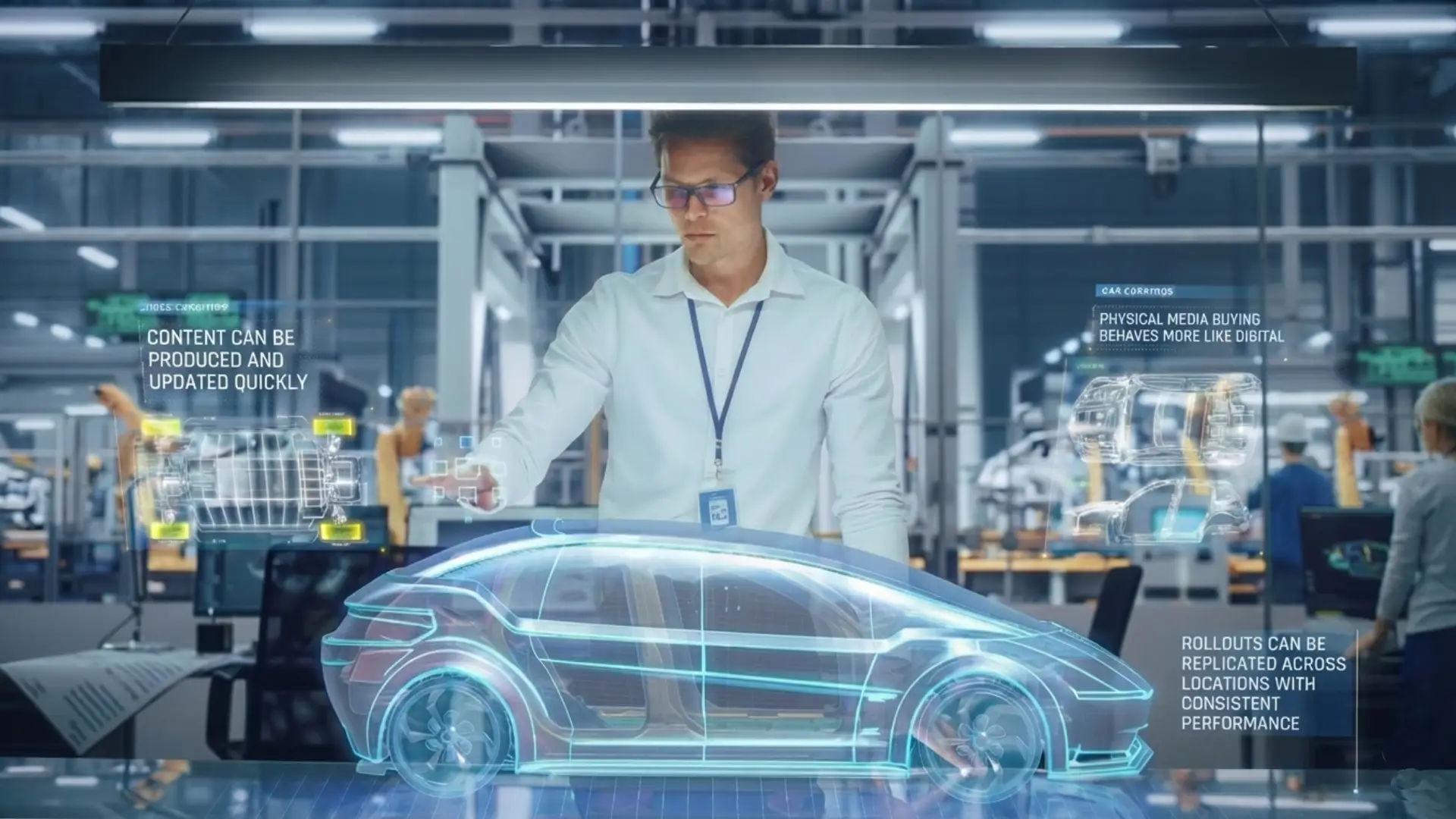
Holography has always been strong at the moment of impact. What it needed was a world where:
-
content can be produced and updated quickly, without specialist bottlenecks,
-
physical media buying behaves more like digital, and
-
rollouts can be replicated across locations with consistent performance.
Those conditions are arriving at the same time.
When that happens, holography will not grow like a niche gadget category. It will grow like infrastructure, because it becomes the premium visual layer on top of a DOOH economy that is already scaling globally.
Further Reading
- IEA Global EV Outlook 2024: Trends in electric cars
- IEA Global EV Outlook 2025: Electric vehicle charging
- Deloitte Digital: Generative AI Content Production
- WPP Media: This Year, Next Year 2025
- World Out of Home Organization: Global Expenditure 2025
- Grand View Research: Digital Out-of-Home Advertising Market Size